
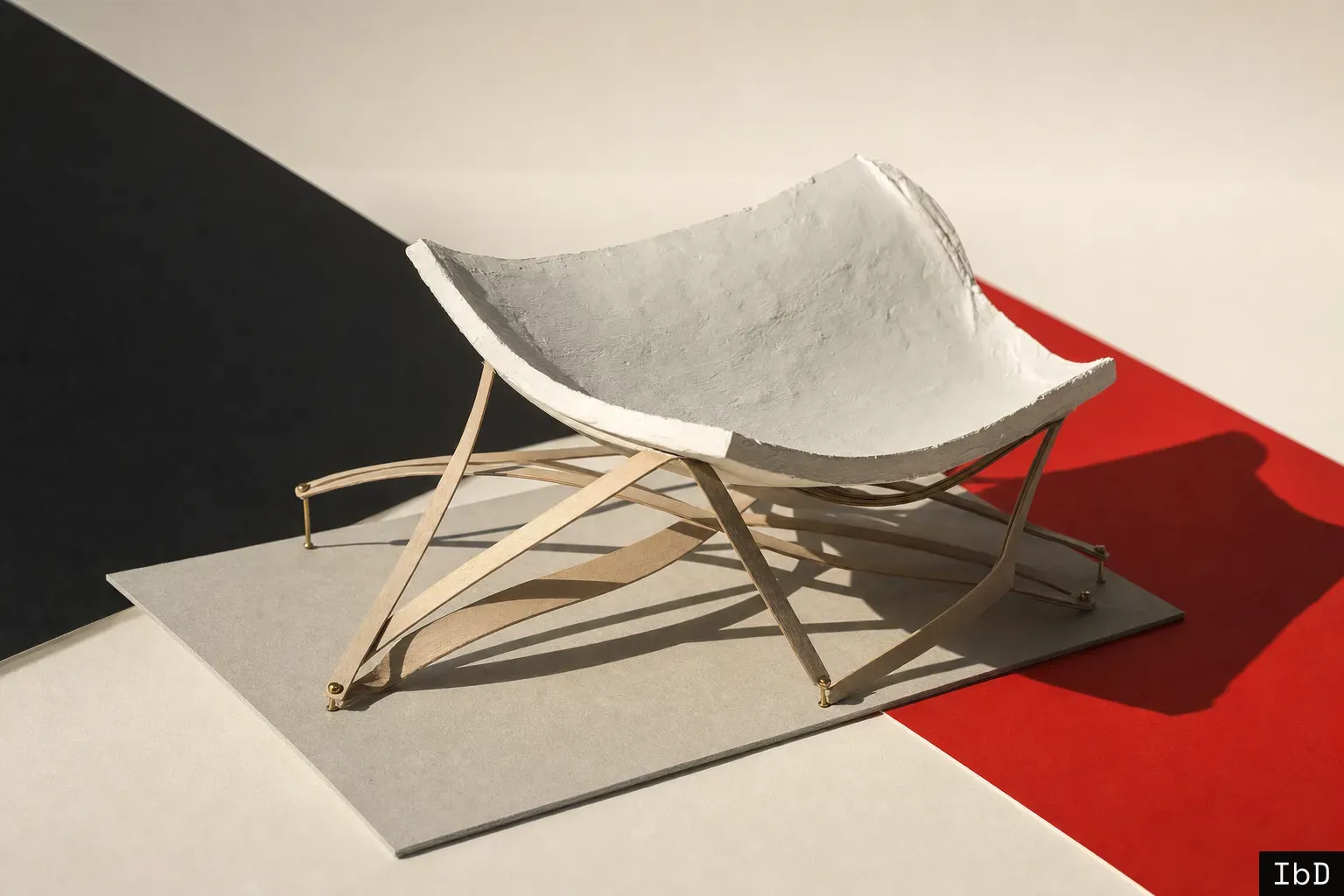
The heaviest moment in a formed concrete shell's life comes before it can carry anything. Wet concrete arrives at full weight and almost no strength, and for a few hours the formwork, its connections and a material still setting carry all of it.
Shell design rarely checks this moment in detail. Analysis is aimed at the cured structure, at the loads it will see over decades. Two pieces of work from 2026 look squarely at the hours before that, one by building a shell and watching its formwork fail, the other by modelling exactly how fresh concrete gives way. Both make the case that the order and timing of construction belong in the structural design.
Wet concrete is all load and no structure
A cured shell works because its geometry turns load into compression. Wet concrete has no geometry of its own. It takes the shape of whatever holds it, and while it is setting it behaves less like a structural material and more like a heavy, slowly stiffening soil.
That changes which parts of the system matter. The shell's thickness and curvature are not yet doing any work. The formwork is, and so are the bolts, clamps and boundary details that hold it in place. The load is also uneven in a way the finished shell never sees. Concrete goes on in passes, so one region can be carrying full wet weight while another carries none, and a flexible form deflects under that imbalance in ways no gravity analysis of the cured shell would predict.
A bent timber form carried 500 kg, then let go
A study published in June 2026 in the International Journal of Space Structures tested this directly, and the project itself is a striking one. Timber strips were bent elastically into a curved formwork, a technique known as bending-active construction, which gives curvature cheaply from straight, flat material. A multi-axis robot then deposited concrete over the bent timber along non-planar paths, laid out to follow the flow of forces rather than flat horizontal layers.
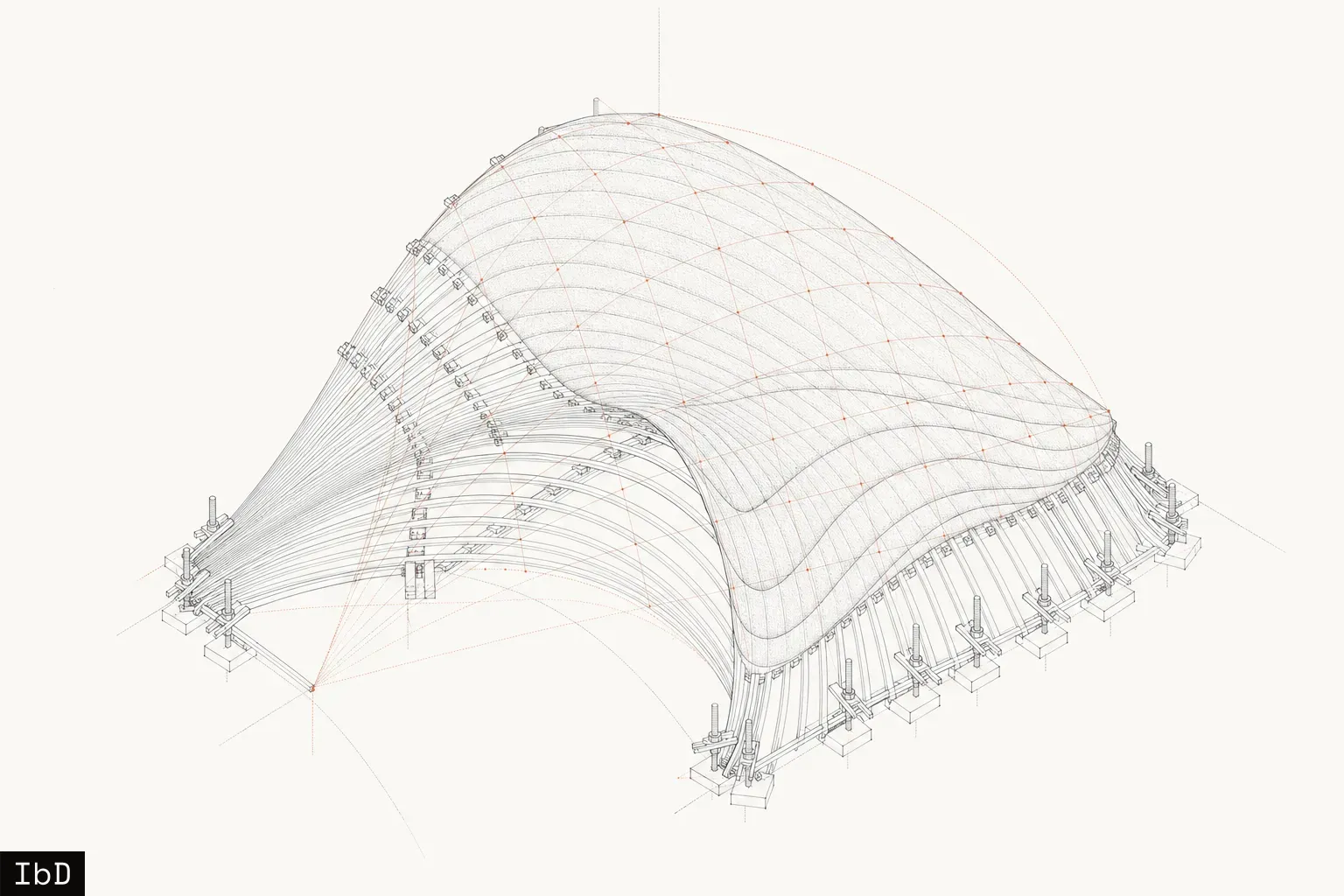
The surrounding workflow was as interesting as the printing. The deformed timber was scanned so the robot worked on the real substrate rather than the designed one, and a voxel-based finite-element model represented the deposition stage by stage, including the concrete's early-age stiffening.
The prototype measured 4.6 by 2 m. The formwork carried about 500 kg of fresh concrete. Then, after the third of five planned layers, the boundary bolts tore out.
The team published the result in full, and its limits too: the model was linear-elastic, so cracking, debonding, creep and plasticity were outside it; there was no complete reinforcement strategy; cleaning up the scans was slow; the robot, track and pump setup was demanding; and the durability of timber left in contact with concrete is unresolved.
The weakest part was the hardware
What failed was not the timber, the concrete or the printing strategy. It was a connection at the boundary, under a load that only existed during construction.
From the formwork side of shell building, this is the most familiar failure there is. Temporary hardware is sized as an afterthought, because it will be removed. But it carries the structure's entire weight at its weakest, under loads that shift with every pass. The lessons transfer to any shell cast on a flexible form, printed or sprayed or poured by hand: design connections for the transient, unbalanced wet load, not the average; scan the formwork in its loaded state, not its empty one; and keep the roles of temporary and permanent elements clearly separate.
What excites me about this study is less the robot than the honesty of the loop around it. The substrate was measured, the stages were modelled, and the failure arrived where the model was weakest. That is a precise map of what to model next.
Buckling and collapse are one process
The second piece of work, a preprint from BAM and TU Eindhoven posted in September 2026, goes after the material itself. Fresh concrete under its own weight can fail in two ways. It can buckle, an elastic instability where a wall or layer suddenly deflects sideways. Or it can collapse plastically, crushing and flowing under load. The two have usually been modelled separately.
The new model treats them as two limits of one process. It uses a smoothed version of the Mohr-Coulomb failure criterion familiar from soil mechanics, adds cohesion that hardens nonlinearly as the concrete sets, activates each layer as it is placed, and checks the stiffness of the whole system at every stage to detect the point where it loses stability. Whichever way the material fails, the model finds it.
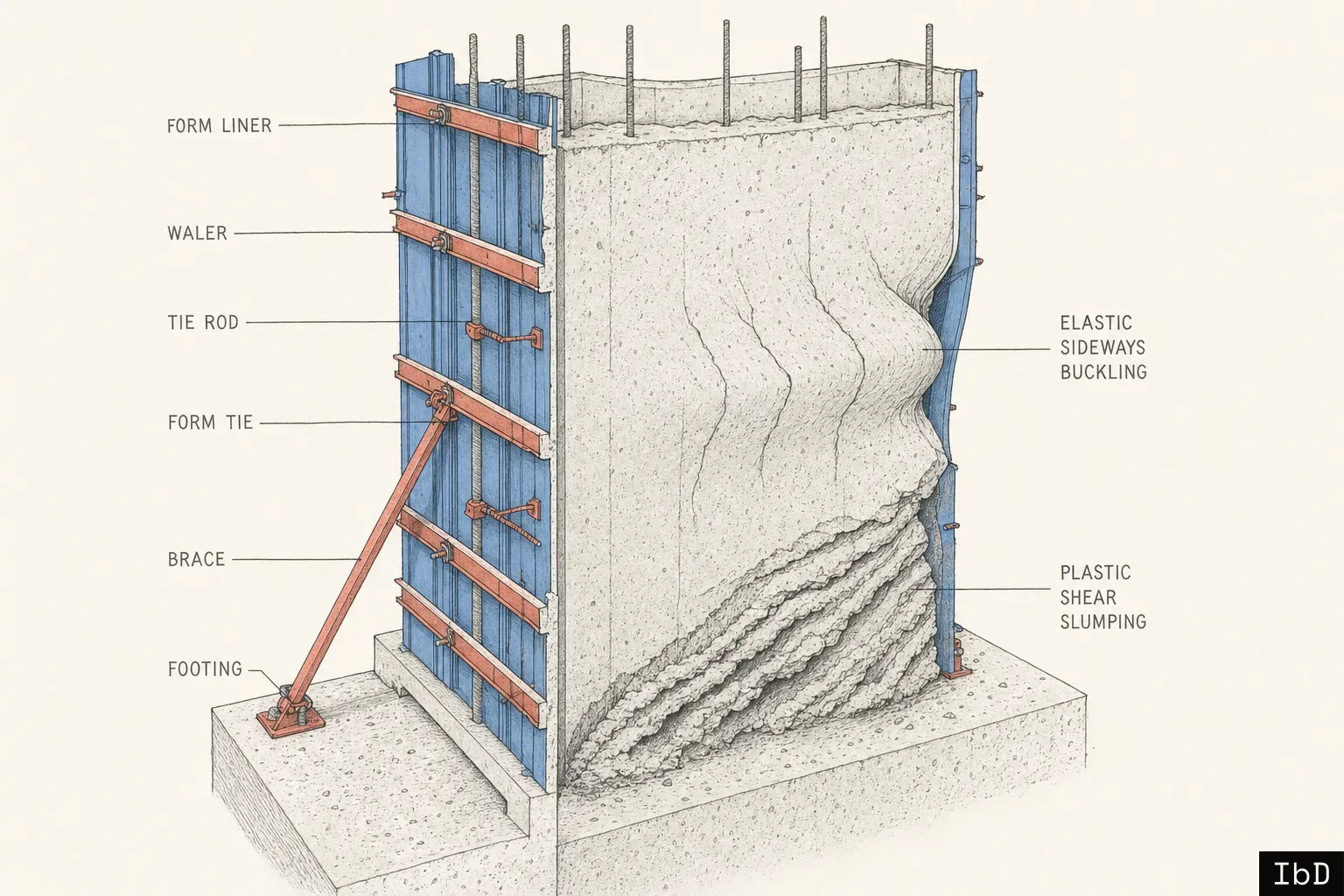
The validation is promising. It reproduced the collapse of a printed straight wall to within a single layer and improved predictions for hollow cylinders.1 The limits are real. It is a preprint. It has been checked on unsupported extruded walls, not on doubly curved shells sitting on formwork, and sprayed concrete on a flexible form behaves differently from a printed layer standing on its own. It also needs inputs that most projects never measure: early-age cohesion, friction angle and modulus.
The first two hours decide
That last limit is the useful one. The model can only be as good as the early-age data fed into it, and most concrete specifications describe a material that does not exist yet while the shell is most vulnerable. A 7-day or 28-day cube strength says nothing about whether a sprayed layer will hold on a steep slope twenty minutes after the previous pass.
The quantities that govern construction-stage stability are different ones: how the material's stiffness and cohesion evolve over roughly the first ten to 120 minutes, the effective bonded thickness rather than the nominal one, and the time between passes under the actual site climate. A hot, dry afternoon and a humid morning produce two different construction problems from the same mix.
Neither study offers a finished method. Together they describe the problem precisely enough to work on: the sequence of application is a design variable, the temporary structure is a structure, and the material has to be characterised while it is changing.
A shell is designed to stand for decades. It has to survive its first afternoon first.
References
- Conformal printing on bending-active timber formwork (International Journal of Space Structures, June 2026): https://doi.org/10.1177/09560599261460824
- Fresh-concrete buildability model unifying buckling and plastic collapse (BAM / TU Eindhoven preprint, September 2026): https://arxiv.org/abs/2609.07679
Footnotes
-
"The framework reproduces the measured collapse of a printed straight wall within one layer and predicts the collapse of a hollow cylinder closer to experiment than existing frameworks." — arXiv, Buildability Assessment of 3D-Printed Concrete Structures Using Smoothed Mohr-Coulomb Plasticity with Isotropic Hardening (2026-09-07). ↩