
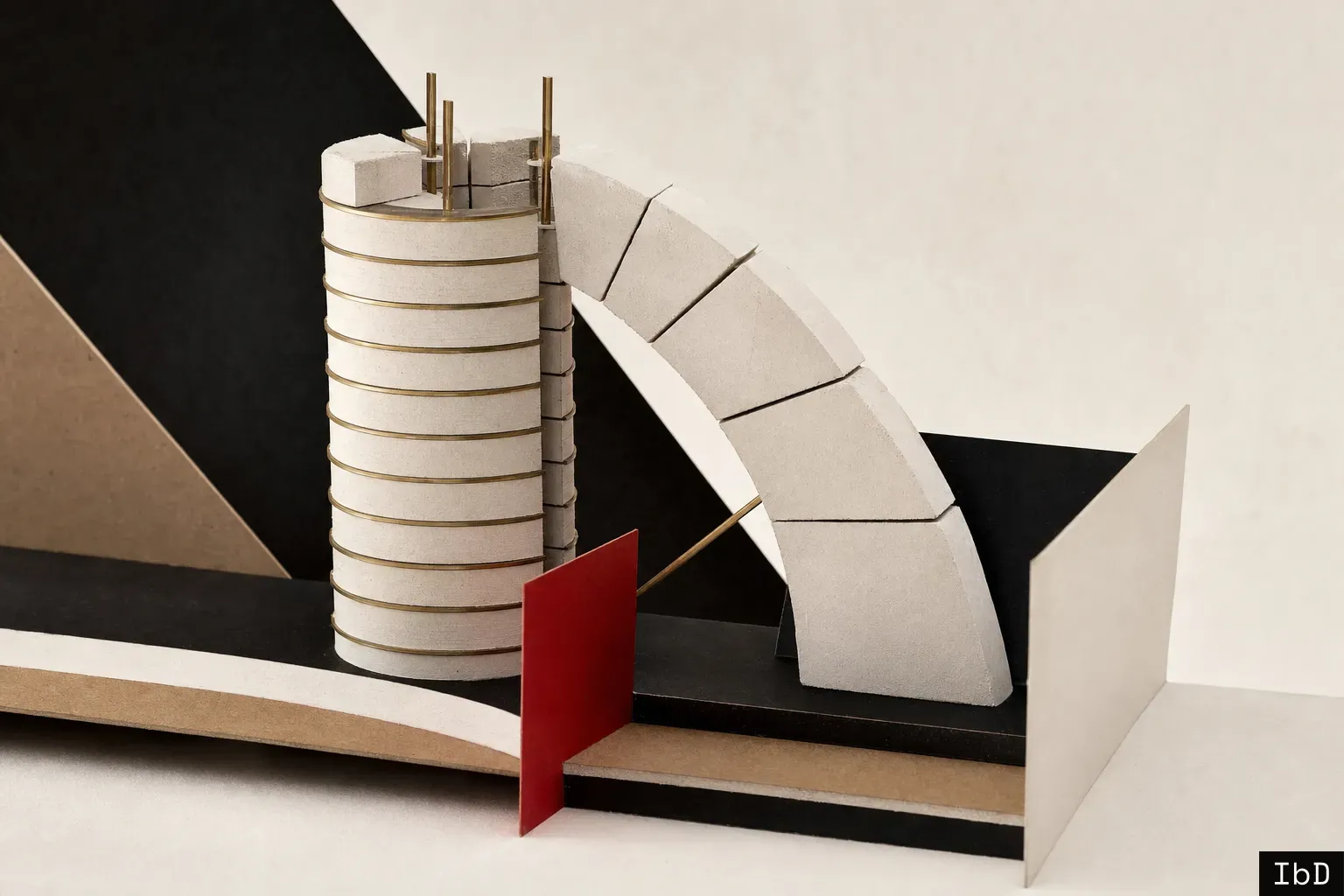
Reinforcement is usually drawn for the finished structure and then fitted into whatever process builds it. In printed, sprayed and segmented concrete, that order stops working.
Conventional reinforced concrete assumes a sequence: formwork goes up, a steel cage goes in, concrete is poured around it and compacted. Remove the formwork, build in layers, or assemble from discrete pieces, and the cage has nowhere to go. Two projects show two different answers. One threads steel through the printing process at the scale of a 30 m tower. The other designs the shell so that compression and joints do most of the work, and treats additive manufacturing as a way to cut precise blocks.
Layered concrete has no place for a cage
A printed or sprayed element is built up in passes. There is no moment when a full cage can be set in place and concrete flowed around it, because the concrete is the formwork for the concrete that follows. Each pass also creates an interface with the one before. Those layer joints are planes of potential weakness, so the material is stronger in some directions than others.
Both facts push reinforcement out of its usual role. Steel has to go in at a point in the process where it can actually be placed, and the design has to account for a material that does not behave the same in every direction.
Tor Alva threaded steel through the print
Tor Alva, the 30 m printed concrete tower that ETH Zurich built in the Swiss village of Mulegns, is the strongest built evidence of how this can work. ETH published its reinforcement and testing strategy in April 2025.
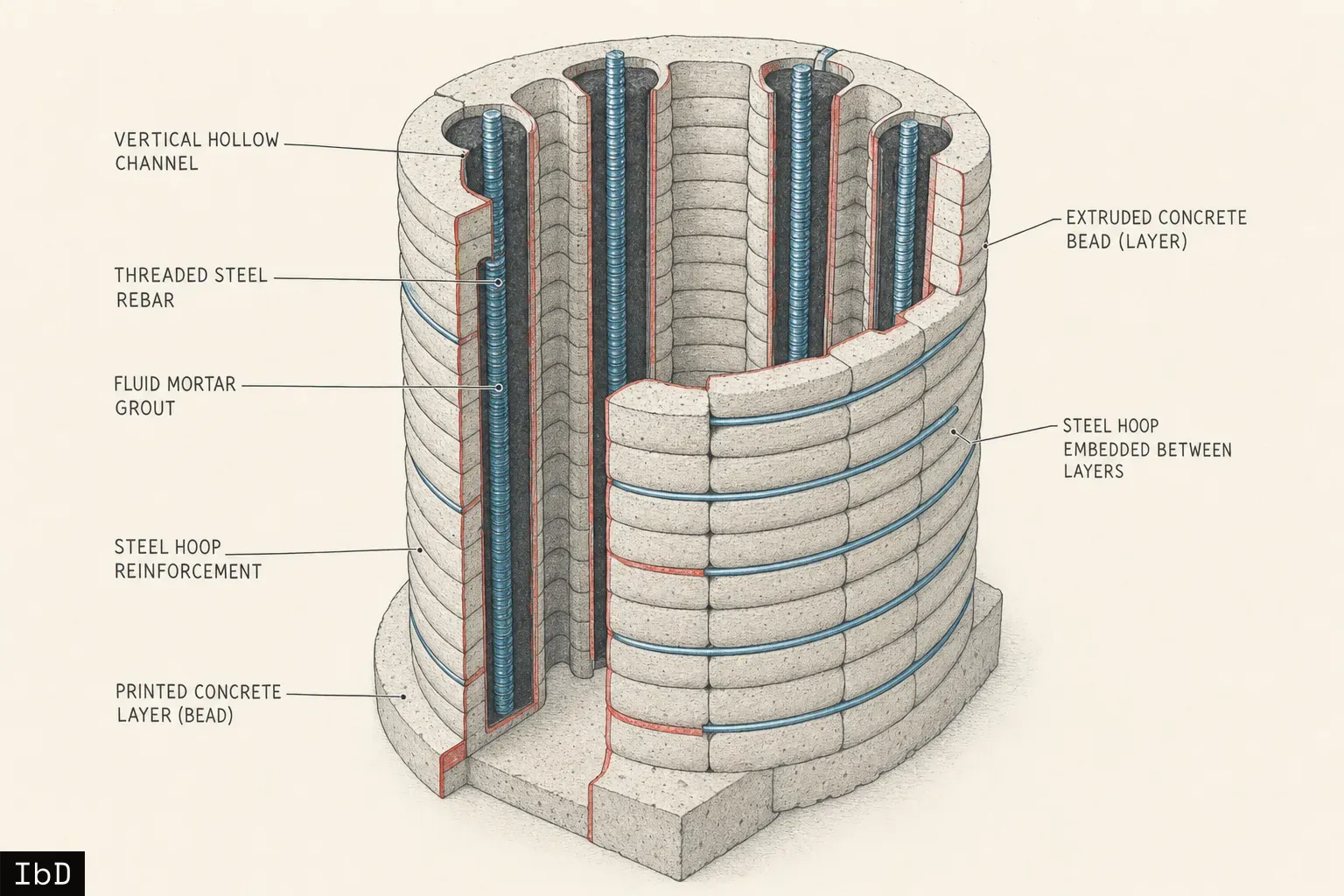
The tower is assembled from printed column elements, and the reinforcement was designed around how those elements were made. Horizontal steel rings were inserted during printing, layer by layer, as the concrete went down. Longitudinal bars could not be placed that way, so the printing formed channels for them instead. The bars were installed afterwards and locked in with self-compacting mortar. In the upper floors, those bars were prestressed. The weakness along layer joints was tested directly, with directional slant-shear tests that loaded the interfaces at angles rather than assuming the material was uniform.
Full-scale components were structurally tested and assembled into a building people can occupy. That is a long way from a lab specimen, and it is the most persuasive answer yet to the question of whether printed concrete can carry real structural steel.
The lesson is the topology, not the tower
The limits are significant. The printing mix is high in cement. The reinforcement is stainless. The robotic infrastructure is substantial. Approval was bespoke. And the geometry and reinforcement logic are specific to columns. Tor Alva is not a shell, and nothing in it is a ready shell solution.
What transfers is the principle. Reinforcement layout is part of fabrication design. Rings that can go in during deposition, channels formed for bars that go in later, laps placed where the process can make them, mortar that locks the steel to the concrete: these are designed together with the making, not drawn afterwards and fitted in. For a fabric-formed or sprayed shell, the same thinking points to textile reinforcement that can lie on a curved form, to steel concentrated at edges and discontinuities where it can be placed accurately, and to post-installed elements where the shell's own geometry makes a channel possible.
Funicular Lithics removes the continuity
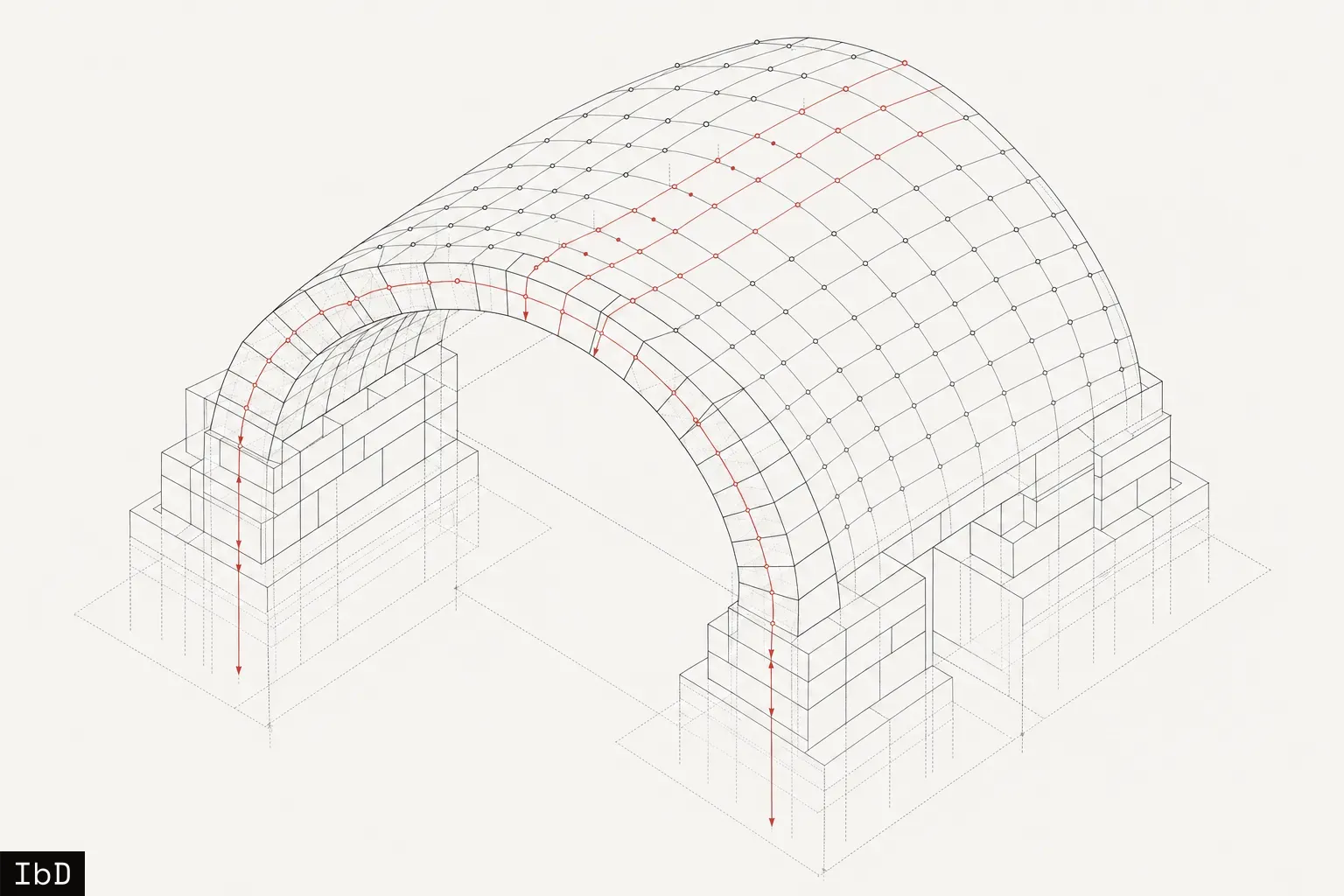
The second project takes the opposite route. Funicular Lithics, presented by Eckersley O'Callaghan at the IASS symposium in September 2026, applies one compression-only design logic to shells built from discrete units, some cut from marble and some 3D-printed in concrete.
The shift is in what additive manufacturing is for. Instead of printing a continuous reinforced structure, the printer becomes a tool for stereotomy, the old craft of cutting stone blocks so that they lock together in compression. A funicular shell needs no tension under its governing loads, so in principle the units can sit against each other and the geometry carries the load. It is a lineage that runs from masonry vaults to the unreinforced limestone shells built by the Block Research Group at ETH Zurich, and it is exciting to see printing used for precision rather than continuity.
The joints are where the steel comes back
This is also the project with the thinnest public evidence. It is a conference presentation and a project-team announcement. The span, thickness, load tests, joint mechanics, prestress, tolerances and erection data have not been disclosed.
The open questions are the ones every segmented shell faces. Compression-only holds for the load cases it was designed for. Wind uplift, seismic action, settlement and the erection sequence itself can all reverse forces locally and open joints. Claims of being steel-free depend on which load cases govern, and in practice ductile ties tend to reappear at edges and discontinuities. Joints that open, however slightly, are also paths for water, so waterproofing has to be an independent layer that bridges the joints rather than a property of the structure. And if every printed unit is unique, the economics are hard.
The practical version of this idea may be less exotic than marble or printing. Segmented shells built from a small number of repeated precast unit families, tied for robustness and covered with a separate weather layer, keep the advantages of controlled fabrication and fast assembly without demanding a different unit for every position.
Two answers to the same question
Tor Alva and Funicular Lithics look like opposites. One puts steel into printed concrete with great care. The other tries to design steel out of the shell. They start from the same observation: once concrete is no longer cast around a cage, reinforcement becomes a question about how the structure is made.
Either the steel follows the making, or the joints do the steel's work. Neither can be added afterwards.
References
- Tor Alva reinforcement and testing strategy (ETH Zurich, April 2025): baug.ethz.ch
- Funicular Lithics at the IASS Annual Symposium 2026 (Eckersley O'Callaghan, September 2026): eocengineers.com