
The instrument
Every shelf you have ever stood in front of was arranged according to an argument about how you think.
The argument has a name. The consumer decision tree, or CDT, is a hierarchy of attributes describing the order in which a shopper narrows a category down to a single item. Hair type, then benefit, then brand, then size. Or occasion, then format, then flavour, then price. It has been the load-bearing instrument of category management since the discipline formalised in the early nineties, and it survives, largely intact, in the assortment modules of every major planning vendor.
Its function is to convert an unobservable cognitive process into a diagram that two commercial parties can argue over. That is not a trivial achievement. A retailer and a supplier sitting across a table need a shared object. The tree is that object.
Its consequence is spatial. If shoppers filter by hair type first, you block the shelf by hair type and let brands scatter within, over the loud objection of every brand manager who wants a vertical block. The tree does not merely describe the shopper. It dictates the geometry.
The defence
The vendors who sell CDT capability are candid about what it is for.
RELEX describes the tree as a visual roadmap of the criteria a customer weighs, exposing the hierarchy of attributes that actually matter, and positions it as an instrument of assortment rationalisation: a way of deciding which items can be cut without leaving a need state unserved. Ipsos runs the same idea under a different name, the Purchase Decision Hierarchy, and treats it as a map of the attributes a shopper considers before selecting.
TELUS Agriculture and Consumer Goods offers the most useful version of the defence, because it concedes the critique first. It states plainly that the evidence is overwhelming that shoppers do not make rational, linear decisions on the path to purchase, and then argues that consumer decision trees retain serious value anyway: executed well, they give a clear depiction of consideration hierarchy and product substitutability, which is what assortment recommendations actually need. It also draws a line that gets crossed constantly in practice, warning that a decision tree and a planogram are different objects and that conflating them causes trouble on the shelf.
That is the strongest form of the argument. The tree is not a claim about cognition. It is a claim about substitutability, wearing the costume of a claim about cognition.
The critique
The costume is the problem.
LEAFIO puts the objection more directly than most vendors would. Real behaviour is not predictable in the way the model requires: some shoppers buy the same thing every week without deliberation, some buy on impulse because they are hungry or the pack is attractive, some buy what the person ahead of them put in the trolley. And the model was formed when categories were small enough that a shopper could genuinely describe their own selection logic. Assortments have since expanded past the point where anyone holds the category in their head.
There is a structural objection underneath the behavioural one, and it is the more damaging of the two.
A tree imposes a strict partition. Substitution, in reality, is a weighted graph. A shopper reaching for an oat milk that is out of stock may substitute laterally into almond, holding brand constant, or vertically into a different oat brand, holding type constant, with roughly equal probability. A tree must rank one of those attributes above the other. Having done so, it structurally forbids the other path. The information loss is not a rounding error. It is the deletion of an entire substitution channel, and it happens by construction, before any data is examined.
What actually replaced the mathematics
The industry did not abandon the tree. It quietly demoted it, and moved the computation elsewhere.
Demand transference asks the pairwise question directly. It compares products on attribute similarity to estimate what a shopper buys when the preferred item is unavailable, and produces a matrix rather than a hierarchy. This, not the tree, is what drives SKU rationalisation decisions in the current generation of planning systems.
Discrete choice models provide the academic backbone. The literature on assortment optimisation distinguishes models chiefly by their substitution assumptions: multinomial logit transfers lost demand in proportion to popularity, while locational choice assumes demand moves to whichever remaining product sits closest in attribute space. Nested logit is worth naming precisely, because it is a consumer decision tree with the rigidity dissolved into probabilities. The branches survive. The determinism does not.
Learned embeddings dispense with the attribute vocabulary altogether. Products become vectors in a space learned from basket co-occurrence and observed switching, and similarity becomes continuous, with no branching order to declare. HIVERY, for instance, trains product groups, product scores and store mixtures jointly on sales data rather than depending on a supplied tree.
So the honest description of the state of the art is this. The tree is a presentation layer over a similarity model. Where it is still doing real work, it is doing communicative work. Where it is doing computational work, it is usually the wrong instrument.
Form follows function, and the sentence has been misread since 1896
Louis Sullivan wrote that "form ever follows function," and the modernist century that followed stripped the sentence of everything that made it interesting.1 Sullivan was writing about organic form, about the tall office building, about how the character of a thing should express its life. The doctrine that survived him was narrower and more mechanical: fitness for purpose, ornament as crime, the object justified entirely by what it does.
Retail design inherited the narrow reading. A well-built display is one that minimises search cost. Findability is the function, the tree is the mechanism, and a shelf that reduces time-to-locate is a shelf that has done its job.
I want to argue two things against this. Not that form should stop following function. That principle is correct and I hold it. But that the current application of it is both insufficient and singular, and those are separate failures.
Function has become a hygiene factor
Minimising search cost optimises for a shopper who has already decided. That shopper arrived with an item in mind and needs the shelf to get out of the way. For her, the store is a fulfilment mechanism, and the entire competitive logic of the last decade has been that physical retail loses the fulfilment contest. Quick commerce will always beat a shelf on time-to-locate, because it removes location from the problem entirely.
So a display optimised purely for findability is a display optimised for the one job the format is structurally losing. It is necessary. Nobody wants a shelf that hides things. But necessary is not the same as decisive, and a category manager who believes findability is the objective function has confused the price of entry with the prize.
The shopper who is actually available to be won is the one who did not arrive with a decision. She is browsing, or reconsidering, or open to trading up, or shopping a need rather than an item. For her the shelf is not a retrieval index. It is an argument. And an argument has to be made in a register that a decision tree does not possess: adjacency that suggests a use rather than a taxonomy, density that signals abundance or scarcity, a break in rhythm that stops the eye. Function delivers her to the right bay. It does not tell her why to reach.
Function is not singular
This is the deeper objection, and it is the one that CDT methodology cannot absorb without breaking.
The same category, in the same store, in the same hour, is shopped by several distinct minds. The weekly replenisher, executing a habit and barely looking. The exploratory shopper, deliberately open to novelty. The gift buyer, optimising for signalling value rather than use value. The constrained shopper, for whom price is the first branch and everything else is downstream. The loyalist, for whom brand is the first branch and price is nearly irrelevant. The dietary-constrained shopper, for whom a single attribute dominates everything and the rest of the tree is noise.
These are not segments in the marketing sense. They are not stable properties of people. The same individual moves between them across the week, and sometimes across a single trip, aisle to aisle.
A single CDT for the category must serve all of them. What it serves, in practice, is their average. And here is the point that the averaging obscures: when several genuinely different populations are pooled, the mode of the aggregate can sit at a location no individual population occupies. The average of a bimodal distribution is the trough between the peaks. A tree fitted to pooled transaction data across all these mindsets is not a compromise between them. It can easily be a structure that serves none of them well, while appearing to fit the data.
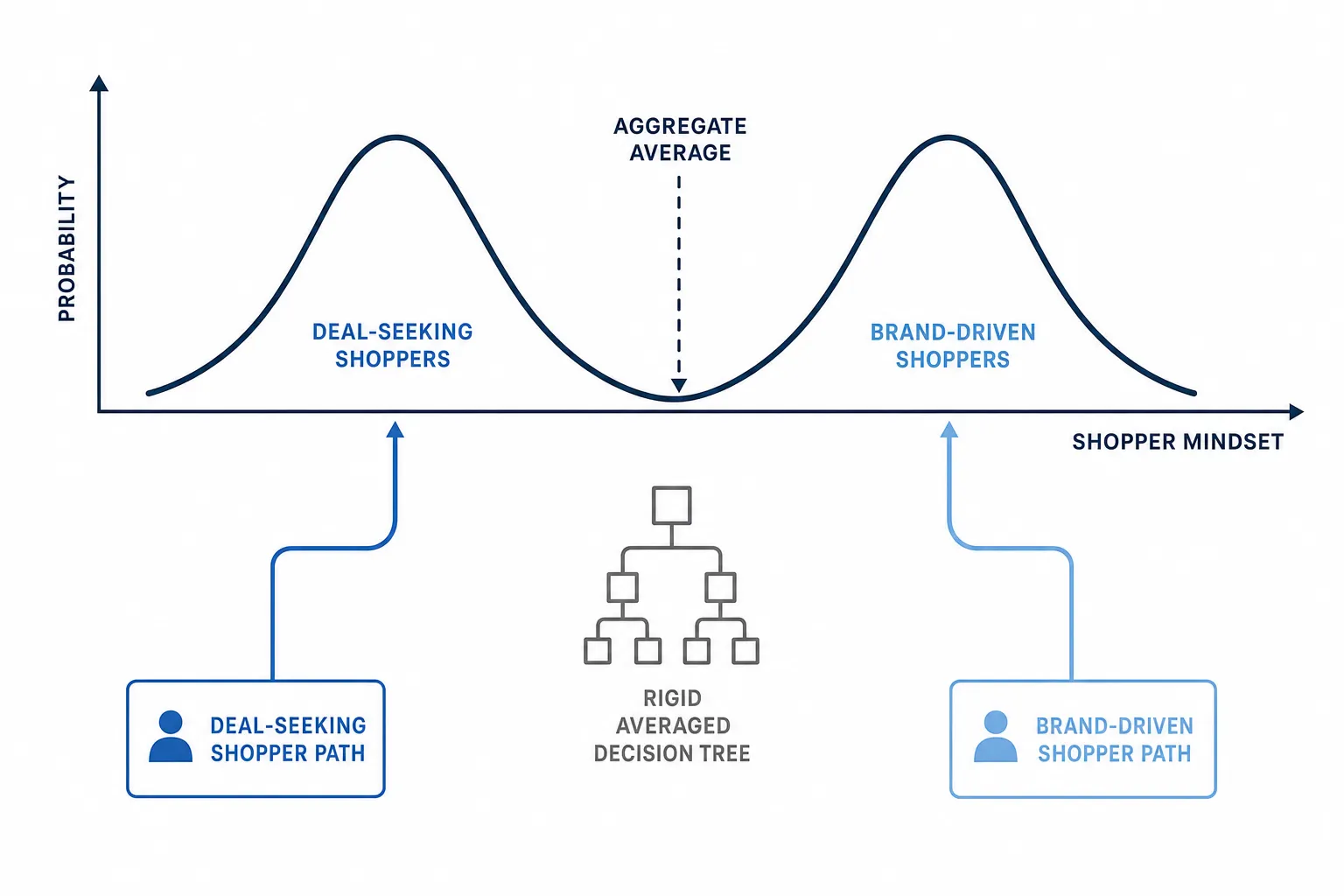
This is the plurality problem, and it is not a data quality issue that better instrumentation will resolve. It is a consequence of insisting on one hierarchy where several coexist.
A forward position
If the tree is a lossy projection of a graph, and the graph is Priority pooling of several distinct behaviours, then the productive move is to stop defending the projection and start measuring it.
Compute the graph, derive the tree, publish the residual. Estimate substitution as a weighted graph from basket switching, clustered by store and by daypart. Then fit a tree to it, because a tree is still the cheapest encoding of a spatial contiguity constraint and a solver needs one. But quantify how badly the tree fits, and treat that number as a first-class output. Toothpaste will fit a hierarchy well. Snacking will not. A category manager who knows which of her categories are lying to her has information nobody currently gives her.
Fit mixtures, not single trees. If several mindsets shop a category, the correct object is a set of trees with mixing weights, not one tree. The weights are themselves informative and vary by store cluster, by daypart, by season. A store where the exploratory mode carries forty per cent of trips should not be blocked like a store where it carries eight.
Design for multiple legibility. This is the design consequence, and it is the hardest. A physical shelf is a single arrangement, but it need not have a single reading. Primary blocking can serve the dominant mode while secondary signals, colour rhythm, sightline breaks, cross-category adjacency, navigational furniture, offer a second and third path through the same fixture. A shelf that reads one way to a shopper hunting a known item and another way to a shopper hunting an occasion is not a compromise. It is a richer object, and it is what the plurality of mindsets actually requires. The tree gives you one legibility. The others have to be designed in deliberately, and at present they mostly are not.
Treat function as a stack, not a scalar. Findability is one affordance among several. Reachability, comfort, legibility, social permission, emotional register, cultural signalling, temporal rhythm. These operate simultaneously and are frequently in tension, and the mistake in the modernist reading of Sullivan is not that form follows function but that it collapsed function into a single dimension. A display that succeeds on findability and fails on social permission - the shelf that is easy to search but embarrassing to linger at - has satisfied one layer and failed the sale.
Make the tree a hypothesis. The technical situation has changed in a way that the methodology has not caught up with. Shelf state can now be read continuously from imagery rather than audited quarterly. Solvers can re-run weekly rather than seasonally. In that regime, a decision tree stops being a doctrine established at the start of a category review and becomes a hypothesis with a measurable error term, revisable on a cadence. The instrument was designed for an era when observation was expensive and revision was annual. Neither constraint holds any more, and the methodology should stop behaving as though they do.
The reformulation
Form follows function. I would not abandon the principle, and the alternative - form following brand hierarchy, or trade spend, or whoever negotiated hardest - is plainly worse.
But function, for a shelf, is not one thing. It is a stack of simultaneous affordances, weighted differently by different shoppers, and by the same shopper on different days. A consumer decision tree is a claim that one of those weightings is the truth. It never was. It was an approximation that suited a period when computation was scarce and the diagram had to fit on a slide.
The correction is not to discard the principle. It is to pluralise it.
Form follows functions.
This research is part of dg2n, an AI + 3D planogramming engine.
Footnotes
-
Common Edge, Louis Sullivan Would Like to Clarify His Thoughts on Ornamentation (2025-01-27) — secondary report. "I pushed back then, as do many of you now, but let's be honest—modernists took “form ever follows function” out of context." ↩