
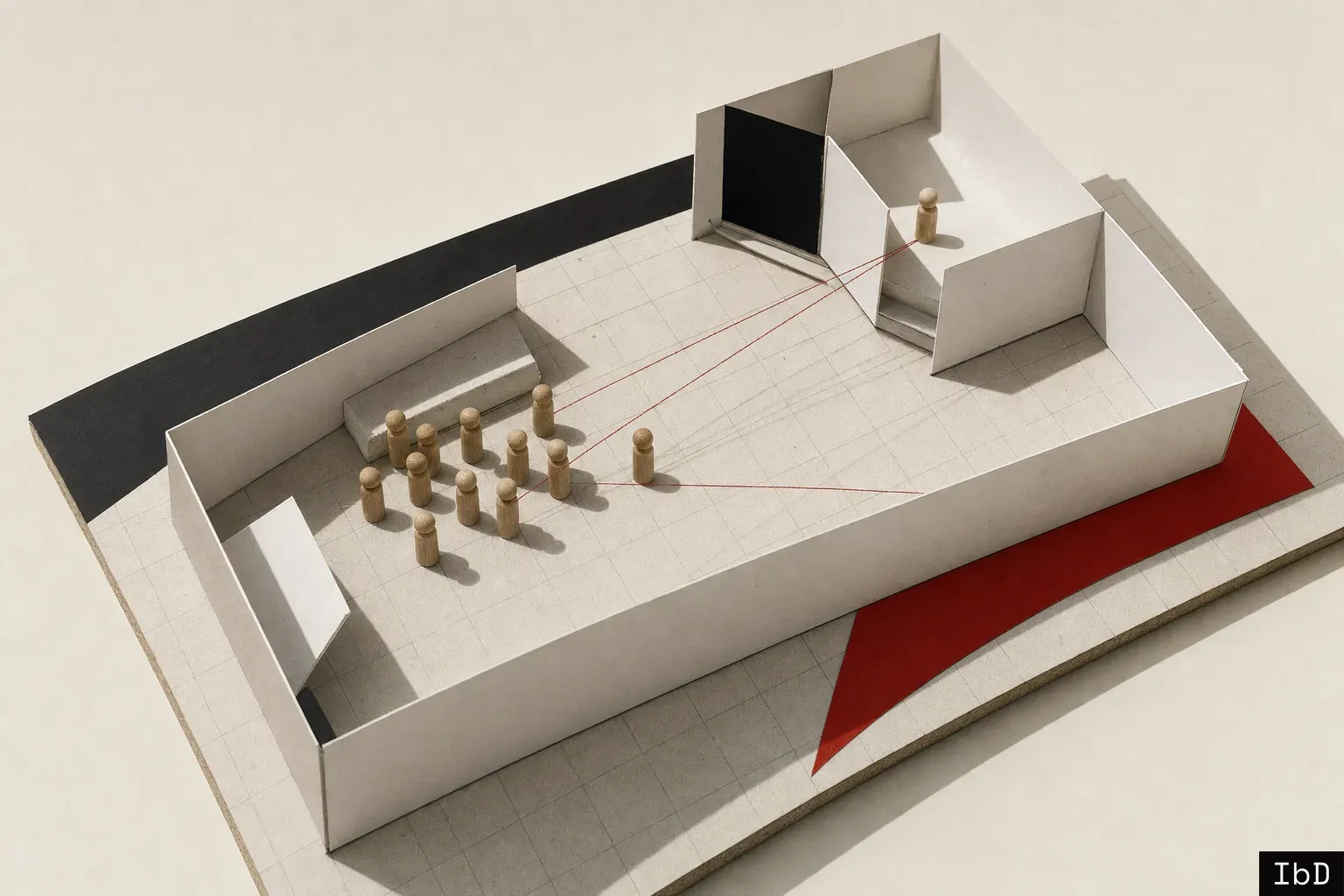
A dining room is drawn once and lived in for a thousand evenings. The evening that decides whether it works is the one when fifteen people arrive.
That evening is a better brief than the room. A dining room as a noun comes with a table size, a clearance, a light fitting and an adjacency to the kitchen. A party for fifteen comes with a host who needs to see the door, a guest who knows nobody, a crowd that forms at the drinks and stays there, and a steady stream of people trying to get past it. The first brief produces a room that meets its dimensions. The second produces a room that holds an evening.
The occasion is the brief
Every room in a program can be restated as the event it exists to host. The kitchen becomes the daily breakfast ritual. The dining room becomes the party for fifteen. The entry becomes the arrival in the rain with shopping bags. Area and adjacency still matter, but they become consequences of the occasion rather than inputs to it.
The restatement also changes what a test looks like. A room gets checked against rules. An occasion gets run. You populate the plan with the people the event brings and watch where it holds and where it gives.
Every guest carries a demand
Each person in the simulation is a bundle of demands on the space, drawn across the layers through which anyone experiences a room: physiological, spatial and proxemic, perceptual and cognitive, social and behavioural, affective and psychological, temporal and rhythmic, cultural and symbolic, and metabolic and infrastructural.
A party for fifteen needs four characters to become hard:
- The host. Needs sightlines to the door and the kitchen at once, and a path between them that does not cross the crowd. Perceptual and social demands.
- The wallflower. Needs a defensible edge: a seat with a wall at the back, a view of the room, and some distance from the main flow. Spatial and affective demands.
- The drinks cluster. Forms wherever the drinks are, stays, and widens as the evening goes on. A social pattern that turns into a spatial problem.
- The mover. Somebody is always heading for the bathroom, the balcony or the door. Tests circulation against everything the others have claimed.
These four pull in different directions. The host wants the room open. The wallflower wants it carved. The cluster takes the space the mover needs. A plan that satisfies one at the expense of the others has picked a winner, and the room still fails the evening.
Characters make intent legible in a way a requirements list cannot. "Provide varied seating" is a line nobody can fail. A wallflower with nowhere to sit is a failure anyone can see.
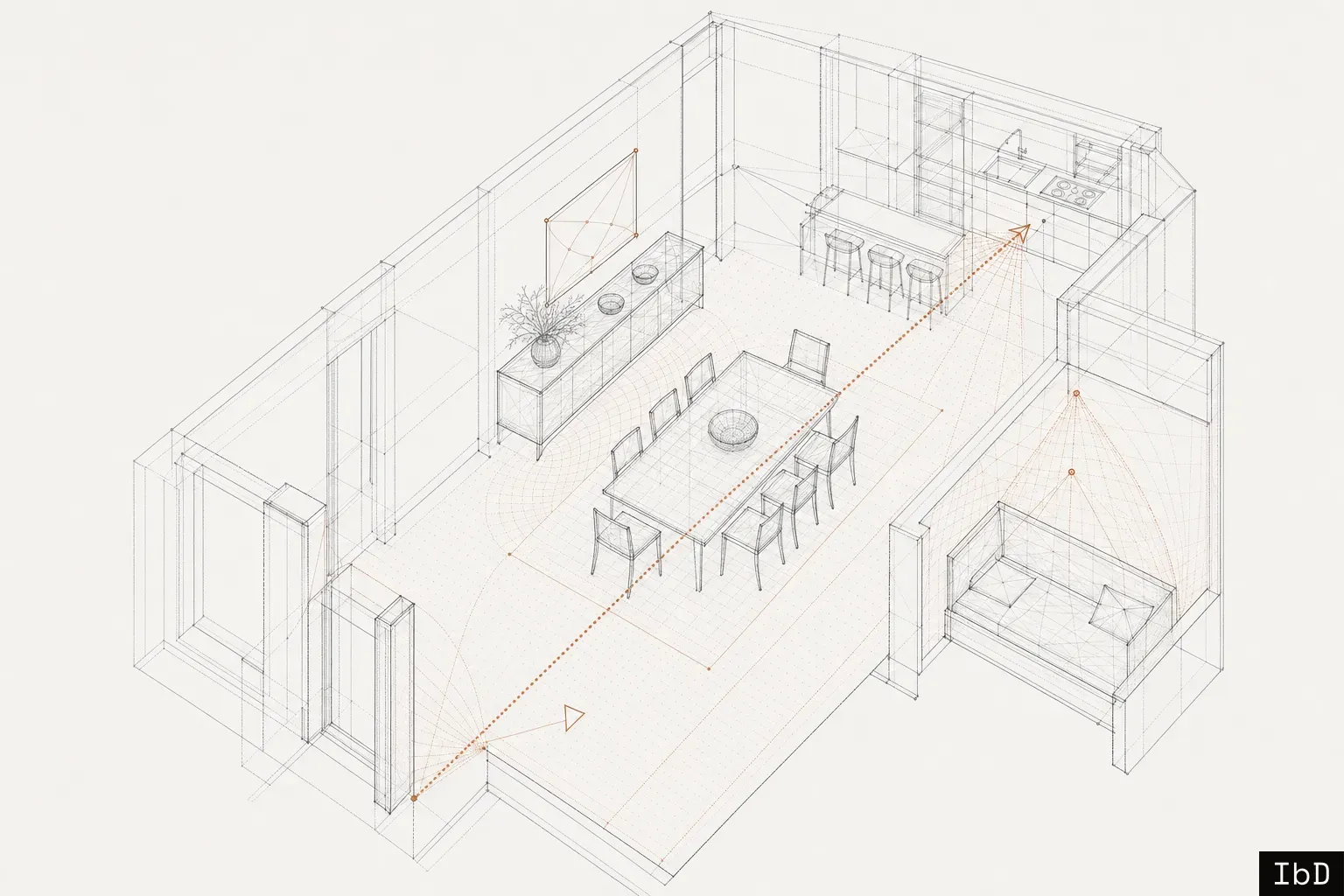
A score has to say where it came from
After the event, each character reports back layer by layer, with a number for every layer it touched rather than a pass or a fail. Those numbers roll up to the room, and the room's number rolls up to the strategy that placed it there.
The value lies in walking that path in reverse. When a plan scores poorly, a designer, a client or a reviewer should be able to follow the number down until it becomes a sentence: the wallflower scored 0.3 on spatial and proxemic demand because no wall-backed seat sits within 1.5 metres of the room's edge outside the main path. That sentence names who, which demand, where and why. It can be acted on.
A score that cannot be traced this way is an opinion with a decimal point. A traced score is an argument the plan has to answer.
Low scores push the walls
The trace explains, and it also steers.
The lowest-scoring demand in the plan is the most direct instruction for what to change next. The wallflower's 0.3 says: make an edge. Move a partition, pull the table off-centre, turn a corner into a niche. Then run the party again and see whether the number moved, and what moved with it.
Evaluation here acts as a force rather than a gate. In machine learning, the loss is what moves the weights. In this loop, the shortfall in a character's satisfaction is what moves the geometry. The mechanics differ: a plan changes through a search over perturbations rather than by following a smooth gradient, which puts it closer to evolutionary design than to backpropagation. The principle carries over intact. Generation is what evaluation looks like once it is allowed to act on the plan.
This keeps the generated design accountable. Every change has a reason, and the reason is a named person's unmet demand. Nothing in the plan arrived because it looked good.
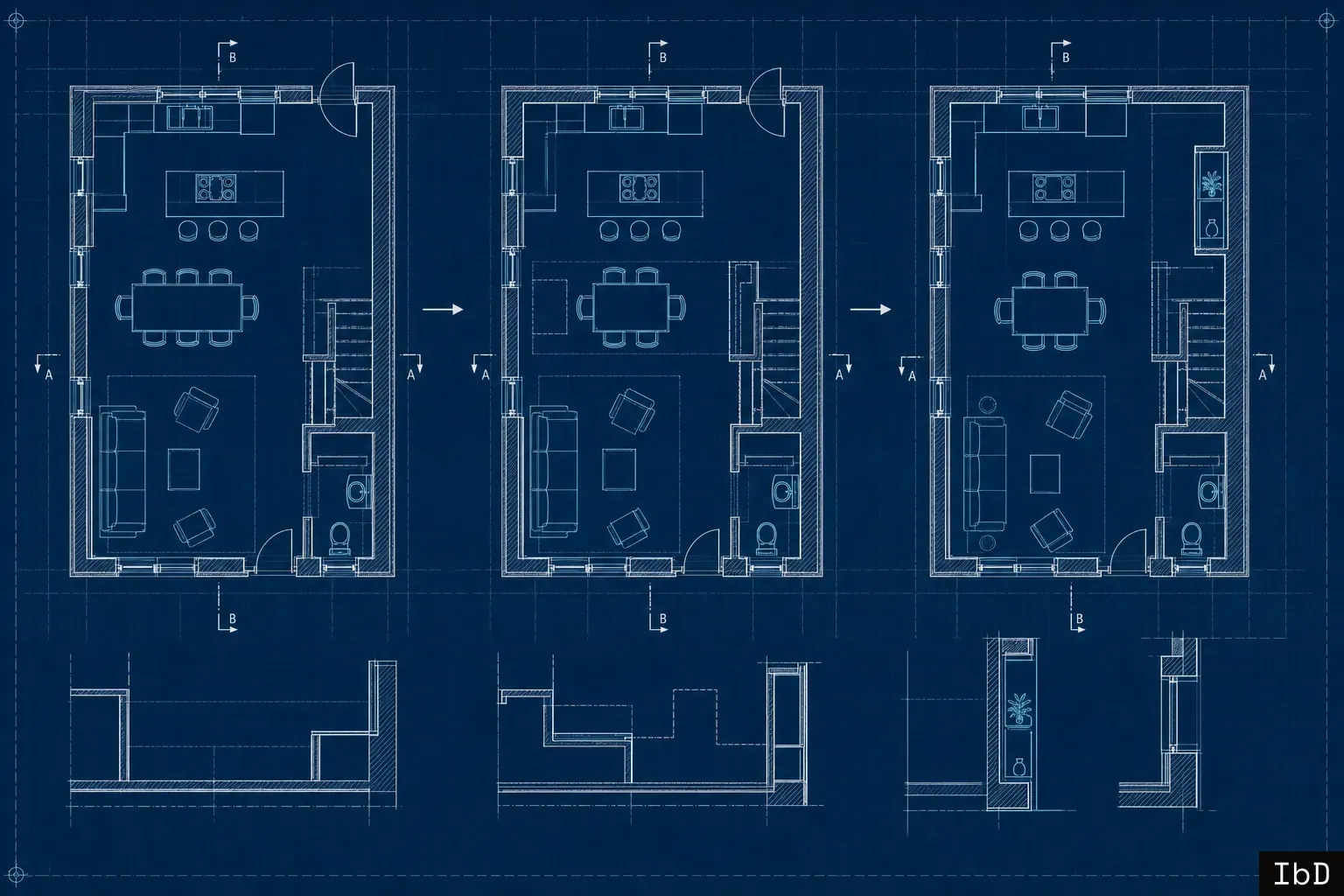
Stop when one guest's gain becomes another's loss
A loop that pushes geometry needs a rule for when to stop, and the rule cannot be "when it looks right." Two conditions do the job.
Floors first. Each character carries a minimum on every layer that matters to them. Below it, the plan is wrong for that person, whatever the average says. A party where the wallflower has nowhere to sit has failed, however good the host's sightlines are. The loop keeps changing the plan until every character clears every floor.
Then stall. Above the floors, the loop continues only while some change can raise one character's score without lowering another's. When every remaining move trades one guest's gain for another's loss, it stops.
It almost always stops with tension left over. Past a certain point, a more sheltered corner for the wallflower costs the host a line of sight to the door. The loop records that instead of hiding it. Its final entry is the reason it halted: further gains for the wallflower cost the host's sightline. That residue is the part of the design that belongs to a person. The system has narrowed a whole room down to one trade between two named people, and handed it over.
A party tests the peak, breakfast tests the routine
A party is a single peak. It asks whether a room survives its busiest night. The breakfast ritual asks something else: whether a space stays good on the three hundredth ordinary morning, when the same two people reach for the same kettle in the same order. The peak rewards surge capacity. The routine rewards low friction, repeated without thought. A room tuned for one can quietly fail the other.
Most rooms host both, and more. The dining table is the party, the weekday homework table and the place visiting parents get fed. A room's real score is taken against a portfolio of occasions, each weighted by how much it matters and how often it happens. Running several occasions against one plan uses the same method with more pressure on the geometry, and the shape that settles is the one that answers all of them at once.
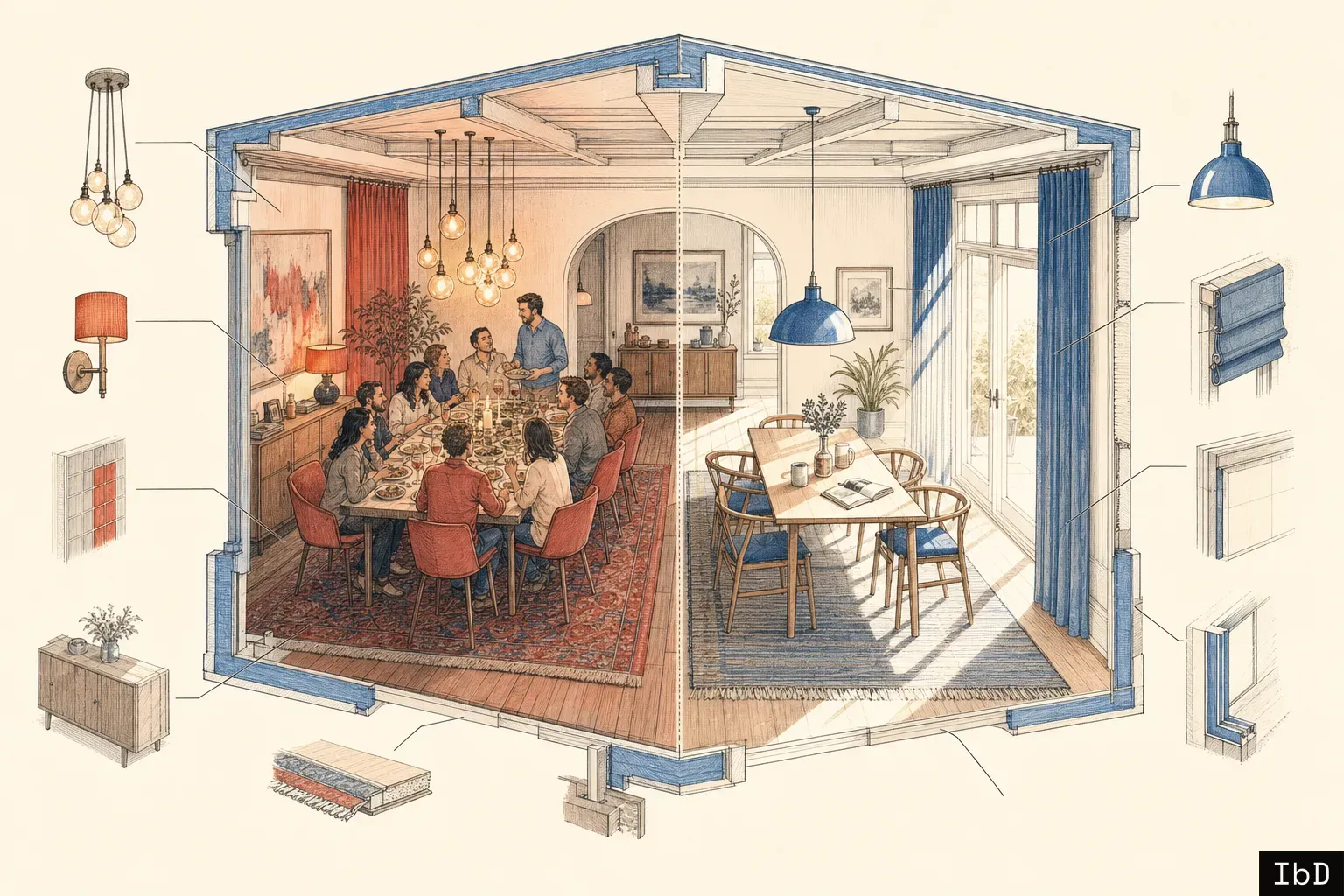
Rooms become contracts, occasions become tests
In Intelligent by Design, this is the work of Simulations. The framework treats each room or composite space as a Block: a contract that carries its identity, constraints and interfaces. Strategies govern how Blocks compose. Simulations populate them with occasions and characters, score the result layer by layer, and push the plan along the shortfalls those scores reveal.
The smallest version that proves the idea is small on purpose: one composite Block, one peak event, four characters, a trace that rolls up and back down, and one loop in which a low score changes the plan and the number visibly moves. Recurrence, portfolios and a full search all build on that loop.
A building is never occupied by its program. It is occupied by people on particular nights. Design for the night, and the room follows.