
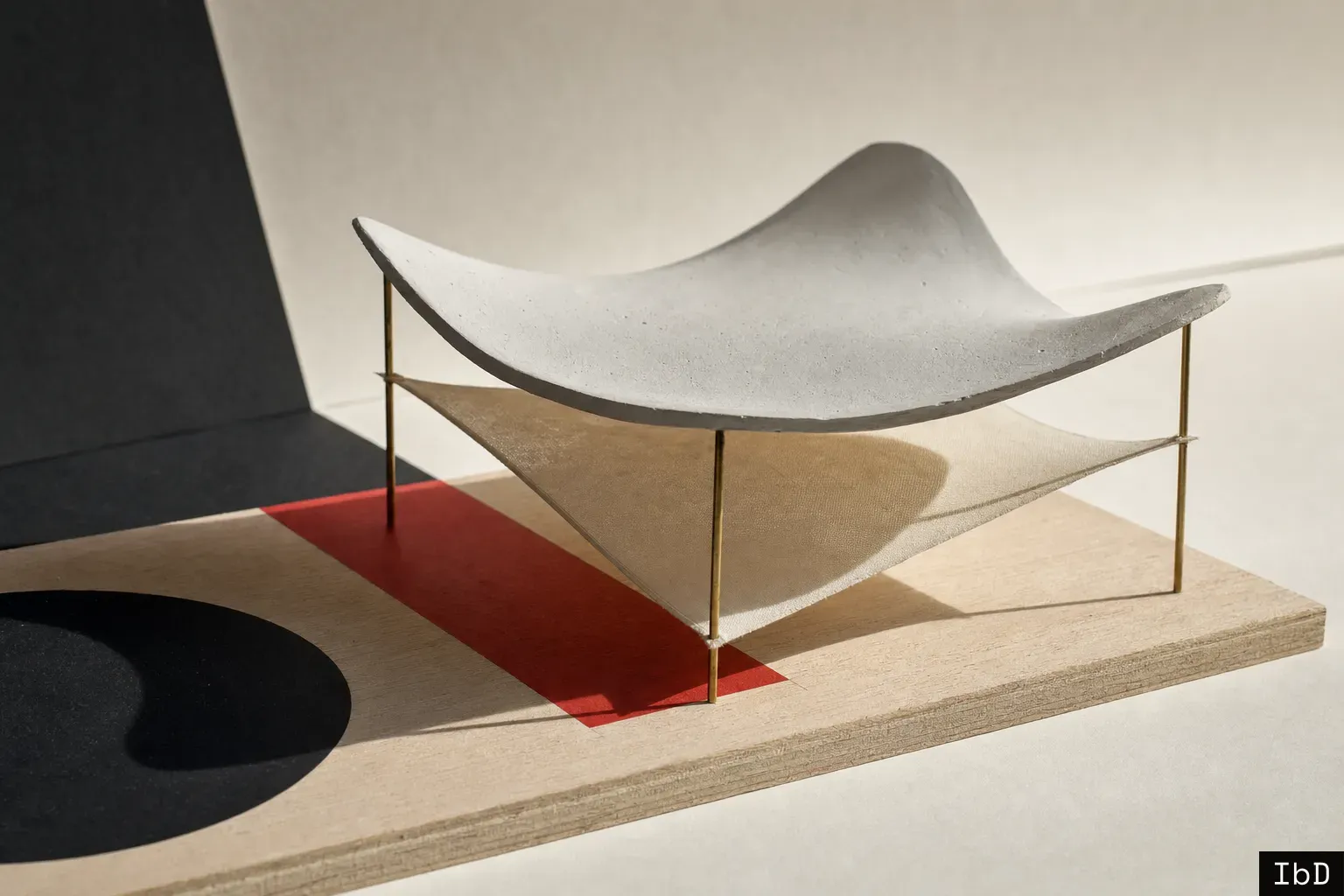
Before a fabric-formed concrete shell carries any concrete, it is already a structure. A tensioned membrane, pulled into shape by its edges and supports, holds its own equilibrium, and every shape the concrete takes afterwards starts from that one.
Form-finding has traditionally solved for the last shape only: the compression shell under self-weight. Three pieces of work from 2026 push the method in different directions. One reconciles the fabric and the shell in a single geometry. One uses machine learning to generate shell candidates at a speed no designer can match. One removes the step where the designed surface gets rebuilt as an analysis mesh. Each is numerical, each has clear limits, and together they change what the early design of a shell can look like.
Two equilibria can share one geometry
A prestressed membrane and a compression shell want different shapes. The membrane is in tension and pulls taut between its supports. The shell is in compression and hangs, inverted, like a chain. Cast a shell on a membrane form-found for tension alone and the concrete inherits a geometry it never asked for. Form-find the shell alone and nobody has checked whether the fabric can hold that shape.
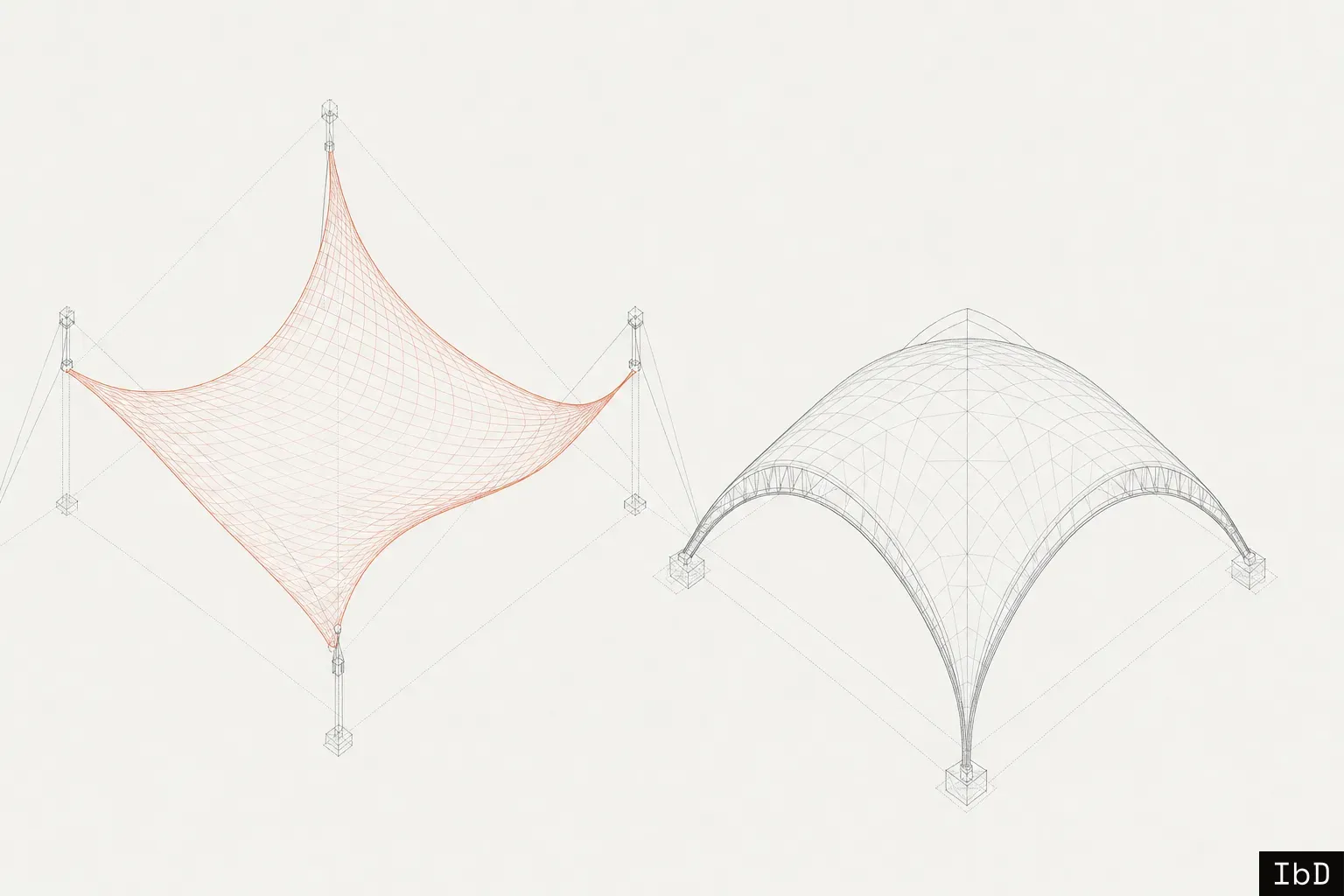
A paper from the Technical University of Munich, presented at the IASS symposium in September 2026, treats the two as one problem. It builds on the force density method, the workhorse of membrane form-finding since the 1970s, and gives a single shared topology two sets of force densities with opposite signs: tension for the membrane, compression for the shell. Gradient-based optimization then pulls both equilibrium states towards the same position in space.
Across four numerical studies, the two states converge to nearly the same geometry. The free edges are the most striking result. Nobody draws them in. They emerge as funicular arches, which is what an experienced shell designer would have aimed for, arrived at here by the mathematics rather than the eye.
The limits are stated plainly. Self-weight is simplified to uniform loads at the nodes. Thickness and material are not design variables. Nothing has been built, so prestress tolerance, sag under wet concrete, and the effect of fabric seams are all untested, and there is no figure yet for how much reinforcement the method might save.
What makes it exciting is the framing. The formwork stops being a support for the design and becomes half of it. The obvious next step is a third state, the membrane carrying wet concrete, which is exactly where geometry drifts on site. Of all the recent form-finding work, this is the method I most want to see tested in fabric and concrete.
Machine learning is an option generator
The second piece of work goes after speed. An arXiv preprint first posted in April 2026, and revised in July, couples a generative model to a physics surrogate. The surrogate scores each candidate with a membrane-factor field, a map of how much of the shell is carrying load through membrane action rather than bending, and the generator is steered towards shells that score well. Promising candidates then go to conventional finite-element analysis.
The reported numbers are good. Test errors on the surrogate go as low as 2.2 percent, and the follow-up finite-element checks support the shapes it favours. For an early design stage that might otherwise produce a handful of options in a week, sampling hundreds of high-membrane candidates in minutes is a real change in what can be explored.
The realism matters just as much. The model only knows the shapes it was trained on, so it is strongest where it is least needed and weakest at the edges of its training domain. Wind reversal, support settlement, openings, thermal action, buckling, cracking and construction loads are incompletely treated or absent. A surrogate that predicts membrane behaviour accurately under gravity is still only predicting membrane behaviour under gravity.
Used well, this is a way to widen the search before the serious work begins. Transparent equilibrium methods and nonlinear verification still make the decision. The generator's job is to make sure the designer is choosing from a better set.
The design surface can be the analysis model
The third piece of work removes a tax that anyone who has designed a shell in Rhino has paid. The surface is modelled as NURBS, then rebuilt as a mesh for analysis, then the results are carried back onto a geometry that is no longer quite the one analysed. Each loop costs time and quietly introduces error.
A paper at IASS-IWSS 2026 describes a workflow built on Kiwi!3D, an isogeometric analysis plug-in for Rhino and Grasshopper. Form-finding and geometrically nonlinear analysis run directly on trimmed, multi-patch NURBS surfaces. The surface the designer draws is the surface the solver analyses, so there is no remeshing and no translation back. The case studies are well chosen for the lineage: hypar umbrellas, groined vaults, and a study inspired by Candela.
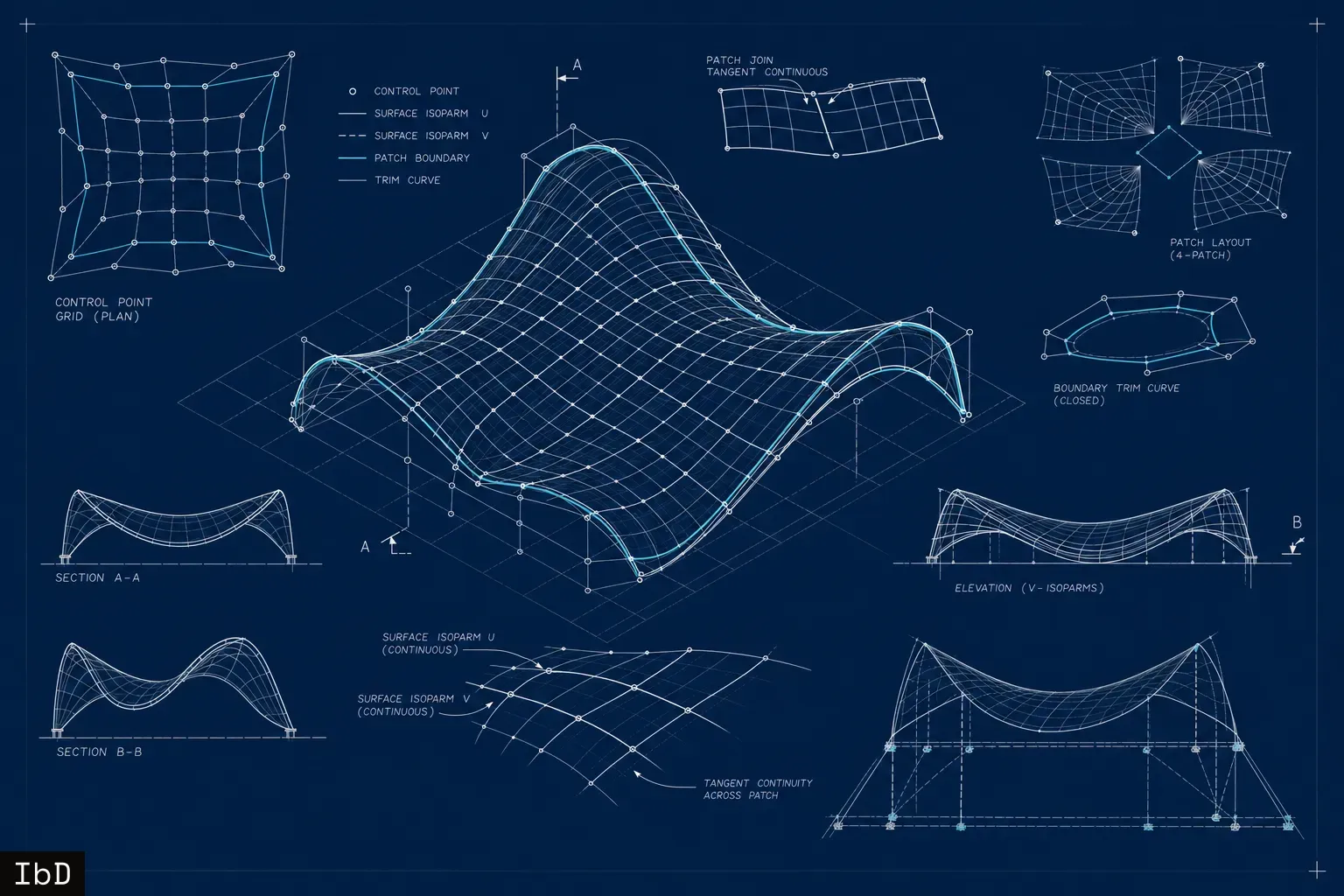
The limits are the familiar ones for any analysis method. Refinement and convergence still have to be checked, and exact geometry does not make a structural model correct. Cracking, imperfections, reinforcement and construction staging are listed as future work. No new physical shell was built for the paper.
What it offers is iteration speed with a clean thread from design to detailing. That is valuable on its own, and more valuable when the geometry is changing quickly, as it will in any coupled form-finding process. Final verification should still be independent, and it should be sensitive to the imperfections that real construction introduces.
The shape now has to survive every state
Taken together, the three pieces of work move form-finding from a single answer to a managed sequence. The coupled method reconciles the fabric and the shell. The generative method widens the set of candidates. The isogeometric workflow shortens the loop between drawing and checking. None of them has been tested in a built shell, and all three say so.
That honesty is part of why this moment is interesting. The tools are good enough to change how early shell design is done, and immature enough that every built and measured shell will tell their authors something new.
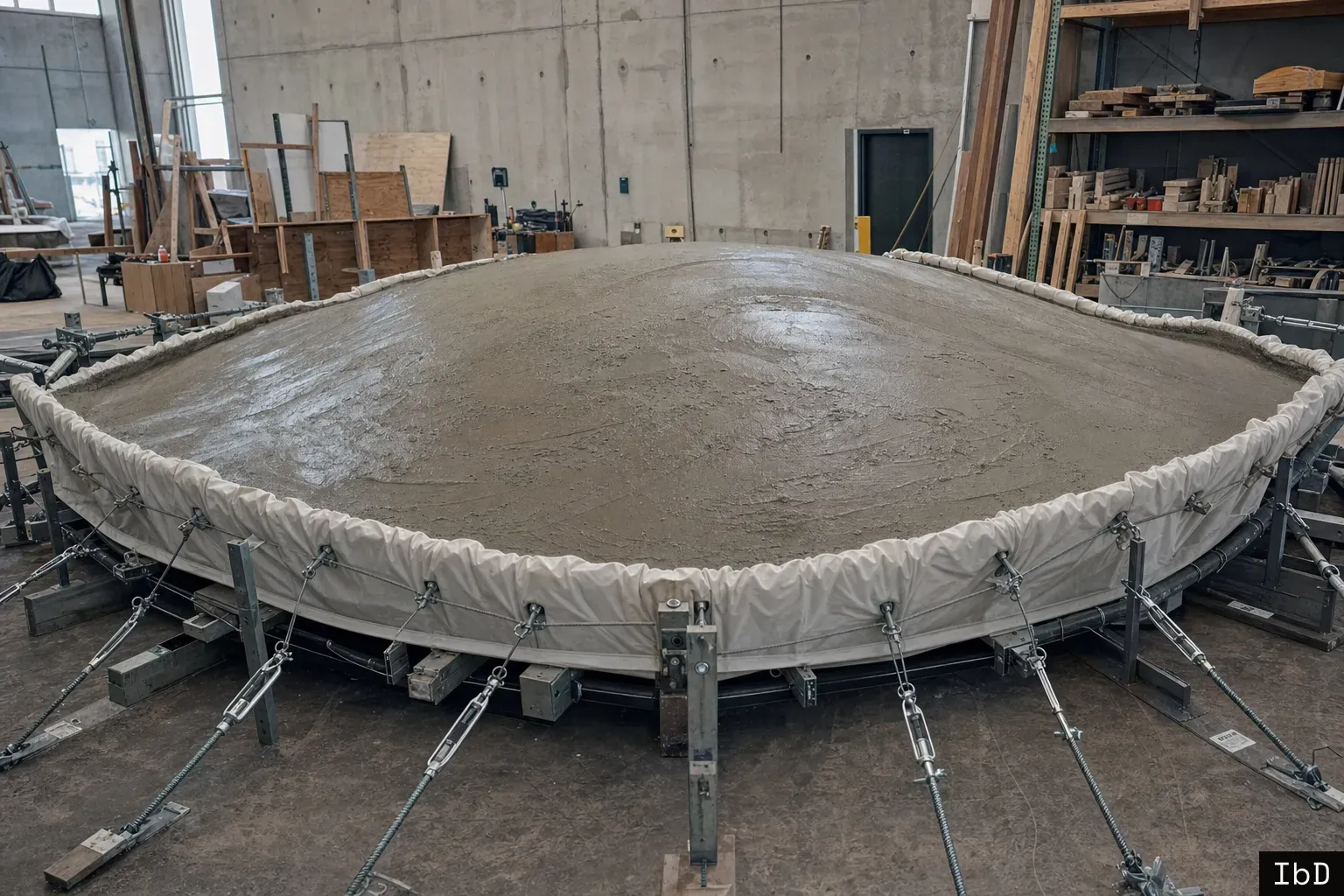
The fabric, the wet concrete and the cured shell can now share a geometry. The next question is whether they can share a timeline.
References
- Coupled membrane-shell form-finding (Technical University of Munich, IASS-IWSS 2026)
- Physics-informed generative design of funicular shells (arXiv preprint, April 2026, revised July 2026)
- CAD-integrated isogeometric thin-shell workflow (IASS-IWSS 2026)
- Kiwi!3D theory and capabilities (official documentation)