

For most of modern economic history, intelligence has been scarce.
We built entire institutions around this scarcity. Companies hired people because they knew how to do things other people did not. Consulting firms sold access to accumulated expertise. Software companies packaged expertise into products and charged by the seat. Governments maintained bureaucracies because administering a country required thousands of people capable of interpreting information and making decisions. Lawyers charged for knowing how to navigate law; engineers for knowing how to design systems; analysts for knowing how to extract meaning from data.
Artificial intelligence changes something more fundamental than the cost of performing these jobs. It changes what is scarce.
If intelligence becomes abundant, it stops being the primary differentiator. If generating an analysis, writing software, interpreting a contract, designing a building, constructing a financial model, or exploring a scientific hypothesis becomes dramatically cheaper, the competitive bottleneck shifts elsewhere.
The obvious response is to say that human beings will move upward: from execution to ideas.
But there is a problem. Most ideas aren’t particularly good either.
Once generating and executing ideas becomes cheap, the world doesn’t automatically become full of brilliant things. It can just as easily become full of mediocre things produced extraordinarily efficiently.
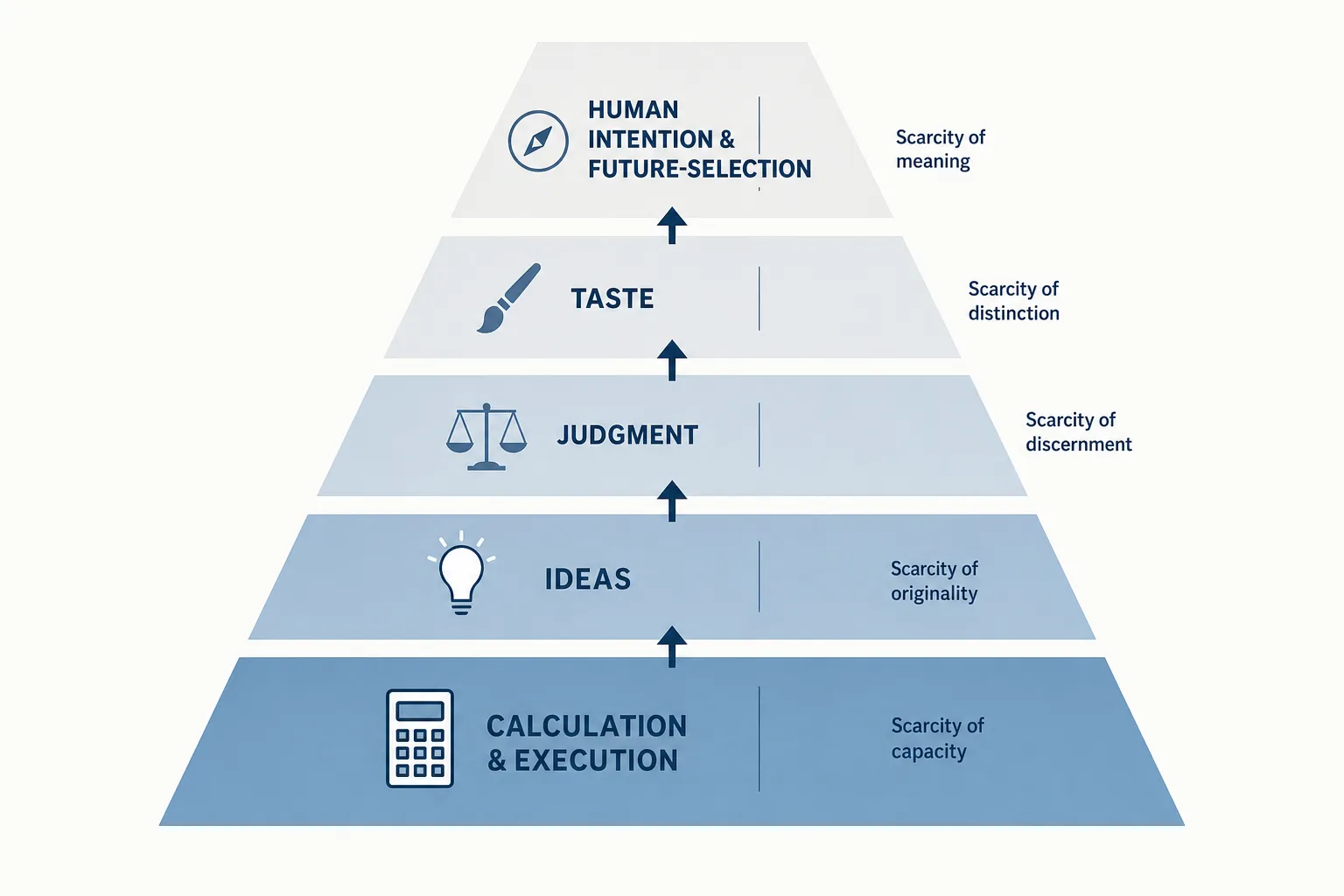
That pushes the scarce resource upward in a continuous progression:
- From intelligence to ideas
- From ideas to judgment
- From judgment to taste
- From taste to intention
- And eventually, to deciding which futures are worth creating
That progression may be one of the most consequential structural shifts of artificial intelligence.
The End of Execution as a Filter
Historically, execution acted as a brutal filter on human imagination. Having an idea was easy; building it was difficult. A software product required engineers. A film required a production company. A new business required capital and employees. A policy proposal required analysts. A building required architects and draftsmen. Research required people capable of reading and synthesising enormous bodies of literature.
This meant that most ideas never encountered reality. The cost of execution eliminated them first.
AI weakens that filter. A mediocre business idea can now acquire a polished brand, a functioning prototype, market research, financial projections, and an advertising campaign remarkably quickly. A mediocre intellectual idea can become a beautifully structured essay. A mediocre aesthetic idea can become a technically accomplished image. A mediocre policy proposal can arrive accompanied by hundreds of pages of apparently sophisticated analysis.
We are therefore likely to experience a strange transitional period. We will see an explosion not merely of creativity, but of competently executed mediocrity.
The constraint moves from can you make it? to should this be made at all? That is an entirely different economy.
Everyone Becomes a Critic
When generation becomes cheap, selection becomes valuable. The interaction with an AI increasingly resembles the relationship between a creative director and a large team.
Generate twenty options. Not that one. Make this less conventional. That solution is technically correct but misunderstands the problem. This feels derivative. Explore the second direction. Combine these two. Start again.
The person may contribute very little to the mechanical production of the final object. Yet their judgment determines almost everything about its quality. This turns more people into something resembling editors, critics, curators, investors, and creative directors. Their value lies not necessarily in producing the answer, but in recognizing one.
This is why "taste" is increasingly discussed in technology circles. But aesthetic taste is only a small part of it:
- Product taste
- Scientific taste
- Policy taste
- Strategic taste
- Investment taste
- Engineering taste
All describe approximately the same capability. They mark the ability to recognise which possibilities deserve further attention before the evidence becomes overwhelming. A good founder doesn’t merely generate more ideas than everyone else; they identify which problem is worth spending ten years on. A good scientist notices which anomalous observation deserves investigation. A good investor recognises which emerging phenomenon represents a structural change rather than temporary noise. A good policymaker understands which problem, among thousands demanding attention, will create disproportionate consequences if ignored.
As intelligence becomes abundant, this capacity becomes more—not less—important.
But AI Can Learn Taste Too
There is an obvious problem with declaring taste the permanent human advantage. AI learns from our selections. Every interaction contains information:
This is good. This is generic. This feels dated. This misses the point. This is beautiful. This is technically impressive but strategically irrelevant.
Given enough observations, a sufficiently capable system can construct an increasingly sophisticated model of someone’s judgment.
The loop becomes: AI generates → human evaluates → AI observes → AI models the evaluation → AI generates closer to the human’s preferences.
Eventually the system may predict what a person will prefer before the person consciously knows. This already exists in primitive form in recommendation systems. But generative systems allow something much richer. Instead of predicting which existing song, film, product, or article someone will like, the system can generate something specifically within that person’s preference landscape.
So perhaps taste isn’t permanently scarce either.
The next refuge becomes the evolution of taste. Human taste isn’t static. People encounter experiences that change them. They become bored. Their values shift. They discover contradictions in their worldview. They encounter something initially uncomfortable that eventually establishes an entirely new standard.
But there is no obvious reason AI must stop at modelling current preferences. With sufficient longitudinal information, it can potentially model how preferences change.
It could infer:
- You currently prefer A.
- People with similar trajectories often move toward B.
- Exposure to C tends to accelerate that transition.
- You are becoming dissatisfied with a characteristic you previously valued.
At that point, AI isn’t merely modelling taste. It is beginning to model the formation of taste. And this is where the question becomes much larger than creativity.
From Predicting Preferences to Shaping Them
A system capable of understanding how preferences evolve also possesses the ingredients necessary to influence that evolution. Recommendation systems already demonstrate the basic mechanism. They do not simply observe what people want; what they show affects what people encounter. What people encounter affects what they become interested in. What they become interested in affects what the system subsequently shows them.
The preference and the recommendation system become part of the same feedback loop.
A much more capable AI could theoretically do this across far more consequential domains: consumption, careers, political beliefs, aesthetics, education, relationships, investment decisions, and even conceptions of a desirable life.
The traditional model of technology is:
Human wants X → technology helps human obtain X.
But increasingly the loop can become:
System shapes environment → environment influences human → human develops preference X → system observes X → system satisfies X.
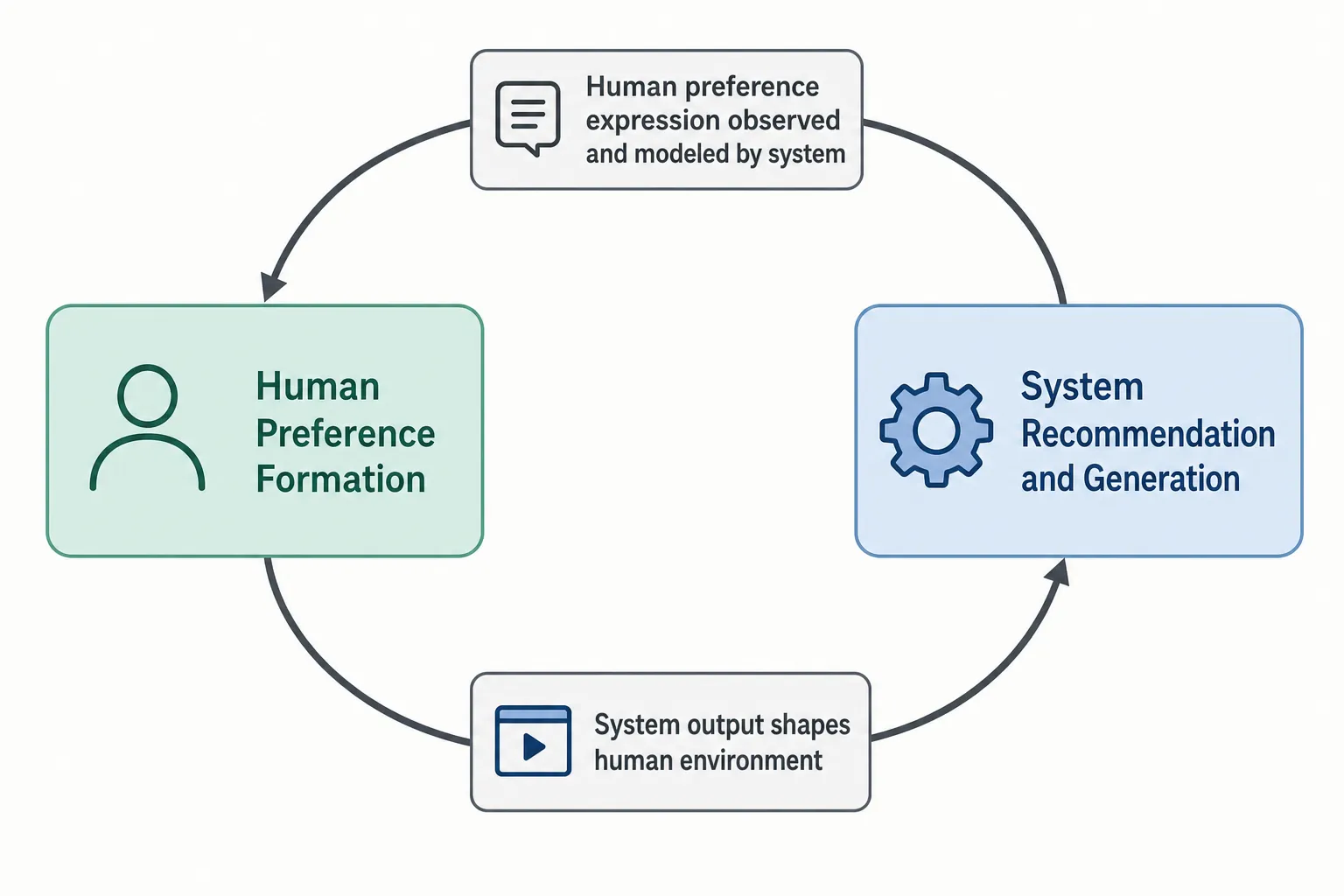
The distinction between discovering demand and creating demand becomes blurry.
This matters because one of the comforting assumptions in discussions about AI is that human beings will always provide the objective. AI might become enormously intelligent, the argument goes, but humans still decide what that intelligence is for. That remains largely true today. It may not remain straightforwardly true forever—not because AI necessarily develops autonomous desire, but because sufficiently sophisticated systems become participants in the processes through which human desires themselves are formed.
The Problem of Wanting
What do human beings actually want? It is tempting to imagine that somewhere inside every person exists a stable preference function waiting to be discovered. Reality appears considerably messier.
Ask someone what tax policy they prefer as a taxpayer and you may receive one answer. Ask them as a parent and you may receive another. Ask them as an entrepreneur, homeowner, environmentalist, or citizen and the answer changes again. Change the time horizon and preferences change. Change the framing and preferences change. Change what information is available and preferences change.
Political philosophy has spent centuries dealing with precisely this problem:
- Utilitarian reasoning asks which arrangement maximises aggregate welfare.
- Libertarian reasoning asks what rights cannot legitimately be violated even in pursuit of greater aggregate welfare.
- Rawls asks us to imagine choosing social institutions without knowing which position in society we ourselves will occupy.
- Other traditions ask what constitutes virtue, dignity, community, freedom, or human flourishing.
The important point isn't which philosophy is correct. It is that different moral frames produce fundamentally different answers from identical facts. AI does not automatically dissolve this problem; in fact, AI makes it impossible to avoid.
When Philosophy Becomes System Architecture
As AI becomes involved in consequential decisions, philosophical questions stop being abstract intellectual exercises. Philosophy becomes system architecture.
Imagine an AI system responsible for allocating a city’s infrastructure budget:
- Give it one objective—minimise preventable deaths—and it produces one allocation.
- Change the objective to maximise economic productivity and it produces another.
- Shift to improve conditions for the worst-off citizens and it produces a third.
- Optimise for minimise inequality between neighbourhoods, maximise long-term climate resilience, or intergenerational welfare, and each yields a distinct spatial plan.
None of these systems necessarily contains an analytical error. The objective changed.
Someone must decide what the optimisation function contains: prosperity, equality, liberty, health, safety, sustainability, resilience, dignity, beauty, or intergenerational welfare. And even if everyone agrees that all these things matter, how much does each matter relative to the others?
There is no obvious unit in which three units of liberty can be exchanged for seven units of sustainability.Politics exists partly because societies contain multiple legitimate but incompatible conceptions of the good. AI doesn’t make pluralism disappear, but it changes the character of the disagreement.
What AI Can Remove From Politics
A sufficiently capable analytical system could begin separating different kinds of political disagreements. Consider an argument over an environmental regulation. One group says it will destroy jobs; another says it will create new industries. One predicts energy prices will rise; another predicts innovation will cause them to fall.
Much political rhetoric depends upon mixing factual assertions with value judgements. An analytical system could clarify:
- This policy is likely to reduce emissions by X amount.
- Industry Y will probably contract, while Industry Z will grow.
- Household energy costs will experience a specific temporary increase before declining.
- Here is the explicit confidence interval around every prediction.
Suddenly a politician has fewer places to hide behind contested facts. The remaining question becomes: knowing these consequences, do we still believe this is worth doing?
That is a moral and political decision. AI could paradoxically make human responsibility more visible rather than making humans irrelevant.
The Borgen Problem
Political leaders rarely choose between obvious good and obvious evil. They choose between competing goods.
In political coalitions, environmental parties want aggressive climate action, labour constituencies want employment, industry wants competitiveness, finance ministries need fiscal stability, and consumers want affordable energy. The leader may genuinely sympathise with all of them. This is politics as trade-off.
At first glance, AI merely improves the information available to the politician. It calculates costs, employment shifts, and carbon reductions more accurately, while the politician still chooses.
But this assumes something extremely important: that the trade-off itself is unavoidable.
What if it isn’t?
AI Expands the Solution Space
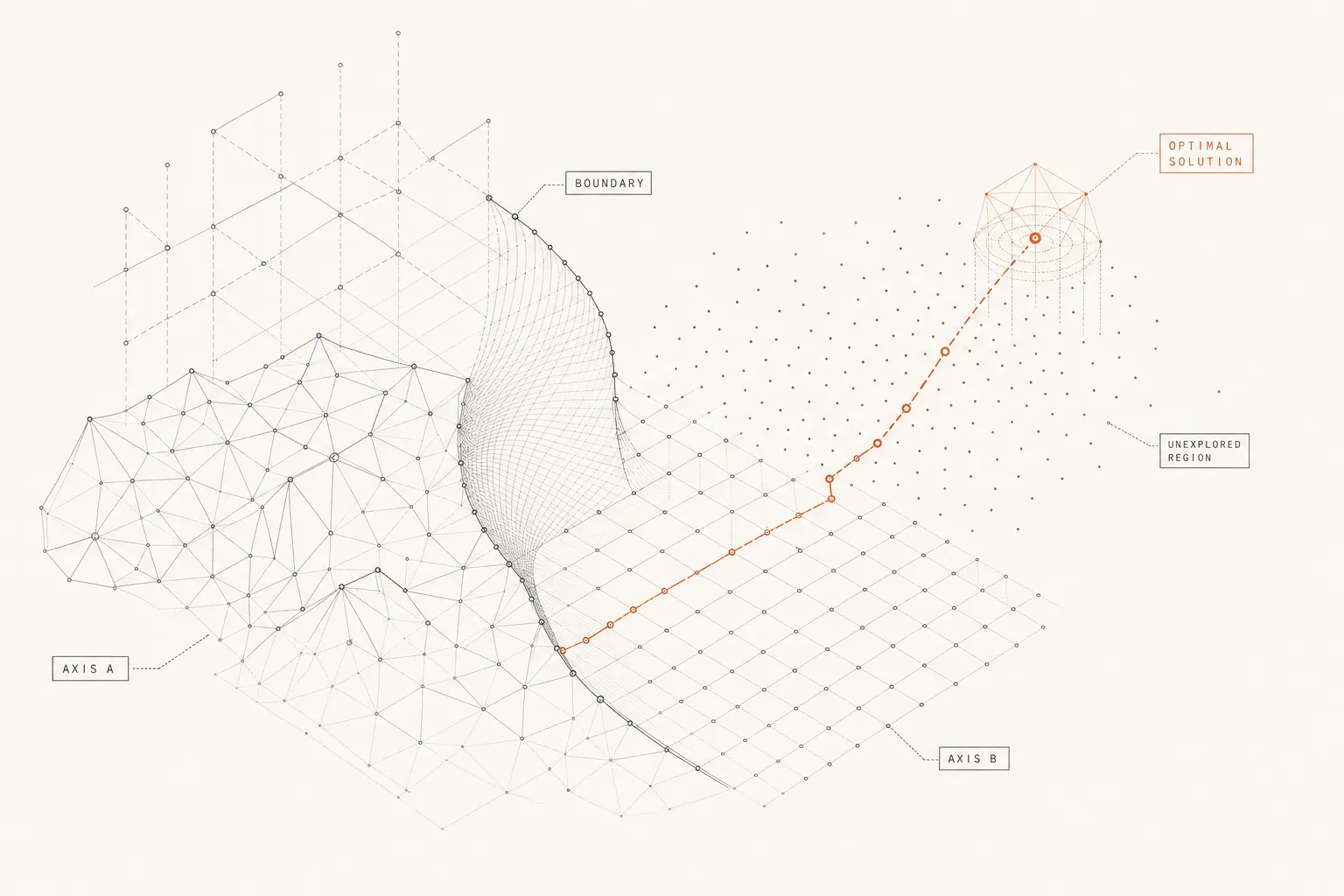
Human decision-makers explore remarkably small possibility spaces. Reality is combinatorially enormous.
Imagine designing an industrial transition policy. There are thousands of variables: tax structures, subsidies, transition schedules, energy technologies, grid investments, training programmes, trade policies, procurement guarantees, income transfers, and regulatory structures.
No ministry can seriously evaluate every combination. No consulting team can model all the interactions. So humans simplify: we construct Option A, Option B, and Option C, and then argue about which compromise is least bad.
But somewhere inside the unexplored possibility space exists Option 37,492: it reduces emissions faster, creates replacement industries in precisely the regions losing employment, lowers long-term energy costs, and uses targeted transfers to protect vulnerable households.
Nobody proposed it because nobody could search enough of the possibility space to discover it.
This is where AI becomes much more than an automation technology. AI becomes a technology for searching possibility spaces.
Three Different Things We Call Trade-Offs
What humans describe as "trade-offs" actually belong to three distinct categories:
1. Discovery problems. A solution exists that leaves everyone substantially better off, but we haven’t discovered it. The conflict is not fundamentally moral; it is computational. More intelligence, better models, or a larger search space can solve it.
2. Coordination problems. A desirable equilibrium exists, but reaching it requires coordination. Everyone might benefit from a new transit network, but building it requires upfront capital and temporary disruption. AI can search not merely for desirable end states, but for feasible transition pathways between states.
3. Genuine value conflicts. Some objectives are genuinely incompatible. A valley cannot remain completely untouched while simultaneously housing physical development. Comprehensive surveillance might reduce violent crime, but citizens may believe no state should possess that capability regardless of efficacy.
No amount of additional intelligence automatically resolves a category-three conflict. But AI's job may be to shrink that category dramatically.
From Optimisation to Counterfactual Civilisation
Consider how governance shifts when systems move from static diagnosis to counterfactual simulation.
A traditional government asks which roads to repair this year. An AI-enabled system integrates road conditions, traffic, accident history, and maintenance costs.
The far more interesting system asks:
- What happens if we don’t repair this road?
- Which assets fail next, and how does traffic redistribute?
- What intervention today minimises total infrastructure expenditure over twenty years?
- How do rainfall projections, land-use changes, population growth, and energy grid demands interact?
Suddenly the system isn’t simply diagnosing the city—it is constructing counterfactual futures. The purpose of a digital twin is no longer merely to reconstruct reality, but to test futures before they are imposed upon the physical world.
Observe → Reconstruct → Understand → Simulate → Choose → Intervene → Measure → Learn
The feedback loop gets progressively shorter.
Hastening Utopia
AI can reduce the distance between a desirable future and our ability to discover a feasible pathway toward it.
We know children shouldn’t die from preventable diseases. We know cities shouldn’t flood because drains weren’t maintained. We know water shouldn’t disappear through leakage. We know welfare should reach eligible citizens without friction.
Many of these are not unresolved philosophical questions. Failures occur because information is fragmented, responsibility is distributed, predictions are weak, budgets are constrained, and institutions move slowly.
These are precisely the constraints intelligence can attack. AI can compress the arc from problem to intervention.
Utopia is not a static destination; it is an increasing velocity at which civilisation can search for better states and navigate conflicting objectives.
The Residual Human Problem
Suppose AI becomes extraordinarily good at discovering Pareto improvements and designing transition pathways. What remains?
The irreducible disagreements.
A forest cannot be both untouched wilderness and physical housing. A secret cannot simultaneously be known and unknown to the state. Present consumption and preservation for future generations will sometimes conflict.
At that boundary, AI can make clear what follows from each choice. But someone still has to choose.
This may ultimately be the primary role of human beings in a world of abundant intelligence: not calculating consequences, but deciding among remaining futures once every avoidable trade-off has been removed.
Intelligence, Judgment, and Responsibility
Anyone can want something, but the deeper scarce resource is responsibility.
The politician’s hardest sentence is not "I have calculated the optimal policy." It is:
"I understand who this choice harms, I understand what alternatives exist, and I still believe this is the future we should choose."
AI can make that statement much more informed. It cannot automatically make it morally legitimate. As the cost of producing possibilities collapses, the burden moves toward choosing among them. And choice creates responsibility.
The Possibility Frontier
In economics, every society operates inside a possibility frontier.
Politics frequently concerns movement along that frontier: choosing more environmental protection but less industrial production, or more public spending but higher taxation.
Technological progress moves the frontier outward. AI moves the frontier in two ways simultaneously: by creating new technologies, and by discovering better configurations of technologies, institutions, and resources we already possess.
When a policymaker is told "you can save the jobs or save the environment," the first response of an intelligence-rich society should be:
Prove that those are the only two possible futures. Search harder. Simulate more. Change the time horizon. Change the financing. Sequence the transition differently. Invent something that changes the constraint.
And only when all of that fails do we confront the genuine moral trade-off.
Intelligence clears away everything we mistakenly thought required judgment. What remains is deciding which future is worth choosing when reality truly will not let us have them all.