


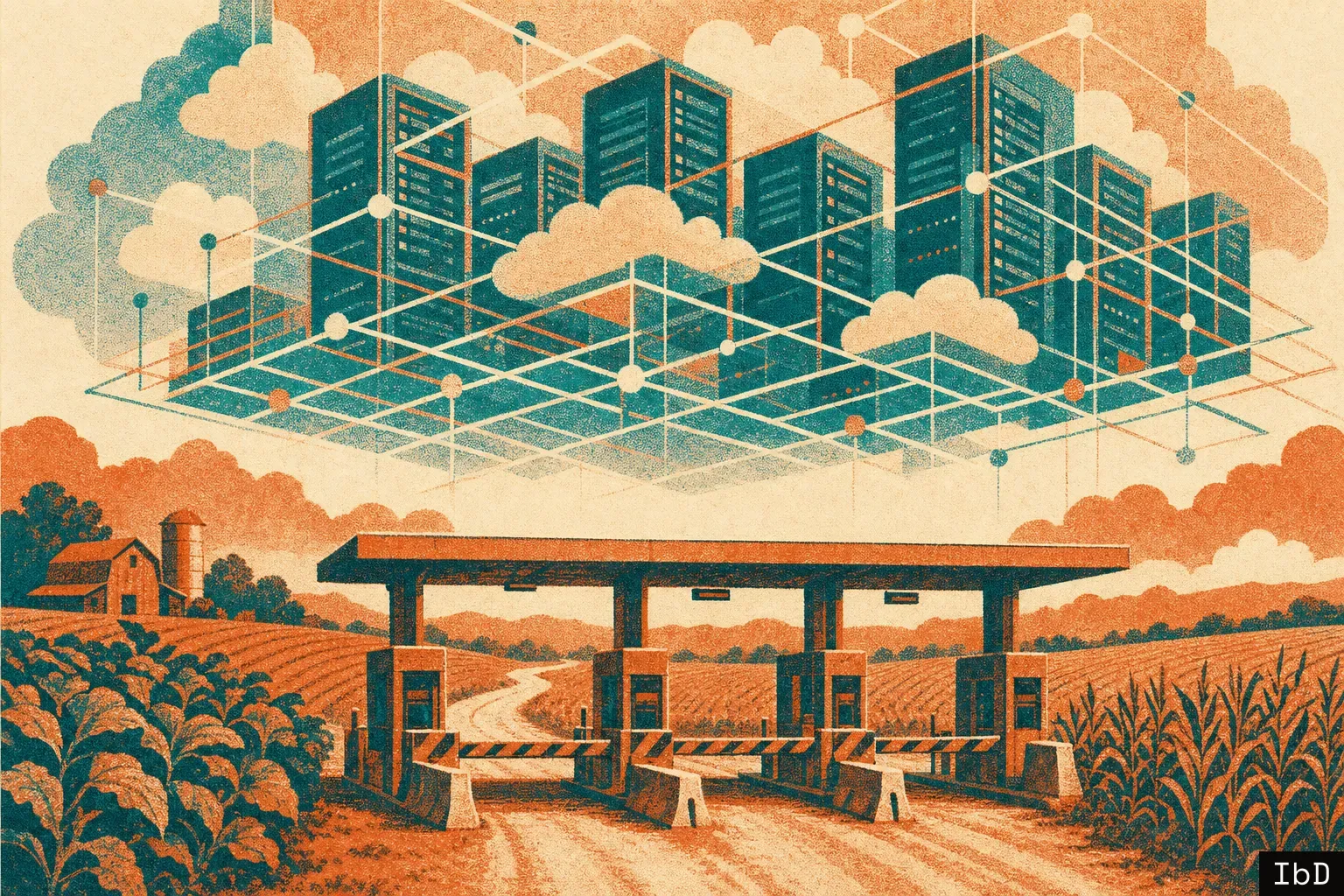
Technology companies are increasingly operating as a new-age zamindari. The analogy is precise if we understand zamindari not merely as land ownership, but as control over the layer through which every other actor conducts economic activity. Historically, the zamindar controlled access to a scarce, indispensable productive asset: physical land.1 The emerging digital equivalent is control over foundational infrastructure and distribution channels: cloud compute, foundation models, app stores, search graphs, digital marketplaces, identity and payment rails, and the emerging interfaces through which people delegate agency to artificial intelligence.
| Zamindari economy | Emerging digital economy |
|---|---|
| Land is the primary productive asset | Compute + models + data + distribution |
| Zamindar controls access to territory | Platform controls access to digital rails |
| Tenant actually produces agricultural yield | Developer, business, or user produces economic value |
| Rent paid for permission to farm | API fees, cloud bills, commissions, subscriptions |
| Land appreciates as surrounding activity grows | Platform appreciates as ecosystem activity compounds |
| Moving away from land is difficult | Switching platforms incurs data, workflow, and ecosystem lock-in |
| Zamindar captures downstream surplus | Rail owner captures downstream value creation |
1. From Search to Delegation: The Agency Shift
Artificial intelligence pushes platform power beyond traditional attention and transaction monetization. Google and Meta monetized attention. Amazon monetized commerce transactions. Microsoft monetized enterprise software and compute infrastructure. An AI agent, by contrast, sits directly between human intention and economic execution:
Human → Agent → Economy
In an agent-mediated economy, consumers no longer execute individual decisions manually. You do not search for flights; an agent selects and books one. You do not compare insurance policies; an agent negotiates coverage. A firm does not manually reconcile invoices; an autonomous agent processes them. A municipality does not manually triage thousands of citizen grievances; agents classify, route, and initiate field responses. Whoever owns that intermediary delegation layer collects economic rent on delegated action.
Once raw intelligence becomes inexpensive and widely available, intelligence itself ceases to be the scarce asset. The scarce asset becomes permission to act: access to systems, institutional trust, proprietary context, distribution, identity, auditability, and legal authorization. The progression of economic power spans six distinct regimes:
Land → Capital → Information → Attention → Intelligence → Agency
At the agency stage, the dominant firm is not necessarily the one producing the smartest model. It is the firm controlling the rails on which agents are authorized to operate. Large technology companies increasingly resemble owners of digital territory rather than vendors of software products. Everyone else innovates and produces on that territory, but a persistent fraction of the resulting economic surplus accrues to whoever owns the underlying rails.
Unlike physical land, software can be duplicated, open-source models can be deployed, interoperability can be mandated, and governments can build open infrastructure. Digital zamindari is a structural choice, not an inevitability.
2. Public Rails as the Structural Counterweight
The public-rails model separates the infrastructure required to participate in an economy from the commercial entity capturing value on top. Consider the structural contrast between a private closed platform and an open interoperable rail.
In a private platform (Producer → Platform → Consumer), the intermediary retains monopoly control over discovery, identity, transactions, reputation, data, and customer access. Because it owns the intermediary territory, it extracts rent from every transaction passing through it.
In an open rail (Producer → Open protocol/rail ← Consumer), a common, non-depriving protocol underpins the market. Competing applications, model providers, and service agents operate across the same shared substrate. No single commercial vendor owns the territory.
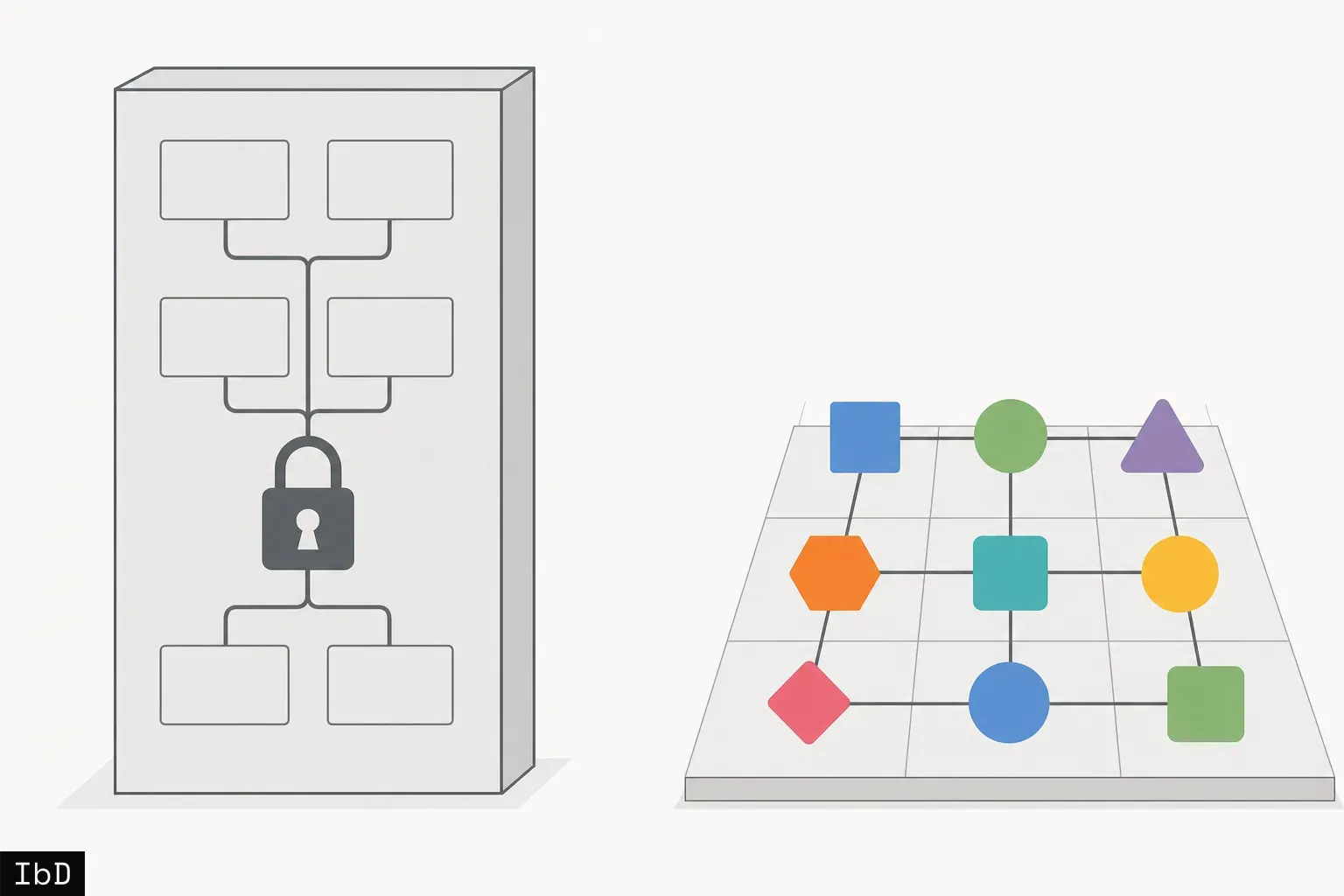
Private Agent Architecture:
User → Proprietary Agent Platform → Closed Identity & Payments → Downstream Economy

Public Rail Architecture:
User → Choice of Agent → Open Protocols (Identity | Consent | Payments) → Open Marketplace
India's Unified Payments Interface (UPI) and Open Network for Digital Commerce (ONDC) demonstrate this architectural decoupling.2 UPI allows banks, fintechs, and payment apps to compete on user experience without any single entity owning the underlying payment network. ONDC extends this principle to digital commerce, pushing interoperability down into the protocol layer rather than forcing merchants and buyers to reside within a single marketplace database.
3. The India Agent Stack: Standardizing Delegation
India's next digital public infrastructure opportunity lies in standardizing the primitives of delegation. Rather than focusing exclusively on foundation model production, an India Agent Stack can establish open protocols for agentic action:
- Identity: Who am I, and who is operating on my behalf?
- Consent: What specific data can this agent inspect?
- Mandate: What scope of actions is this agent authorized to execute?
- Discovery: Which protocols and services can the agent interact with?
- Transaction: How does the agent settle payments within defined limits?
- Credentials: What verifiable attributes can the agent prove to third parties?
- Audit: What immutable record remains after the action is completed?
- Revocation: How can human authority immediately suspend agent privileges?
This separates the agency stack into three distinct layers:
Intelligence → Delegation → Rails
Durable economic sovereign power resides in the rails through which delegation becomes legitimate and executable.
4. Where Transaction Rails Break Down: Infrastructure & Governance
While UPI and ONDC solved transaction interoperability, physical infrastructure governance presents a fundamentally different challenge. A payment either settles or fails; an order is fulfilled or cancelled. Infrastructure governance, by contrast, operates on messy, continuous physical reality without discrete B2C transaction events.
Consider something as mundane as a city road segment. Today, that road exists in fragmented departmental silos:
- GIS systems track spatial geometry.
- Municipal asset registers maintain administrative IDs.
- Contractor bills of quantities describe construction materials.
- Finance holds tender history and payment milestones.
- Citizen portals record geolocated complaints.
- Computer vision algorithms log pothole coordinates.
- Field engineers log manual inspection reports.
The fundamental infrastructure problem is not "Can AI detect a pothole?" The deeper problem is: Can every authorized system agree that Road Segment X, maintained under Contract Y, subject to SLA Z, has received valid evidence C to trigger administrative action D?
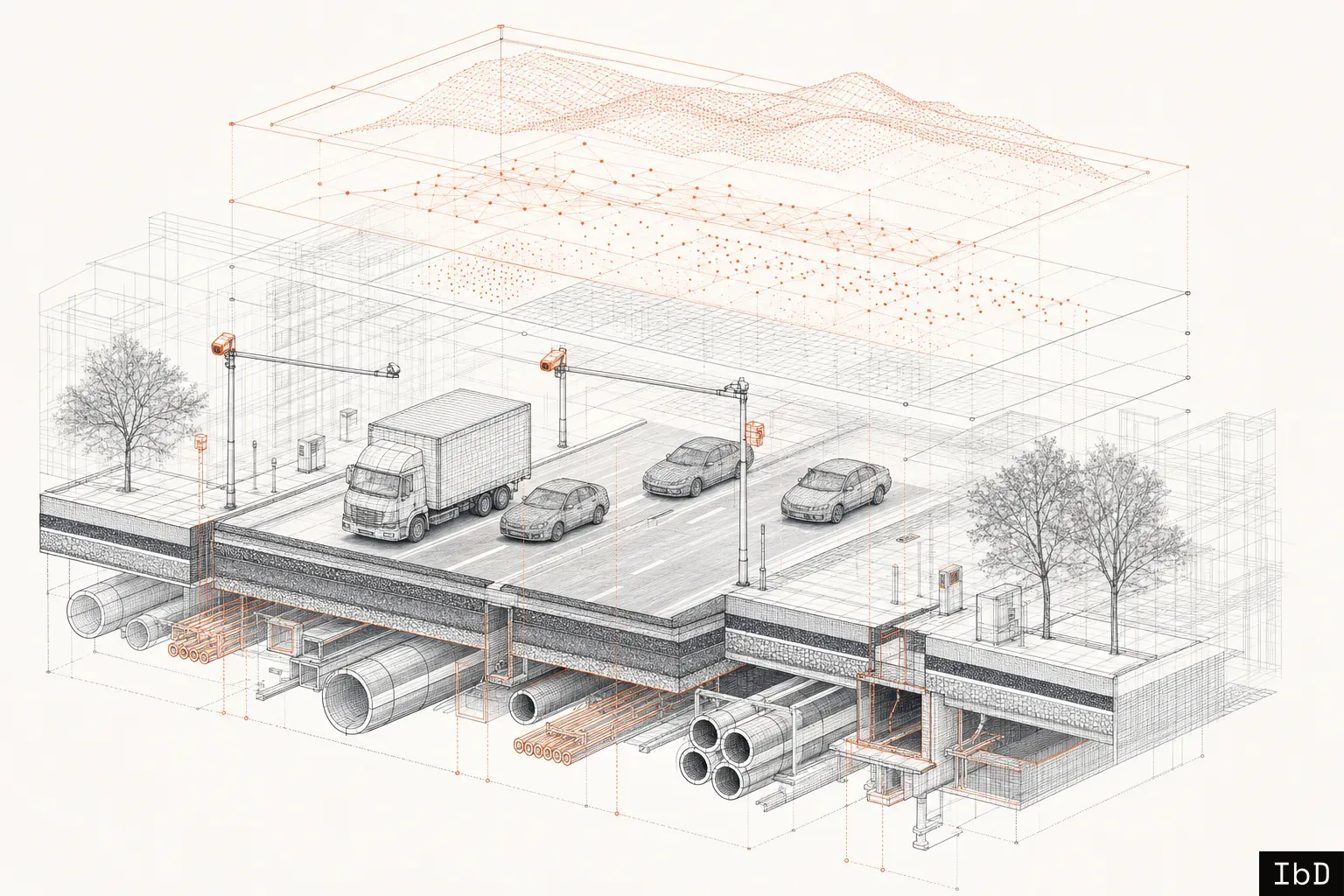
Layer 1: Reality          Canonical Urban Registry & Knowledge Graph
       ↓
Layer 2: Evidence         Multi-Source Sensor & Observation Stream
       ↓
Layer 3: Policy           Institutional Rules & SLA Logic
       ↓
Layer 4: Decision         Attributable Reasoned Lineage
       ↓
Layer 5: Execution        Automated Workflow & State Updates
The UPI analogy goes too far if treated as a direct architectural template. UPI coordinates digital organizations across standardized transaction endpoints. Governance, however, coordinates ambiguous physical reality where discretion, historical context, competing objectives, and budget constraints outweigh simple rule execution.
5. From Transaction Rails to Shared Institutional Memory
Instead of enforcing a rigid decision rail, public infrastructure must provide a shared state layer. The state should not commoditize discretion or local policy; it must commoditize the representation of physical reality and institutional lineage.
The physical world does not arrive with primary keys. A bank account has Account_ID = 739182, but a 270-meter damaged road stretch outside a university has no natural universal identifier. One department draws it as one segment; another splits it into three; a tender bundles it into a package; satellite vision sees pixels and GPS traces.
Continuous Institutional State Construction:
Physical World → Imperfect Observations → AI Reconciliation & Entity Resolution → Probabilistic State → Decision → Action → Updated World State
To prevent vendor lock-in, the state must maintain institutional continuity. If a single private technology vendor owns the mapping between physical reality, departmental databases, historical tenders, and decision logs, the vendor accumulates the state's operational memory. Switching vendors then becomes impossible—not because of contract terms, but because the state has ceded its own understanding of its territory.
6. The Reality-Interpretation Economy
In the AI era, the scarce asset is neither raw compute, generic foundation models, nor static datasets. It is the accumulated interpretation of the physical and institutional world.
Physical Reality → Perception → Entity Resolution → State Estimation → Institutional Meaning → Defensible Claims
An observation (a satellite frame, a CCTV clip, a citizen photograph) is not yet a government fact. An interpretation engine must continuously reconcile noisy, contradictory observations into trusted claims about reality:
- Perception: Converting raw sensor pixels into raw observations (pixels → pothole).
- Reconciliation & Entity Resolution: Mapping multiple records (camera clip + citizen complaint + GIS record) to the exact same physical asset (Road Segment 392).
- Institutional Interpretation: Linking the physical defect to administrative context (resurfaced 8 months ago under Contract 7281 → active defect liability period).
7. The Emerging 6-Layer Startup & GovTech Ecosystem
The transition to a reality-interpretation economy restructures the GovTech and startup landscape into six distinct layers:
| Layer | Category | Function & Moat |
|---|---|---|
| 1. Observation | Physical Evidence Market | Satellites, vehicle cameras, drones, IoT, utility telemetry, citizen feeds |
| 2. Perception | Foundation & Vision Models | Converting raw signals to observations (rapidly commoditizing) |
| 3. Reality Infrastructure | Entity Resolution & State Graph | Resolving spatial/temporal entities, sensor fusion, state estimation, provenance |
| 4. Domain Interpreters | Institutional Semantics | Vertical domain logic (road engineering, water networks, urban property, environmental rules) |
| 5. Decision Agents | Reasoners & Optimizers | Autonomous agents executing mandates over interpreted state (planning, audit, compliance) |
| 6. Execution Systems | Transaction & Workflow ERP | Municipal ERP, e-office, work orders, procurement, contractor disbursements |
PHYSICAL WORLD
  ↓
OBSERVATION MARKET (Satellites · CCTV · Dashcams · IoT · Citizen Feeds)
  ↓
PERCEPTION MODELS (Vision · Multimodal · Geospatial)
  ↓
REALITY INFRASTRUCTURE (Entity Resolution + Temporal State Graph + Provenance)
  ↓
LANDSCAPE / DOMAIN INTERPRETERS (Roads · Water · Property · Power · Environment)
  ↓
CLAIM LAYER (Attributable Claims + Confidence + Supporting Evidence)
  ↓
AGENT MARKET (Planning · Compliance · Audit · Resource Allocation)
  ↓
EXECUTION SYSTEMS (ERP · Work Orders · Procurement · Payments)
  ↓
PHYSICAL WORLD
The healthiest ecosystem is not built merely around open data, but around contestable interpretation. Multiple companies can observe, interpret, and reason over physical reality, while the public institution retains the raw evidence, canonical IDs, and decision lineage. By ensuring evidence survives the vendor and provenance survives the model, we prevent technology platforms from becoming the landlords of physical and institutional reality.
Footnotes
-
B. H. Baden-Powell, The Land-Systems of British India, Clarendon Press (Oxford, 1892). archive.org. ↩
-
National Payments Corporation of India (NPCI), Unified Payments Interface (UPI) Product Overview and Architectural Framework (2021) and ONDC Strategy Paper, Ministry of Commerce and Industry, Government of India. npci.org.in. ↩