
I. The Restaurant That Already Knew
I'd been walking since three. A meeting that ran long, then the decision to skip the cab and clear my head on foot - the kind of decision you make at 4 PM and regret by 6. By the time I saw the place - narrow, warm light, a door the colour of dark honey - I wasn't choosing a restaurant so much as choosing to stop. I pushed the door. Somewhere on my wrist the grey band shifted, a half-second buzz I'd long since stopped feeling, the way you stop hearing a clock.
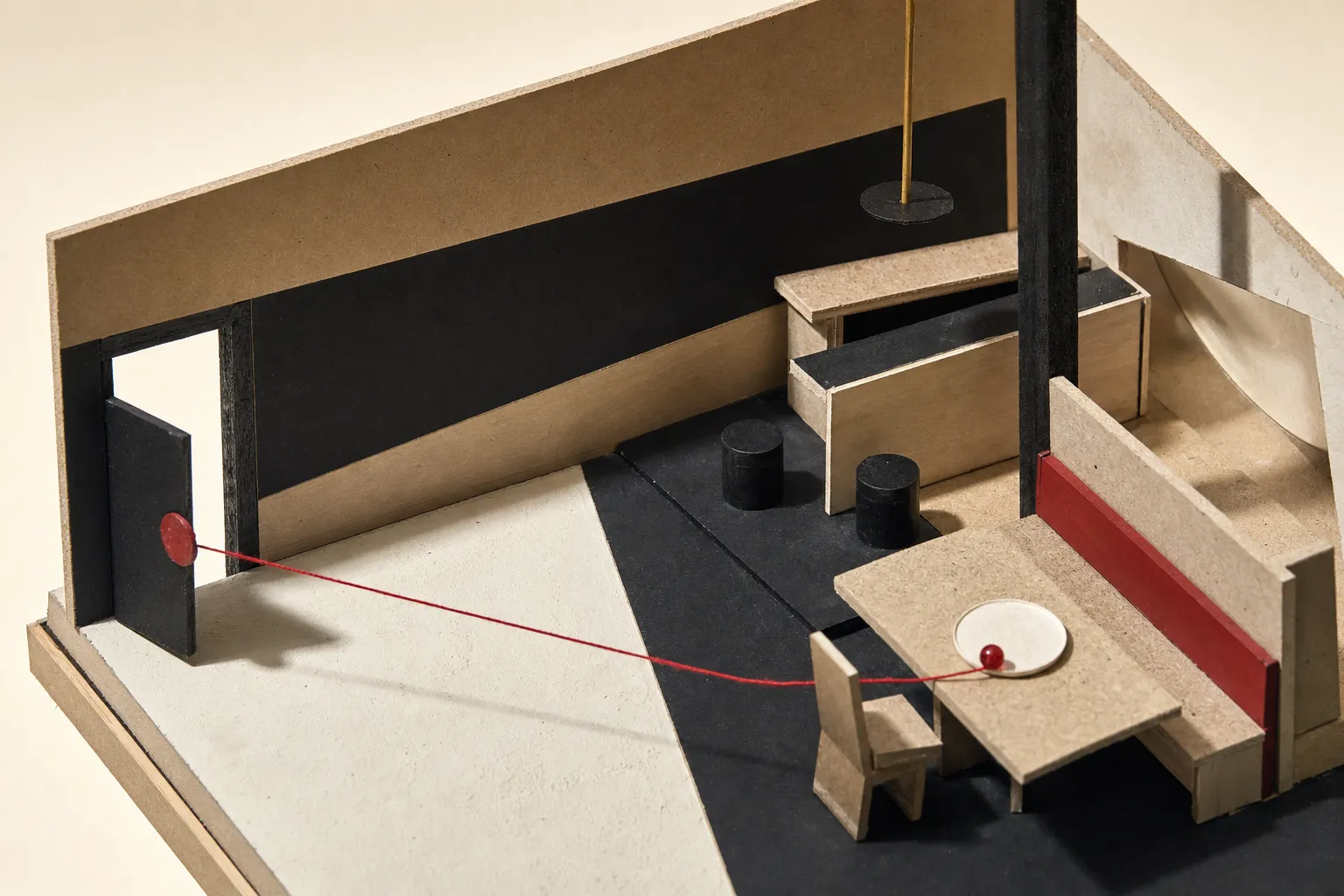
Inside it was cool and low and half-full. A woman near the window laughed at something on her plate. I took a small table at the back without being led there, and I remember thinking the room felt like it had been expecting a slightly larger crowd and settled, graciously, for me.
The drink arrived before I'd taken my jacket off.
Tamarind and salt, cold enough that the glass was already crying down its sides. I looked at it for a moment - I don't think I said anything - and then I drank half of it in one go, because it turned out I was thirstier than I'd admitted to myself, and because the salt was exactly, almost rudely, right. I assumed I'd ordered it. You do assume that. A thing appears in front of you and your mind quietly writes the memory of having asked for it, the way it stitches over a blink.
There was no menu on the table. Some old habit in me went looking for one before catching myself, the way your tongue finds the gap of a tooth that's been gone for years. Menus. Right. I let the reflex settle, and didn't think much about why it embarrassed me just a little.
I didn't order food either. I'm sure of that now, though I wasn't then.
It came twelve minutes later. Grilled, something dark and slow-cooked beside it, a little mound of rice that steamed when I broke into it. Heavier on protein than I'd have picked if I'd been picking, and lighter on the sweet, sticky things I actually wanted - the things I always want and always regret around nine, when the crash comes. I ate all of it. It was the meal you'd order for yourself on the one day a year you had perfect discipline and perfect appetite at the same time, which never happens, which is exactly why I never order it.
Halfway through I felt good in a way I couldn't place. Not full-good. Corrected-good. Like a note that had been slightly flat all afternoon quietly coming into tune.
It was only when I reached for the last of the drink - salt, again, and I thought why salt, why does the salt matter so much today - that the small things began, one by one, to lean toward each other.
The salt. The walk since three, no lunch, the long sweat of the afternoon. The protein and the slow rice and the absence of anything that would spike me before the crash I get, reliably, around nine. The drink that came before I'd asked. The food that came before I'd asked. The table nobody led me to. The room that had, I now understood, been expecting exactly one more.
And the half-second buzz at the door.
My band knew I'd trained that morning. It knew I hadn't eaten since noon. It knew, to the point on the curve, where my glucose was and where it was heading. It knew I was low on salt and water because it had been counting the whole walk. It knew all of this the way it always knows it, silently, for me and only me - except that for four seconds at the threshold, it had spoken. Not my records. Never my records. Just the shape of what I needed, handed quietly to whatever was listening on the other side of that honey-coloured door.
That was the menu I'd gone looking for, of course. It just hadn't been on the table, or on a screen, or anywhere I could pat with my hand. It had been the walk, and the missed lunch, and the training, and the hour, and the low tide in my blood - read, translated, and answered before I'd finished sitting down. I never placed an order because I never needed to.
I looked up. The woman by the window was gone. My glass was empty. And on the table, where a bill should have been, there was nothing at all - because that, too, had already been a conversation I wasn't part of, between something that was entirely me and something that had simply, politely, asked.
I hadn't decided a single thing since I opened the door.
And I could not, for the life of me, name one decision I would have made differently.
II. Why this is a near-term bet, not a far one
The scene above needs no new physics and no breakthrough in reasoning. Every component either exists today or is a straight-line extrapolation of something that does. What makes it plausible on a three-to-four-year horizon isn't the wearable - it's the chain of forces that pushes the wearable into existence, and each link in that chain is already under tension. Let me walk it.
The intelligence race makes ownership a strategic question
AI has become geopolitical infrastructure, the way steel and semiconductors were before it. When heads of state make sweeping public claims about AI leadership, they are signaling to their own enterprises that dependence on a foreign, closed, API-gated model is now a risk - commercial, regulatory, and national. The rational enterprise response to that risk is the same one it's always been when a critical input gets politicized: bring it in-house.
You can't bring a closed frontier model in-house. You can bring an open-weight one. That single asymmetry is the hinge the whole future turns on.
Open weights are where self-hosting actually happens
An enterprise that wants to own its stack needs weights it can run on its own hardware, audit, fine-tune, and never send a single token off-premise. The open-weight ecosystem is precisely where a great deal of recent competitive energy has gone, and a meaningful share of the strongest openly-released models have come out of Chinese labs. Set aside who's "ahead" this quarter - the durable point is structural: a strategy built on releasing capable weights creates exactly the substrate that self-hosting enterprises need, and a strategy built on gating capable weights behind an API does not. Whichever side leans into open release ends up owning the self-hosting default, almost regardless of raw capability at the frontier.
So the political pressure to own your infrastructure, plus the availability of capable open weights to own it with, produces the first flurry: a wave of enterprise self-hosting.
Self-hosting infra is a solved-enough problem, and getting cheaper fast
This wave doesn't require anyone to invent the tooling - it requires the existing tooling to get boring. Inference engines, quantization, serving frameworks, and orchestration on Kubernetes are all maturing quickly, and the confidential-computing primitives that let you run proprietary weights on hardware you don't fully trust are arriving on exactly the timeline this argument needs. The cost curve of running a strong model on your own silicon is dropping steeply. When a capability that used to require a hyperscaler contract becomes a Helm chart and a GPU box, adoption stops being a procurement decision and becomes a default.
What starts at the enterprise doesn't stay there
Here's the step that turns an infrastructure trend into a lifestyle one. Every prior wave of computing that began as enterprise infrastructure - the relational database, the web server, the container, the GPU - eventually got miniaturized, commoditized, and handed to individuals. The same forces that make an enterprise want a private, owned, always-on model make an individual want one too: privacy, latency, control, and the simple fact that a model that lives with you can know things about you that you'd never upload to someone else's cloud.
Once running a capable model privately is cheap and normal at the org level, the same stack shrinks to the person level. A model that is yours - that holds your health data, your preferences, your context, and never phones home - is the natural consumer endpoint of the self-hosting wave. Not because a company decides to sell it to you, but because the components fall into place and someone inevitably assembles them.
The body is the obvious sensor, so the model goes on the body
A personal model is only as good as its context, and the richest, most continuous, most decision-relevant context about a person is physiological. Wearables already stream heart rate, HRV, sleep, activity, temperature, and - increasingly, continuously - glucose. That's the exact signal set you'd need to answer what should this person eat right now. The wearable isn't a gadget bolted onto the personal model; it's the sense organ that makes the personal model worth having. So the personal model migrates to where the data is: onto the body.
Agents that talk to agents write the restaurant scene for us
The last link is the cheapest, because it's already being built. Models are becoming agents - entities that hold context, form intent, and negotiate on your behalf through machine-to-machine protocols. The moment my model can represent my intent and the restaurant's model can represent its menu, capacity, and kitchen state, the "order" is just a negotiation between two agents. No app, no menu, no waiter relaying a request. My agent says this person, right now, needs roughly this; their agent says we can do exactly this; and the drink appears.
The physical world becomes machine-readable first - inventory, menus, health, capacity all rendered as structured state - and then machine-run: the transactions between those states executed by agents without a human in the loop for each step. That's the same progression showing up everywhere agents are being deployed. The restaurant is just a vivid instance of it landing on your dinner.
III. What has to be true - and what could break it
I'm not claiming certainty. The chain has real weak links, and honesty requires naming them.
The strongest version of the counter-case is regulatory and social, not technical. Handing an agent the authority to act on your behalf - to spend, to order, to disclose even an abstracted intent - requires a trust and liability framework that doesn't fully exist yet. Health data crossing between your model and a merchant's, even in the deliberately thin "intent, not records" form of the story, will draw privacy law and public unease. And there's a real question of desire: some people will find the restaurant that already knew delightful, and others will find it a small horror, and that split matters for adoption.
There are technical soft spots too. On-device models capable enough to reason well about your physiology are heavier than today's wrist hardware likes; the compute-on-the-body part is the piece most likely to slip past four years, with the model perhaps living on a phone or home node and the wearable as sensor and relay. Agent-to-agent commerce needs interoperability standards that are still forming. And the "one side is favorably poised" premise is a snapshot, not a law - open-weight leadership can and does move.
But notice that none of these are capability objections. They're about trust, standards, hardware packaging, and taste - the kinds of frictions that slow a thing by a year or two, not the kinds that prevent it. The scene at the top of this piece doesn't wait on a scientific breakthrough. It waits on a series of commercial and political incentives that are already pulling in the same direction, plus the unglamorous work of making the pieces interoperable and legal.
That's what makes it a near-term bet. The future where your drink is already on the table isn't science fiction because the science is hard. It is only "science fiction" because we haven't finished plugging in the parts - and the plugging-in has very clearly begun.