
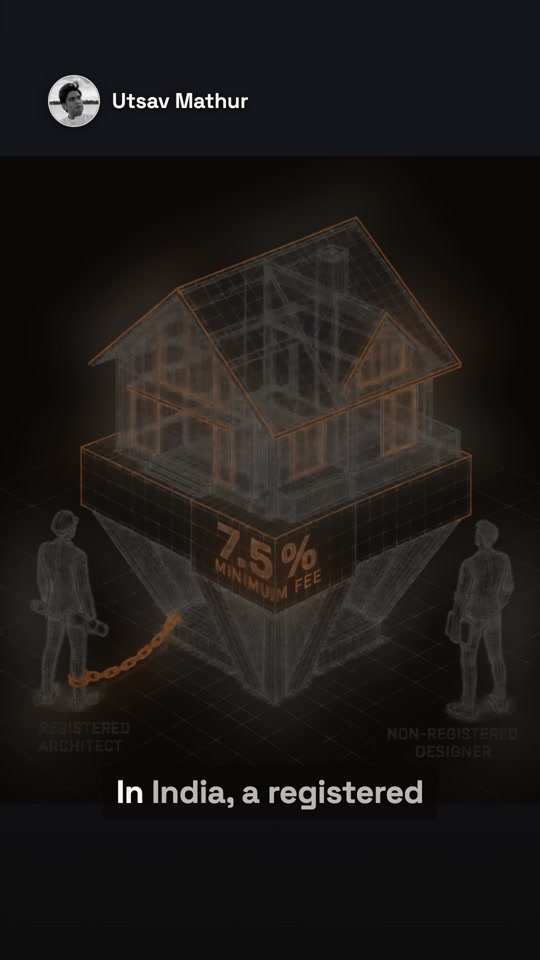
An architect in India may not legally charge less than 7.5 percent of construction cost to design a house. Anyone who is not an architect may charge whatever they like, and may design the same house.
Both halves of that are settled law. Together they describe a profession holding a price floor over a market it has no claim to, and the result is visible in who designs the overwhelming majority of Indian buildings.
The legislature was offered a monopoly and turned it down
The question reached the Supreme Court in Council of Architecture v. Mukesh Goyal, decided on 17 March 2020 by Justices Chandrachud and Rastogi. Section 37 of the Architects Act 1972 was argued either to bar unregistered persons from practising architecture, or merely to bar them from using the title.
The Court found the second. Reading the Statement of Objects and Reasons, it held that in protecting the public from untrained practitioners the legislature faced two options: bar them from the profession altogether, as it had done with physicians and advocates, or prevent them from calling themselves architects. It chose the latter and went to lengths to make that choice explicit. Engineers and others may design and supervise construction. What they may not do is take the title, which is also why the Court held that a development authority cannot fill a post named "architect" with someone unregistered.
So the Architects Act protects a word. The Advocates Act and the medical legislation protect a territory. This was a deliberate legislative choice, made in 1972 and reaffirmed by the country's highest court forty-eight years later.
The Council then put a price floor on a market it does not hold
Under the Architects (Professional Conduct) Regulations 1989, amended in 2003 and framed under the Act itself, the Council of Architecture prescribes a mandatory minimum scale of professional charges. For an individual or independent house it is 7.5 percent of the cost of works assigned, excluding land. Most non-housing work is 5 percent. Urban design falls to 1 percent. A further 10 percent of the professional fee is charged for documentation and communication in all engagements, with 18 percent GST on top.
These are minimums, not guidance. A registered architect who knowingly charges below the prescribed rate is in breach of professional conduct and exposed to disciplinary action under the Act.
The asymmetry is stated plainly in the profession's own commentary on the rule: non-architects offering the same services are not bound by the Council's regulations at all. The floor applies to exactly one group of people, and that group is the one with seven years of training.
The arithmetic removes architects from most of the country
Take a household building a ₹15 lakh house, which is an ordinary self-built outcome across most of India. The minimum fee is ₹1.125 lakh, and once documentation charges and GST are applied it lands near ₹1.35 lakh. That is close to a tenth of everything they have, for drawings.
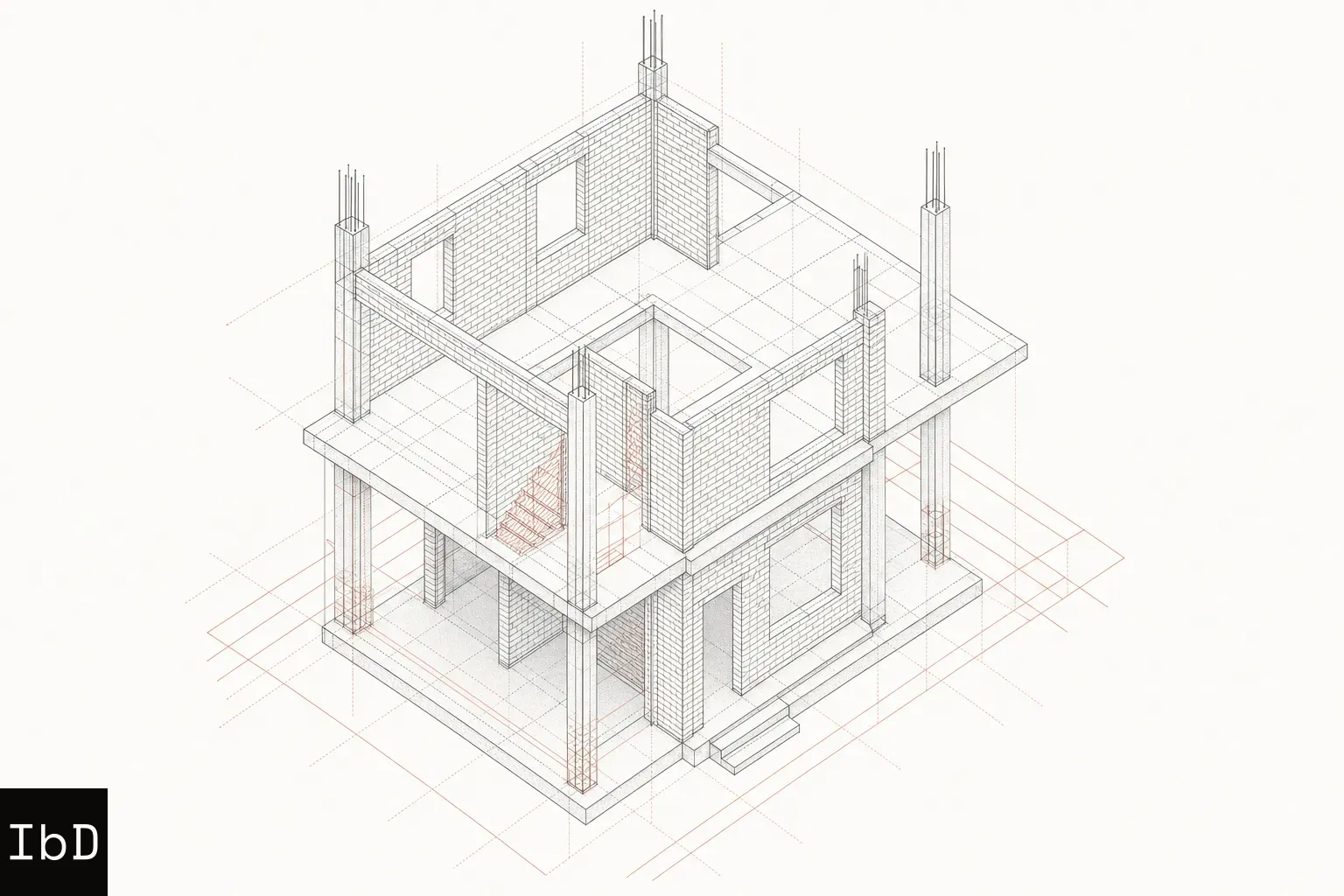
They will not pay it, and they do not have to. A 3D elevation from an online provider costs ₹1,999 and takes three days. That transaction is entirely legal for the people selling it and would be a conduct breach for a registered architect selling the same thing at the same price.
The floor does not raise architects' earnings in that segment. It removes architects from the segment, and the work carries on without them.
The comparison the profession reaches for is the wrong one
Indian architects arguing for the floor usually point at Britain and America. The record there is real. Britain's Monopolies and Mergers Commission required the RIBA to drop its mandatory fee scales in 1982 after roughly a century of them, the Office of Fair Trading forced the withdrawal of the recommended and indicative scales that replaced them, and by 2009 the RIBA had stopped publishing fee information altogether. The US Department of Justice took the AIA to a consent decree in 1972 that scrapped its fee schedule, and to a second in 1990 that barred the institute from restraining how architects price at all. Practitioners in both countries describe what followed as a race to the bottom, and they are not inventing it.
The part that gets left out is what each country kept. American architecture is regulated through state licensure, and in most states the statute restricts the practice rather than only the title. American architects lost the fee schedule and kept the territory.
India has no territory to lose. It is the only one of the three that took on the full cost of a price floor while holding the weakest claim to the market the floor was supposed to defend.
The register is growing into a market it is priced out of
Annual registrations with the Council ran at 3,411 in 2011 and 4,001 in 2013. By 2016 the figure was 7,306, by 2017 it was 9,631, by 2018 it was 13,912, and the year after that it passed 14,000. Intake roughly quadrupled inside a decade. The register now stands at around 145,900, and an analysis of the Council's own age data found 85.4 percent of registered architects to be 45 or under.
None of this indicates a saturated market. The Council's 2020 Perspective Plan on architectural education classifies fourteen states, Bihar, Assam, Arunachal Pradesh and West Bengal among them, as places where new colleges are needed. Bihar holds 1,168 registered architects against a state population its own 2022 survey put at 130.7 million, which is one architect for roughly every 112,000 people. The Council's own document records Tamil Nadu at one for every 9,503.
A twelvefold internal gap is not the signature of a profession that has run out of work. It is the signature of a profession that cannot reach most of the country at the price it is required to charge.
The floor is already being ignored, in the least useful way
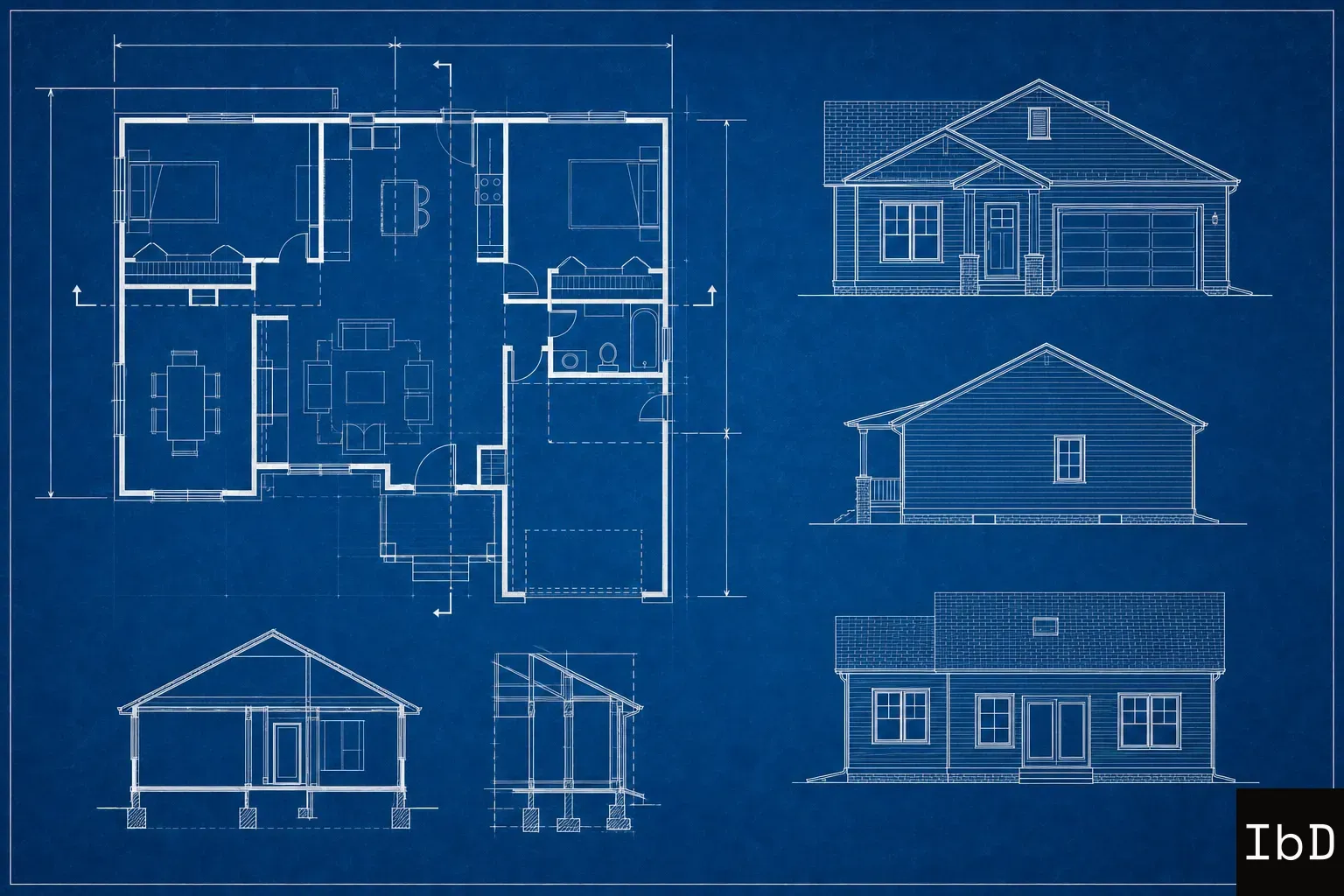
Residential architects in India quote between ₹30 and ₹60 per square foot for design-only work, against 5 to 10 percent of construction cost for full service. Those serving smaller projects, tier-two and tier-three cities and budget-sensitive clients routinely quote below the mandated minimum.
So the regulation's practical effect is not to lift fees. It is to make the only commercially viable way of serving a mass market a technical breach, which pushes that market toward entities the Council cannot reach. The online design businesses selling plans and elevations at four-figure prices are structured as companies, and a company with no registered architect responsible for its conduct sits outside the professional conduct regime entirely.
The rule intended to protect architects has handed the largest residential design market in the world to people it does not govern.
Three options, and the profession keeps asking for the one it cannot have
Reserve the practice. This is what most of the profession wants, and it requires Parliament to reverse a choice the legislature made deliberately in 1972 and the Supreme Court confirmed in 2020. It would also make design more expensive for exactly the households that currently receive none of it, which is worth saying out loud before campaigning for it.
Keep the floor and accept the consequence. This is the status quo, and it is coherent as long as it is stated honestly. It means conceding that Indian architects design for the top few percent of construction value and that everything below that belongs permanently to others.
Create a limited-scope tier with its own published fee. A registered architect could then sell a defined product, a plan and an elevation and a set of buildable details with no supervision attached, at a fixed price, without being in breach of anything. This is the only one of the three that sits inside the Council's existing power, needs no legislation, and reaches the segment where the buildings actually are.
Nobody is taking the work away from Indian architects. It was never given to them, and the fee floor is what stops them going to get it.