
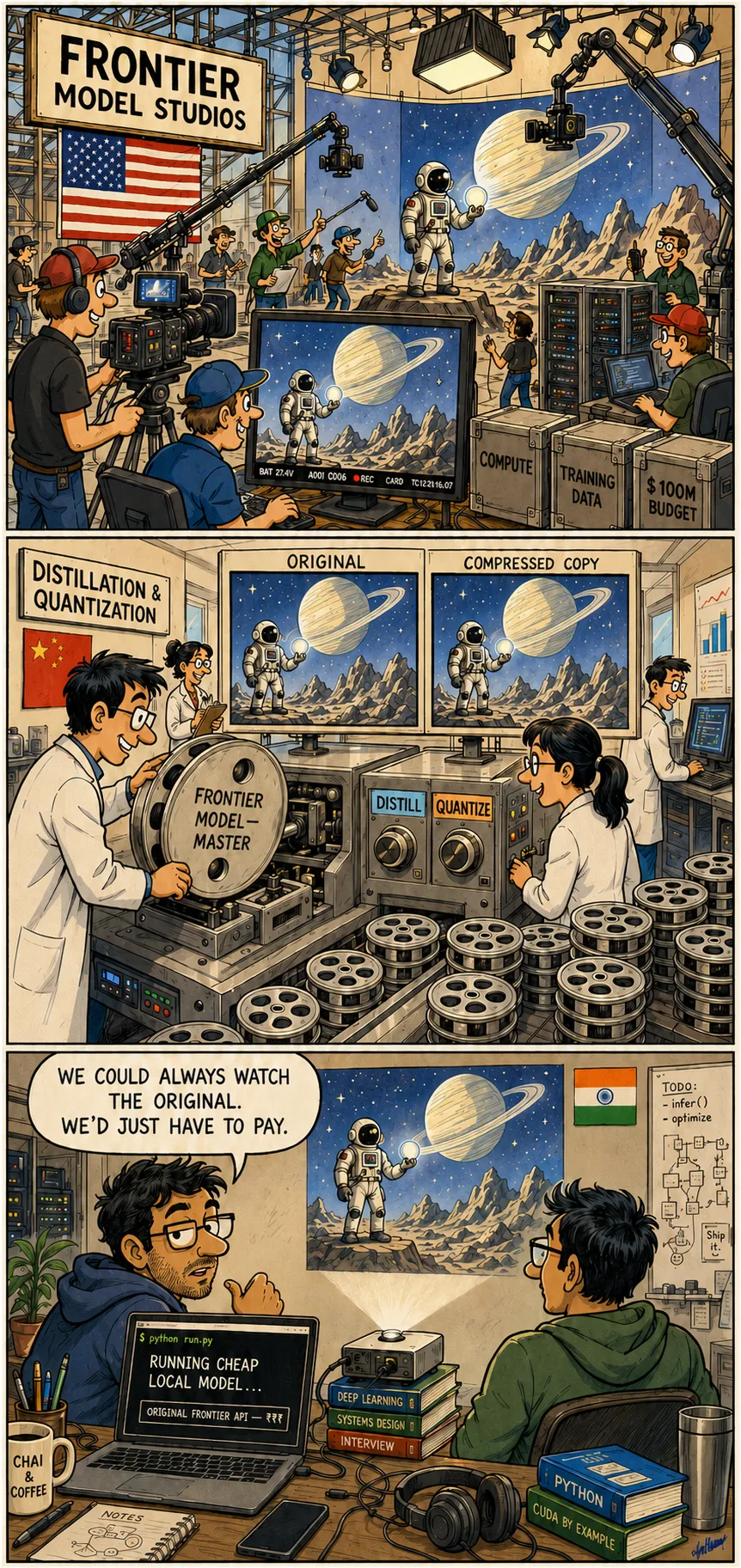
The compute topology of artificial intelligence is splitting into three distinct geographic functions. What begins as a multi-billion-dollar pre-training run in a desert data center ends as a quantized local asset running on a developer's desktop halfway across the world.
1. Frontier Pre-Training as High-Budget Production
Frontier models function like cinematic blockbusters. Training a trillion-parameter foundation model demands tens of thousands of liquid-cooled accelerators, nuclear-grade power purchasing agreements, and bespoke datasets. The resulting artifact is too heavy for casual distribution and too expensive to give away. To recoup capital, frontier labs encapsulate their weights behind API paywalls, charging by the million tokens consumed.
2. Distillation and the Compression Pipeline
A model trained on raw web scale carries immense structural redundancy. Open distillation labs take the outputs of frontier teacher models and train compact student architectures to replicate their reasoning traces. Paired with post-training quantization—reducing 16-bit floating point parameters to 4-bit or 2-bit integers—the massive master checkpoint is compressed by orders of magnitude with minimal loss in task accuracy.
Compression is the primary vector of AI democratization. Once a frontier capability is distilled into an open-weight format, it escapes the walled garden and becomes public infrastructure.
3. Local Inference and Zero-Marginal-Cost Compute
For the developer operating outside sovereign cloud boundaries or venture-backed budgets, API meters represent a continuous operational tax. Local inference changes the accounting entirely. Once a 7-billion or 14-billion parameter distilled model is downloaded to a local GPU or unified-memory workstation, the marginal cost per query drops to the price of local electricity.
The original frontier model remains sharper at the extreme edge of capability. But for ninety percent of software workloads, the distilled copy running on local silicon is not just good enough—it is free from latency, paywalls, and telemetry.