


For roughly thirty years, technology monetization relied on two convenient proxies for value:
- Services: people × hours × rate
- Software: people × seats × subscription
Both models rested on a single, unchallenged assumption: human time is the scarce unit. Services charged for the human effort required to deliver an outcome; software charged for the human attention that accessed a tool.
Generative and agentic systems break that assumption.
The deeper shift underway is not that software dies or services disappear. It is that the economic unit used to monetize knowledge work is vanishing. When human effort ceases to be the scaling factor, pricing models that measure human effort become value-destructive.
The Reverse Economics of Labour
Traditional IT services operate on an additive economic model. If an IT consultancy employs 100 engineers to generate revenue $X$, doubling revenue requires hiring another 100 engineers. In that environment, automation is economically awkward: eliminating 30 per cent of the workforce directly eliminates 30 per cent of billable revenue.
AI inverts that relationship.
Consider an AI-native services firm operating with ten domain specialists and forward-deployed engineers (FDEs), backed by frontier models, reusable agent frameworks, and proprietary workflow IP.
Old Model:  100 Humans × $100k billable  = $10M Revenue  ($8M Cost  → $2M Margin)
New Model:  10 Humans + Agents + IP      = $5M Fixed     ($1M Cost  → $4M Margin)
If this company continues charging per billable hour, it destroys 90 per cent of its own top line. If instead it charges $5 million for an outcome that previously cost the customer $10 million—while its own cost of delivery drops to $1 million—automation converts from a revenue destroyer into a margin multiplier.
Services are not becoming unattractive. Services without proprietary leverage are becoming unattractive, while services embedded in tacit context become indispensable. This explains the strategic push by frontier model labs to place Forward Deployed Engineers (FDEs) directly inside banks, retailers, and infrastructure providers. Raw intelligence alone does not know the unwritten institution—the informal exception workflows, which database field everyone silently ignores, which regulation actually dictates policy, or who holds real decision authority. FDEs discover and encode this tacit context once; agentic systems execute it thousands of times.
Selling labour and delivering services are no longer the same business.
The Seat-License Paradox in SaaS
SaaS discovered a remarkably simple billing engine in the seat license. Charging $50 per user per month tied software revenue directly to headcount growth.
Imagine an enterprise procurement department with 500 employees, each holding a seat for procurement software. Five years later, internal reorganization and agentic workflows leave 100 humans working alongside 400 autonomous agents.
Year 1:  500 Humans  × $50/mo = $25,000 / month
Year 5:  100 Humans + 400 Agents = ?
Charging for 100 human seats while the software performs five times the work it handled for 500 humans is economically irrational for the vendor and nonsensical for the buyer.
This misalignment explains why software pricing is migrating toward consumption, actions, and completed outputs. Yet tokens are not the final monetization unit either.
Tokens measure the vendor’s cost of intelligence, not the value created for the buyer. As inference costs decline, token consumption rises because systems run deeper loops, invoke more evaluations, and attempt more complex paths. Tokens represent the raw operational bill, not the measure of business value.
This shift marks the transition from Software-as-a-Service to Service-as-Software. Yet pure outcome pricing encounters an immediate real-world limit: attribution. If an infrastructure model predicts where urban flooding will occur and a municipal crew fails to clear the drain, who owns the flood? If an AI identifies a high-intent enterprise lead and a sales representative mishandles the call, who owns the lost contract? In enterprise deployments, buyers frequently prefer activity and work-unit pricing over pure outcome billing because arbitrating outcome attribution introduces immense operational friction.
The sustainable equilibrium pricing structure becomes hybrid:
The Scarcity Hierarchy
When raw intelligence becomes cheap, value bottlenecks migrate elsewhere. If models can reason, draft, code, analyze, and summarize cheaply, intelligence stops being the bottleneck. The bottleneck becomes whether the system possesses the context, authority, data, and accountability to do something useful in the real world.
The new scarcity reorganizes around seven layers:
- Context: Proprietary institutional knowledge, live data, exceptions, tacit rules, and unwritten customer reality.
- Judgment: Deciding what matters, which trade-offs to accept, and what risk threshold is permissible.
- Permission and Agency: The authority to execute inside enterprise systems—spending money, approving workflows, modifying records, and transacting.
- Trust: The willingness of an organization to let an autonomous system act without constant human verification.
- Distribution: Deep access to customer workflows, decision-makers, and embedded interfaces.
- Accountability: An entity willing to stand behind the outcome when failure carries consequences.
- Unique Real-World Data: Continuously refreshed observations that competitors cannot cheaply reconstruct or scrape.
| Economy | Scarce Thing | Commercial Unit |
|---|---|---|
| Industrial | Physical production capacity | Unit produced |
| IT Services | Skilled human labour | Person / hour |
| SaaS | Access to software tools | Seat / month |
| Cloud | Compute and storage infrastructure | Compute / storage |
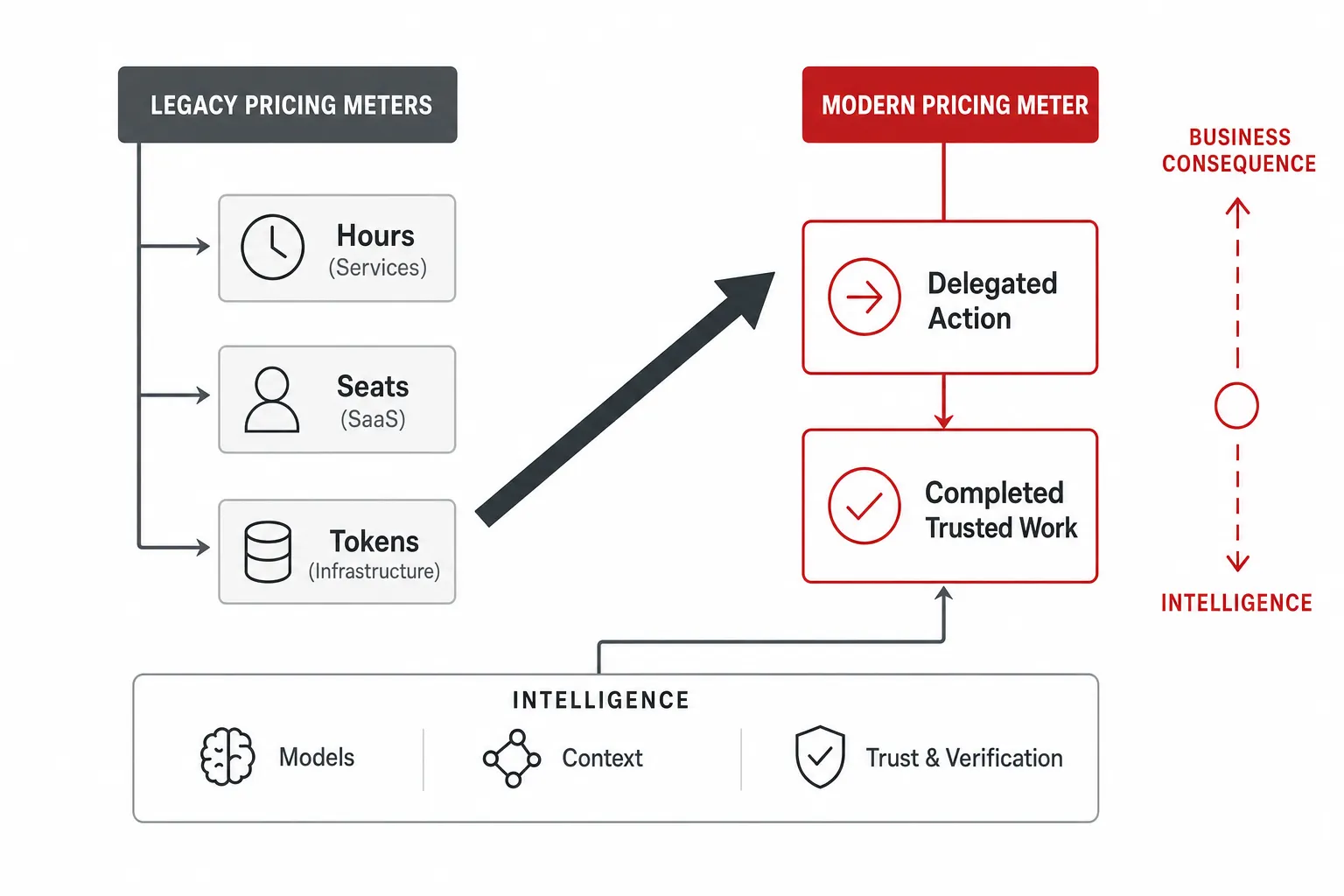
| Early AI | Intelligence consumption | Tokens |
| Agent Economy | Completed, trusted work | Action / workflow unit |
| Mature AI Economy | Business consequence | Outcome share |
The Commercial Unit: Completed, Trusted Work
The commercial unit that emerges from this shift is completed, trusted work. The scarce metric is no longer who did the work, but whether the work crossed the threshold from intelligence to decision to execution.
Instead of charging flat SaaS or billable human rates, monetization attaches directly to execution units:
- Real Estate: ₹X per property title verified
- Legal: ₹X per matter processed or diligence cycle conducted
- Infrastructure: ₹X per kilometre of road or asset assessed
- Procurement: ₹X per purchase cycle executed
- Insurance: ₹X per claim adjudicated
- Support: ₹X per customer issue resolved
- Urban Governance: ₹X per planning decision supported
┌─────────────────────────────────────────────────────────────┐
│                      Model Layer                            │
│           (OpenAI / Anthropic / Open Source)                │
└──────────────────────────────┬──────────────────────────────┘
                               │
                               ▼
┌─────────────────────────────────────────────────────────────┐
│                 Domain Intelligence Layer                   │
│         (Schemas, Ontologies, Evals, Rule Sets)            │
└──────────────────────────────┬──────────────────────────────┘
                               │
                               ▼
┌─────────────────────────────────────────────────────────────┐
│                   Workflow Factory                          │
│     (Agents, Integrations, UI Generation, Orchestration)    │
└──────────────────────────────┬──────────────────────────────┘
                               │
                               ▼
┌─────────────────────────────────────────────────────────────┐
│                Customer-Specific Product                    │
│             (Mass-Customized Executable Software)           │
└──────────────────────────────┬──────────────────────────────┘
                               │
                               ▼
┌─────────────────────────────────────────────────────────────┐
│                     Delegated Work                          │
│           (Completed, Trusted, Accountable Action)          │
└──────────────────────────────┬──────────────────────────────┘
Selling Delegation
In an abundant-intelligence economy, the ultimate scarcity is the right to decide. A model can generate 100 viable strategies for a municipality or enterprise. That does not mean the organization can execute 100 strategies. Someone must still choose one, allocate capital, absorb operational risk, and defend the decision.
The highest-value AI enterprises will sell neither software nor intelligence. They will sell delegation:
"You can give us this class of problem, and it will get handled."
This commercial contract resembles electricity, payments, or logistics infrastructure far more than traditional SaaS. Rather than paying for access to tools, the buyer purchases operational offloading.
The equilibrium pricing structure becomes three-tiered:
In government, civic, and infrastructure systems, raw insight is already cheap. The scarce capacity is turning messy, uncodified reality into a defensible decision that an official or executive is actually willing to sign off on and execute.
The Convergence of Software and Consulting
Mass customization collapses the distinction between product and service. Traditional software economics demanded strict standardization: build once, sell identically 10,000 times. Custom software was too expensive to scale.
AI enables common primitives to manufacture bespoke software applications for every customer. Forward-deployed engineers discover and encode institutional context once; workflow engines execute it thousands of times. The customer experiences something resembling bespoke consulting; the supplier experiences something resembling software margins. Consulting becomes executable software, while software becomes individually tailored service.
The defining strategic question for technology firms becomes:
What proprietary asset allows the enterprise to deliver the next unit of valuable work at a dramatically lower marginal cost?
Whether that asset is an ontology, a corpus of historical decisions, deep system integrations, distribution, or privileged access to cheap compute, the rule holds: endangered businesses are those that price on eliminated scarcity.
The winners will locate the new scarce unit and put the meter there.