

There is a phone call that owners of small businesses dread. In a remote hotel it is the cook saying he is going home for a family function and is not sure when he will be back. In a machine shop it is the one man who can set up the CNC. In a clinic it is the technician who knows what the old analyser does when it throws error 14.
What follows is never a staffing inconvenience. It is a slow collapse. At the hotel, the next guest checks in on Friday. Breakfast is fine, because breakfast is always fine. Dinner is where it shows. The kitchen helper, who has spent two years watching, can cut and boil and fry but cannot season. The food goes out anyway. By Sunday there are two reviews on the internet that will sit there for three years, and the property has lost more in forward bookings than it spends on that cook in a decade.
Every small business sits one or two people away from this. The scarce input is never labour. Labour without talent can be arranged in a week. What cannot be arranged is judgment that lives in somebody's hands and has never been written down.
Which is why one sentence from Anthropic this week is worth more attention from operators than it is going to get. Describing the Model Hardware Standard, released Thursday as a research preview, the company said the point is to let AI agents understand how a piece of hardware works without depending on paper manuals or on tacit knowledge that sits with a handful of experts 1.
That is not a robotics announcement. That is the small business problem, described by an AI lab, about machines.
A standard for the physical world
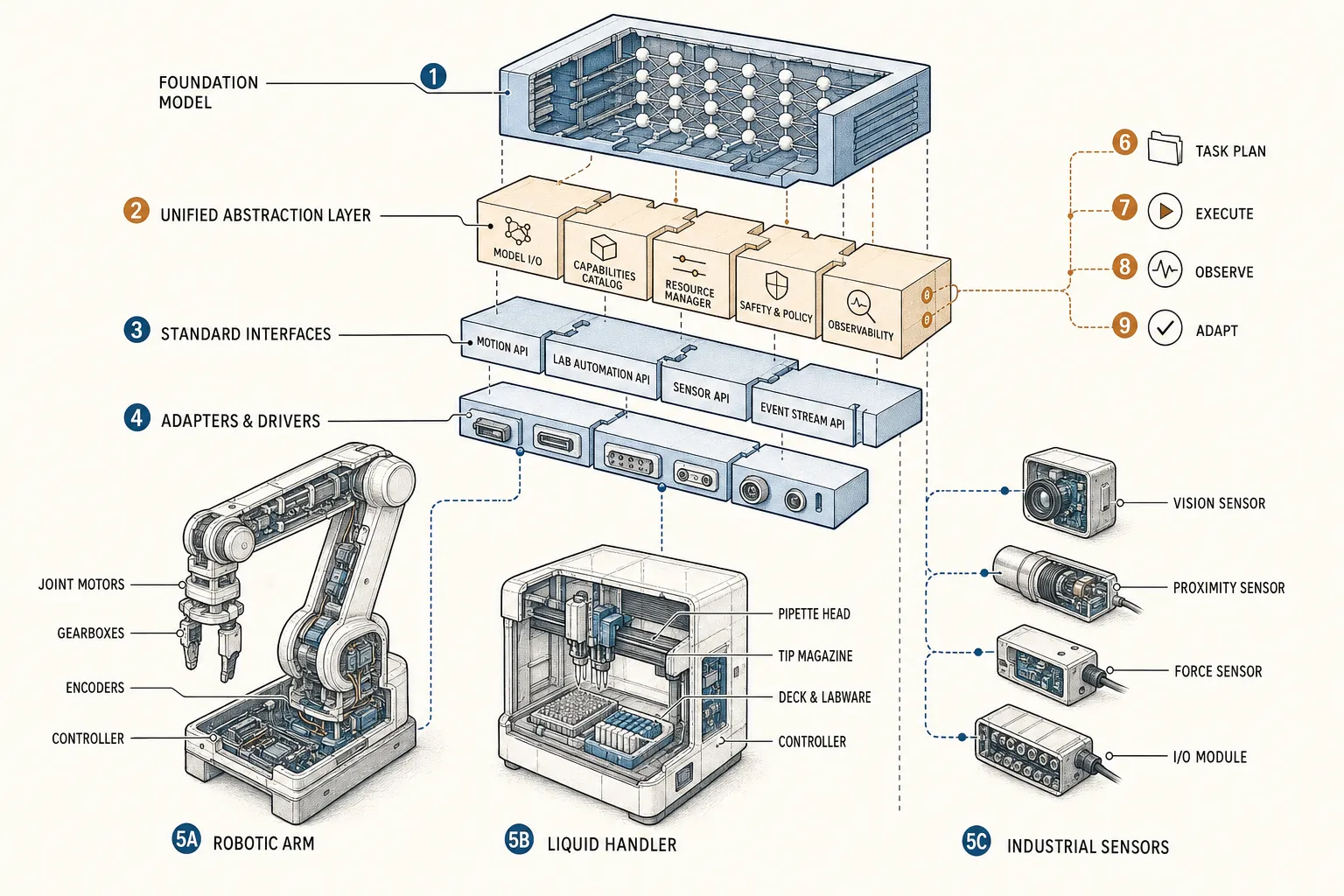
MHS is a shared specification that lets AI agents discover, communicate with and operate programmable hardware: microscopes, liquid handlers, robotic arms, instruments inside quantum computers 12. It is model agnostic, so it is not a lock-in play for Claude, and Anthropic says it will open source it once the preview closes 34.
The partner list is not a toy list. Genentech ran a protein assay coordinated across a liquid handler, a robotic arm and a plate reader. Doosan Robotics is testing it on robotic arms for automated quality assurance and multi-robot coordination. AWS is supporting it through its Strands Robots library. Carnegie Mellon, Danaher, Automata and HHMI Janelia, where the work started, are all in 45. The claimed effect is device integration falling from weeks to hours 5.
Integration time is the whole game. It is why a robot arm costs several times its sticker price to actually deploy, and why nobody sells one to a business with fewer than fifty staff.
Cheap bodies, open brains
Set that against the rest of the year.
In 2024 you could not buy a humanoid at any price. Today you can order one online for $4,290. Unitree's R1 starts near $4,900 and the G1 at $13,500, against $90,000 for the H1 two years ago 67. Somewhere between 13,000 and 18,000 humanoids sold globally in 2025, roughly ninety percent Chinese-made. AgiBot shipped its ten-thousandth robot in March. Unitree cleared STAR Market IPO registration in July, targeting around 20,000 units for the year 6.
The software layer is consolidating just as fast, and most of it is open. NVIDIA released GR00T N1 in March 2025 as an open foundation model for humanoids. Hugging Face's LeRobot and SmolVLA push small open vision-language-action models onto consumer hardware. Physical Intelligence's π0 is partly open. Unitree open-sourced UnifoLM-VLA-0 in March 2026, a twelve-task manipulation model built on Qwen 2.5 VL, alongside a large open teleoperation dataset 89.
Then this. LeRobot v0.5.0, also March 2026, added full G1 support with ACT, Diffusion, π0 and GR00T all compatible 9. One open library, one commercial humanoid, four interchangeable brains.
The capital has followed. Global robotics and physical AI funding reached roughly $55.8 billion by early June 2026, close to double the previous full-year record 10. Travis Kalanick's Atoms raised $1.7 billion in July, led by a16z, with Uber participating and Ben Horowitz joining the board 1112. Barclays has a trillion-dollar market by 2035 on the table 3.
Every bottleneck in robotics that stayed hard for forty years turns out to be a data and intelligence bottleneck, and those are the ones falling fastest. Grasping a wet plate of unknown shape was a research problem in 2020. It is a checkpoint you download now. What used to need a robotics PhD per site is collapsing into a model, a driver and a config file.
Hardware is moving from the other direction. Chinese manufacturers are treating humanoids the way they treated drones and electric two-wheelers: produce first, cut price annually, take margin later, backed by industrial policy. A $4,290 humanoid today is a $2,000 humanoid in three years with better actuators, because that is what has happened in every category they have entered. At that price the machine stops being capital equipment and becomes a consumable you replace rather than repair, which dissolves most of the careful arguments against fast timelines, including the ones about service networks.
Four years to a humanoid doing dishes in an ordinary kitchen is not a wild claim on those curves. Dishwashing is close to the ideal first task: fixed location, high repetition, tolerant of slowness, cheap to get wrong, nobody's competitive advantage. People have been consistently wrong about pace here for three years running, and betting against it now, on the grounds that the last mile is always harder than it looks, is the bet that was made against language models in 2021.
Where the machines actually are
The prices above are partly an illusion, and the detail matters.
Unitree's $13,500 base G1 ships with no SDK access. It walks, balances, performs its built-in routines, and will not run your code. The real developer entry point is the G1 EDU at around $43,500 67. The cheap humanoid in the videos is a demonstration unit, and much of the public excitement is priced off the prop rather than the product.
Underneath that sits the constraint every serious survey of the field names: there is nowhere near enough real manipulation data, and it does not scale the way text did, because every hour of it requires a machine in physical contact with the world 8. Simulation narrows the gap without closing it.
Then everything that has nothing to do with intelligence. Spare actuators. Voltage stability. Dust and monsoon humidity. A robot arm that throws a joint error in a remote location is a hard stop with a technician three hundred kilometres away, which turns an intermittent human failure into an unrecoverable mechanical one in exactly the place where recovery is hardest. Certification is a real gate: joint torques on a G1 are high enough that contact at speed injures people, and operation near uncontrolled groups is not certified 9.
Follow the deployments and the pattern is unmissable. Miso Robotics has spent a decade and about $65 million on a fry-station robot for high-volume QSR 13. Chef Robotics raised around $43 million and is pushing further into packaged food manufacturing rather than restaurants 14. Keenon has over 80,000 service units out, overwhelmingly in dense Asian cities. Hilton's Relay rollout passed 400 properties, delivering towels in select-service brands. Pudu is building a fully robot-serviced hotel in Shenzhen, phased through 2030 151617.
High density. High repetition. Rich service networks. Not one of them is a fourteen-room property four hours from a city.
Japan's Henn na Hotel gets quoted too glibly by both camps. It went robot-first, retired a large share of the fleet in 2019 when novelty gave way to maintenance, and has still grown to around twenty locations 15. Both halves are true, and people tend to quote the half they arrived believing.
Nobody knows which clock is running
Strip the noise and the disagreement is narrow. It is about which bottleneck binds.
If it is intelligence, timelines compress, because intelligence is falling on a software curve and software curves are merciless. If it is everything downstream of intelligence, timelines hold, because spares and power and certification and a technician in a small town sit on infrastructure curves, and infrastructure takes a decade for the same reason roads do.
There is no honest way to settle this from the outside. The people with billions committed have not settled it either. Ben Horowitz is betting on specialised machines rather than humanoids, which is a bet that the general-purpose curve is slower than it looks 18. Kalanick is building inside real estate he already controls, which is a bet that deployment environments matter more than machines. Both are hedges dressed as convictions.
Written down, or watched
The natural response to uncertainty is to build the thing that pays off either way, and there is an obvious candidate.
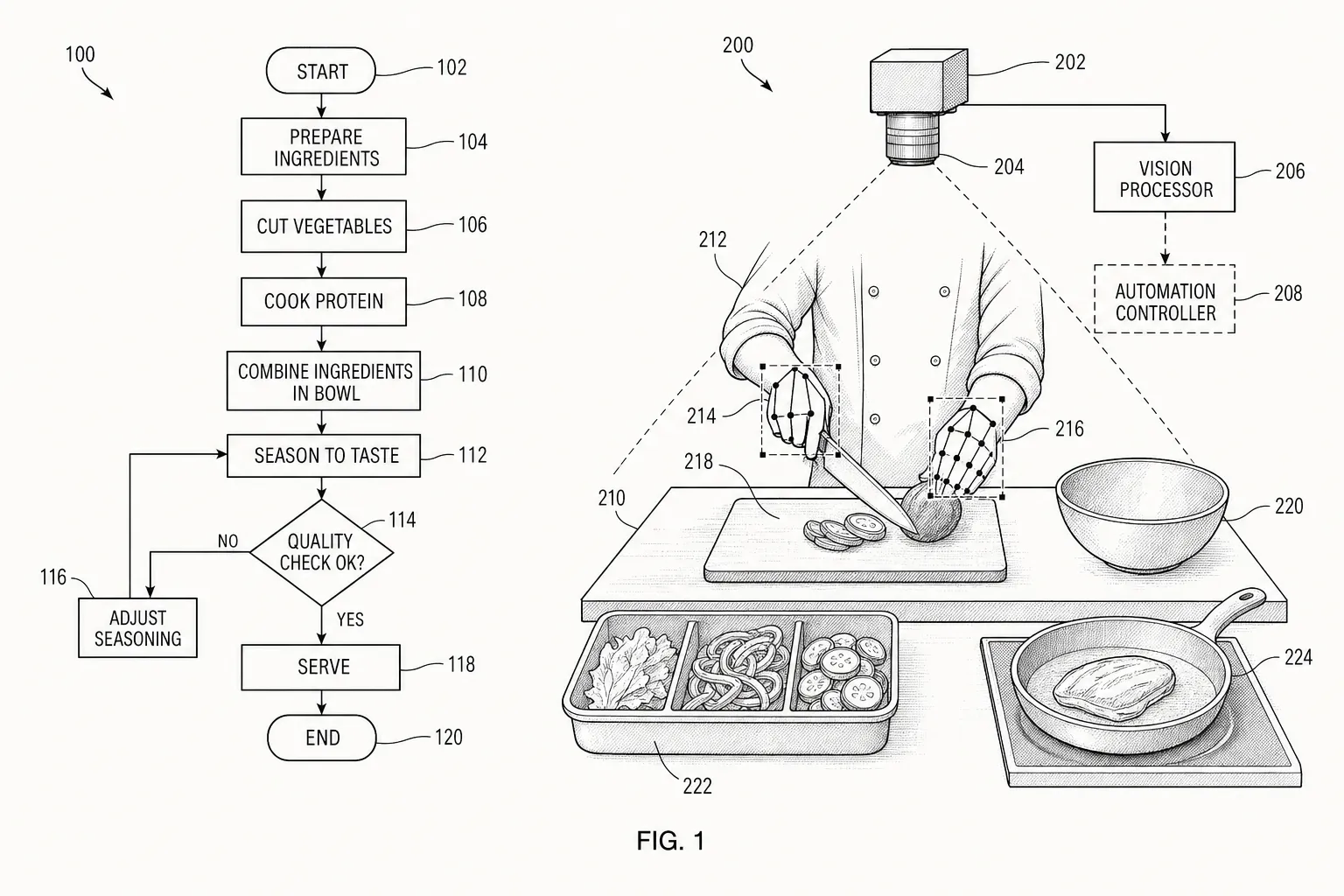
The value in small business automation was never in the machine. It is in the encoded process. The McDonald brothers solved chef dependency in 1948 without a robot, by moving judgment out of a person's hands and into specification, portioning and purpose-built equipment. In hospitality today that means standardised components on a cold chain, machines running fixed profiles, and a menu a semi-skilled operator executes without judgment. India already manufactures the equipment. Mukunda Foods in Bengaluru has shipped it since 2012: Dosamatic, Wokie for Indian and Asian gravies, Rico for rice and noodles, Doughbot for rotis, an E-Pan for regenerating pre-cooked items. Thousands of installations, customers including ITC, Rebel Foods and Chaayos, a Series A led by Zomato 192021. Their own executives have said the driver of automation in India is not shortage of labour but shortage of skill, which inverts the American churn story completely 19. Almost nobody in hospitality is looking at it, because none of it is marketed as robotics.
Do that and you have not just deskilled a kitchen. You have written the property down. The recipes are policies. The components are a defined action space. The workflow exists in the form a standard like MHS consumes. When a general-purpose machine gets cheap enough to drop in, that site swaps hardware while everyone else starts from zero.
Except that argument may be exactly backwards.
The entire premise of MHS, and of imitation learning, and of every vision-language-action model in the list above, is that tacit knowledge no longer has to be written down. Anthropic's stated purpose is a world where the agent does not need the manual. If that lands, then four years spent documenting how your kitchen works is four years spent building a moat out of the one thing the machine acquires by watching. The operator who wrote nothing down and simply bought the robot in 2031 arrives at the same place, having skipped the hard part. Documentation has been the losing side of that trade before. Every expert system built in the 1980s was somebody carefully writing down what they knew, and a statistical model ate all of it.
So the safe move might be the wasteful one. It depends entirely on whether the machine needs to be told or only needs to be shown, and that question is genuinely open.
What gets lost either way
There is a second problem underneath, and it does not resolve on any timeline.
Small businesses often sell the opposite of standardisation. The local cook cooking in the local style is frequently the reason the booking happened. The irreplaceable man is not only the risk. He is the product. Solving the dependency and destroying the differentiator may be the same act performed once.
The buffet at a 300-room business hotel should be automated and nobody will mourn it. The mutton at a homestay in Coorg is a harder call, and it is the sort of call that gets made in a hurry, by an owner who has just spent a bad season covering for someone who left. Most of these decisions will not be made by futurists. They will be made on a Thursday, by someone tired.
Two smaller things, since they always come up. Transparency is a real feature and has nothing to do with robots: a live prep feed or a clip attached to the order is testable this quarter with a camera and a QR code, and post-pandemic hygiene expectation already sits among the demand drivers analysts cite for hospitality robotics 15. The catch is that you are publishing evidence, and every bad day becomes permanent. And the robot dog carrying luggage, where these conversations always end up: Unitree's B2 is rated at 120kg standing but just over 40kg walking, which is two suitcases 2223. It is mostly a photo op. Though photo ops drive direct bookings, and novelty deployments are how service networks and operator familiarity get built in the first place. The prop may well be how the product arrives.
The thing nobody can price
Set the two pictures side by side and neither dissolves.
Bodies are getting cheap on a curve that has embarrassed every sceptic for three years. Brains are becoming open, interchangeable and free. A standard for talking to machines went into preview this week and will be open sourced. On that evidence, a humanoid stacking plates in a small hotel by 2030 looks less like a forecast than a schedule.
And a robot arm still cannot get itself repaired in a hill town, the cheap humanoid still will not run your code, there is still not enough manipulation data, and every deployment that has actually worked has happened in a dense city with a service network attached.
Both of those are true today. They will both still be true for a while, and the interval between them is where every small business owner has to make a decision without the benefit of knowing which one was the real constraint.
What is worth saying is that this last mile has never been walked by labs or by factories. Neither will work out what a fourteen-room property in Himachal needs, get a technician there, or convince the owner. Somebody local does that, or it does not happen. That part has not changed and probably will not.
Whether they should start now, and with what, is the question. I do not think anyone has earned the right to be confident about the answer.
Footnotes
-
The Japan Times / Bloomberg, "Anthropic tests new way for Claude to work with robots and scientific lab tools", 28 August 2026 — https://www.japantimes.co.jp/business/2026/08/28/tech/anthropic-claude-ai-robots/ ↩ ↩2
-
Tech Startups, "Anthropic launches Model Hardware Standard to let AI agents control physical machines", 27 August 2026 — https://techstartups.com/2026/08/27/anthropic-launches-model-hardware-standard-to-let-ai-agents-control-physical-machines/ ↩
-
CNBC, "Anthropic pushes into physical world with new standard to help AI agents operate machines", 27 August 2026 — https://www.cnbc.com/2026/08/27/anthropic-pushes-into-physical-world-with-new-standard-to-help-ai-agents-operate-machines.html ↩ ↩2
-
PYMNTS, "Anthropic Previews Standard for AI Control of Physical Devices", 27 August 2026 — https://www.pymnts.com/news/artificial-intelligence/2026/anthropic-previews-standard-for-ai-control-of-physical-devices/ ↩ ↩2
-
Quartz, "Anthropic Model Hardware Standard connects AI to lab equipment", 28 August 2026 — https://qz.com/anthropic-model-hardware-standard-ai-robots-lab-equipment-082826 ↩ ↩2
-
RobotSourced, "Humanoid Robot Prices: From $4,290 to $170,000+ (2026 Guide)" — https://robotsourced.com/pricing/humanoid-robots/ ↩ ↩2 ↩3
-
RoboZaps, "Unitree G1 Price 2026: From $13,500, EDU Cost & Full Specs" — https://blog.robozaps.com/b/unitree-g1-review ↩ ↩2
-
Humanoid Hub, "Robot Foundation Models: 2026 landscape" — https://humanoid-world.com/en/foundation-models/ ↩ ↩2
-
ZMProbots, "Unitree G1 Humanoid Robot: The Complete 2026 Guide" (LeRobot v0.5.0 support, UnifoLM-VLA-0, safety limits) — https://www.zmprobots.com/blog/unitree-g1-complete-guide-2026/ ↩ ↩2 ↩3
-
Dealroom data on global robotics and physical AI funding, 2026 year to date, as cited in coverage of the Atoms round — https://www.investing.com/news/stock-market-news/kalanicks-atoms-raises-17b-in-a16zled-round-for-industrial-ai-4807057 ↩
-
TechCrunch, "Travis Kalanick's robotics company raises $1.7B, led by a16z", 22 July 2026 — https://techcrunch.com/2026/07/22/travis-kalanicks-robotics-company-raises-1-7b-led-by-a16z/ ↩
-
MLQ News, "Travis Kalanick's Atoms Raises $1.7B Led by a16z, With Uber as Investor" — https://mlq.ai/news/travis-kalanicks-atoms-raises-17b-led-by-a16z-with-uber-as-investor/ ↩
-
Miso Robotics company profile and funding history, Tracxn — https://tracxn.com/d/companies/miso-robotics/__ztpUbuojzKKzyiH3gIXBuMSL7BvaPSdWC8YthHzmWi0 ↩
-
Chef Robotics company profile and 2026 product expansion, Tracxn — https://tracxn.com/d/companies/chef-robotics/__ay3hGWqv7pvqyV-3mAPooHpdlYPGiPBXN_cM3_6WjTs ↩
-
Market Research Future, Hospitality Robot Market report (Keenon deployments, Hilton and Relay rollout, Henn na expansion, demand drivers) — https://www.marketresearchfuture.com/reports/hospitality-robot-market-26539 ↩ ↩2 ↩3
-
The AI Insider, "Pudu Robotics Partnering to Develop Full-Scenario Robot-Serviced Hotel", June 2026 — https://theaiinsider.tech/2026/06/01/pudu-robotics-partnering-to-develop-full-scenario-robot-serviced-hotel/ ↩
-
Interesting Engineering, "World's first hotel run entirely by robots planned by China's Pudu", June 2026 — https://interestingengineering.com/ai-robotics/world-first-hotel-robot-china-pudu ↩
-
Ben Horowitz on specialised versus humanoid robots, a16z, July 2026, as reported by The AI Insider — https://theaiinsider.tech/2026/07/23/travis-kalanicks-physical-ai-startup-atoms-raises-1-7b-in-funding-led-by-a16z/ ↩
-
The Spoon, "From Dosas to Biryanis, Mukunda Foods is Automating Indian Cuisine" — https://thespoon.tech/from-dosas-to-biryanis-mukunda-foods-is-automating-indian-cuisine/ ↩ ↩2
-
Restaurant India, "Mukunda Foods raises $5 mn from Zomato as part of Series A round" — https://www.restaurantindia.in/news/mukunda-foods-raises-5-mn-from-zomato-as-a-part-of-series-a-round.n20265 ↩
-
The Better India, "Startup's Robot Chefs Have Automated 3000 Kitchens in 22+ Countries" — https://thebetterindia.com/299762/dosa-to-noodles-mukunda-foods-kitchen-automation-startup-robot-chefs/ ↩
-
Unitree Robotics, B2 product specifications — https://www.unitree.com/b2/ ↩
-
Unitree Robotics, B2 launch announcement, 120kg standing load and over 40kg continuous walking load — https://shop.unitree.com/blogs/news/unitree-robotics-releases-industrial-quadruped-robot-b2-breaking-through-limits-with-hyper-evolution/ ↩