
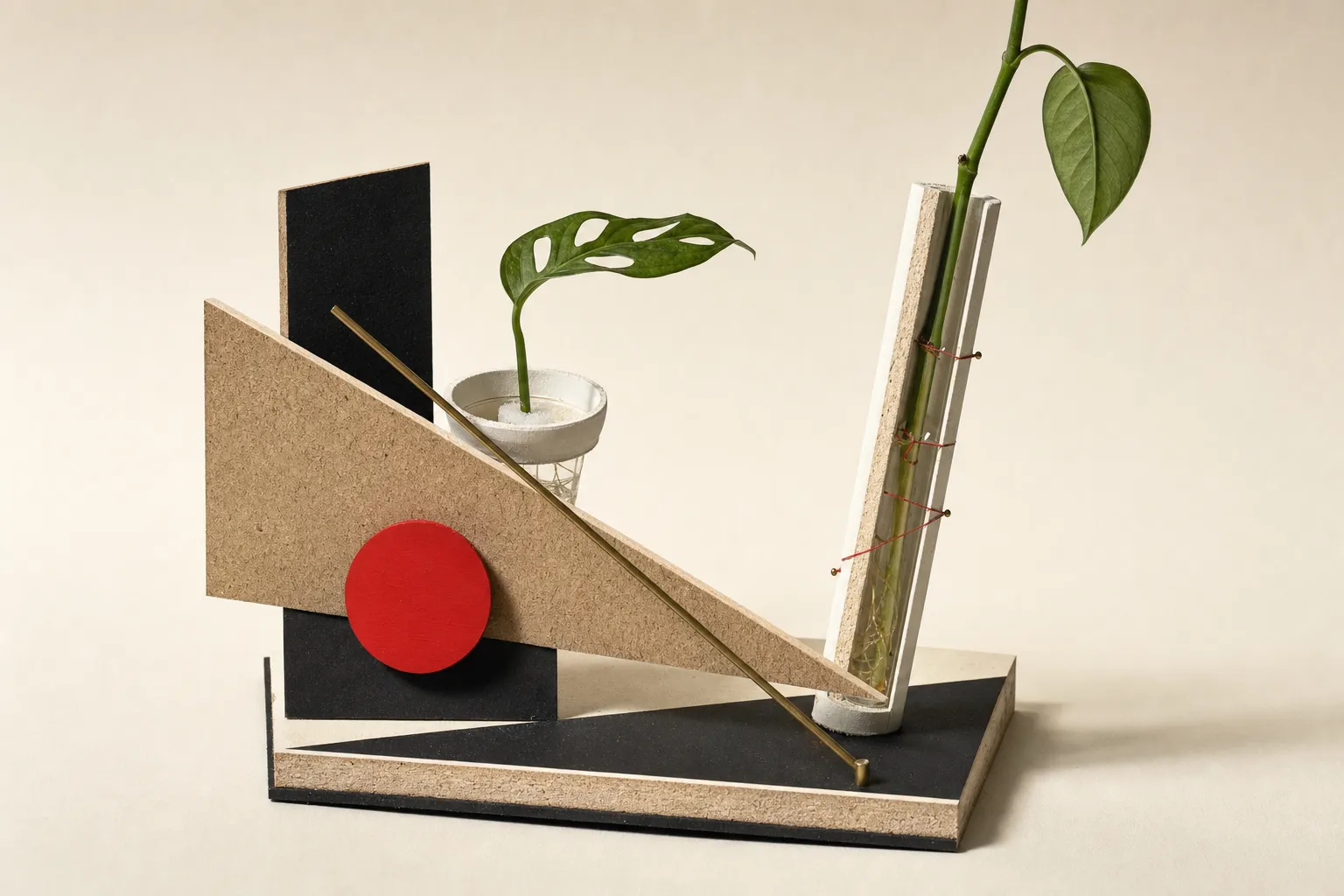
Some years ago my mother finished her evening tea and, instead of throwing the dregs away, poured the leftover water into a small glass holding a single severed leaf. She kept doing this daily, out of some private curiosity. The leaf did not wilt. It did not politely survive. It grew, alarmingly, for more than two months, on nothing but the runoff of a tea habit.
At the time this seemed unreasonable to me. It is actually the most ordinary fact in botany: plants have no vital organs. No heart, no brain, no single point of failure. Nearly every plant cell carries the full program for building the rest of the plant. Cut a human in half and you have a tragedy. Cut a plant in half and you frequently have two plants.
Harvest, then, is not death. Harvest is amputation, and plants are indifferent to amputation. The lettuce cut this morning is not dead this evening. It is respiring, metabolizing, still running its programs. What kills your vegetables is everything we do next: dehydrate them in transit, chill them into metabolic arrest, seal them in bags where they slowly asphyxiate, and then, days or weeks later, sell the result under a sign that says fresh.
A refrigerator does not keep produce alive. It suppresses the rate at which produce dies. It is a hospice that manages decline, and the entire fresh supply chain is organized around it: harvest, kill slowly, chill to slow the killing, race the clock to the plate. Every innovation in fresh logistics for a century has been a refinement of this race. Better cold chains, better coatings, better bags. All of it optimizing the management of death.
There is another option, and its cost structure is absurd. Keeping a mammal alive outside its normal condition takes a ventilator, a heart-lung machine, a team. Keeping a plant alive outside the ground takes a glass of used tea water. Plant life support is nearly free. We just never built the system that uses this.
The design variable nobody touched
Ask who does the work of growing your food. Today there are exactly two answers. In the first, the farmer does one hundred percent: grows, harvests, kills, ships, and you buy the managed corpse. In the second, you do one hundred percent: seeds, planter, grow light, and you become a farmer, badly. An entire graveyard of home-growing startups testifies to how that goes. People do not want to garden. They want to eat.
Between zero and one hundred sits a spectrum that has never been treated as designable. Suppose the farmer does ninety-seven percent and hands you a living plant at the peak of its life, and your only job is to not kill it for a few days — a job so easy that failing at it takes effort.
A farm grows food in individual pods rather than shared troughs. The pod is the unit of exchange. At full maturity the plant is not harvested. It is handed over, pod and all, still growing. At home sits a simple receptacle — no lights, no pumps, no app — that accepts pods and supplies water plus the small nutrient charge each pod ships with. You pluck leaves as you cook. When the plant is consumed, the pod is rinsed like a utensil and returned with the next delivery, the way milk bottles and dabbas have circulated in Indian cities for a century. Nothing is refrigerated, because nothing is dying.
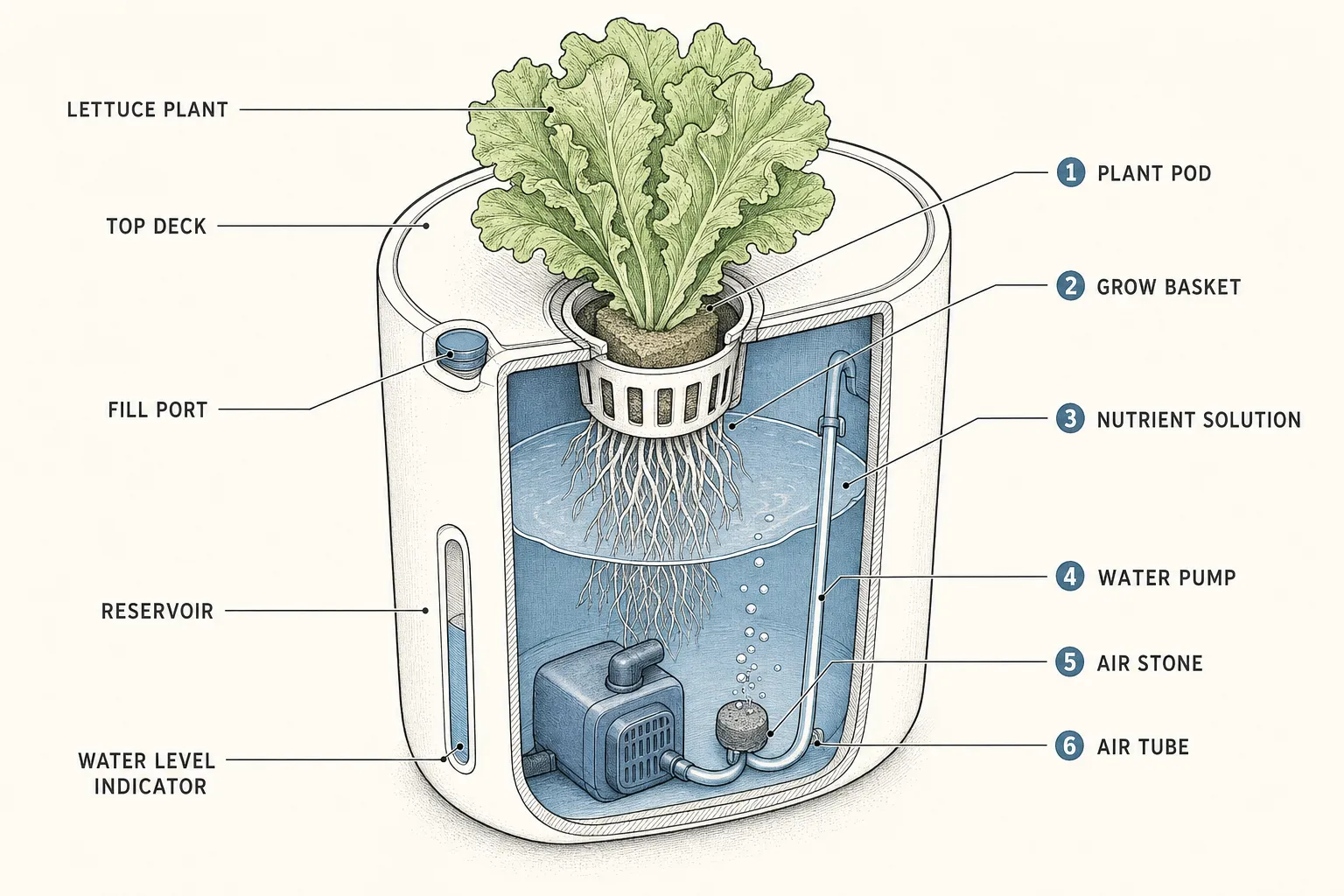
The scheduling layer is what turns a product into a system. A household that eats lettuce every other day does not receive four ready heads that all peak on Tuesday. It receives one pod ready today, one ready in three days, one in five, one in seven. Ripeness staggered across the week, maturing on the counter, so that shelf life stops being a race against decay and becomes a delivery cadence. The farm, in turn, runs as a continuous conveyor of plantings synchronized to each household’s consumption curve. It is less a farm than a scheduling machine wearing a farming costume, and that scheduling layer, not the growing, is the hard part.
Three levels of life support
Not everything needs its roots. The system generalizes across a spectrum of vascular support, and the middle tier has been hiding in plain sight for centuries.
At the fullest level sits the root pod, described above: whole living plants, for lettuces, greens, and herbs.
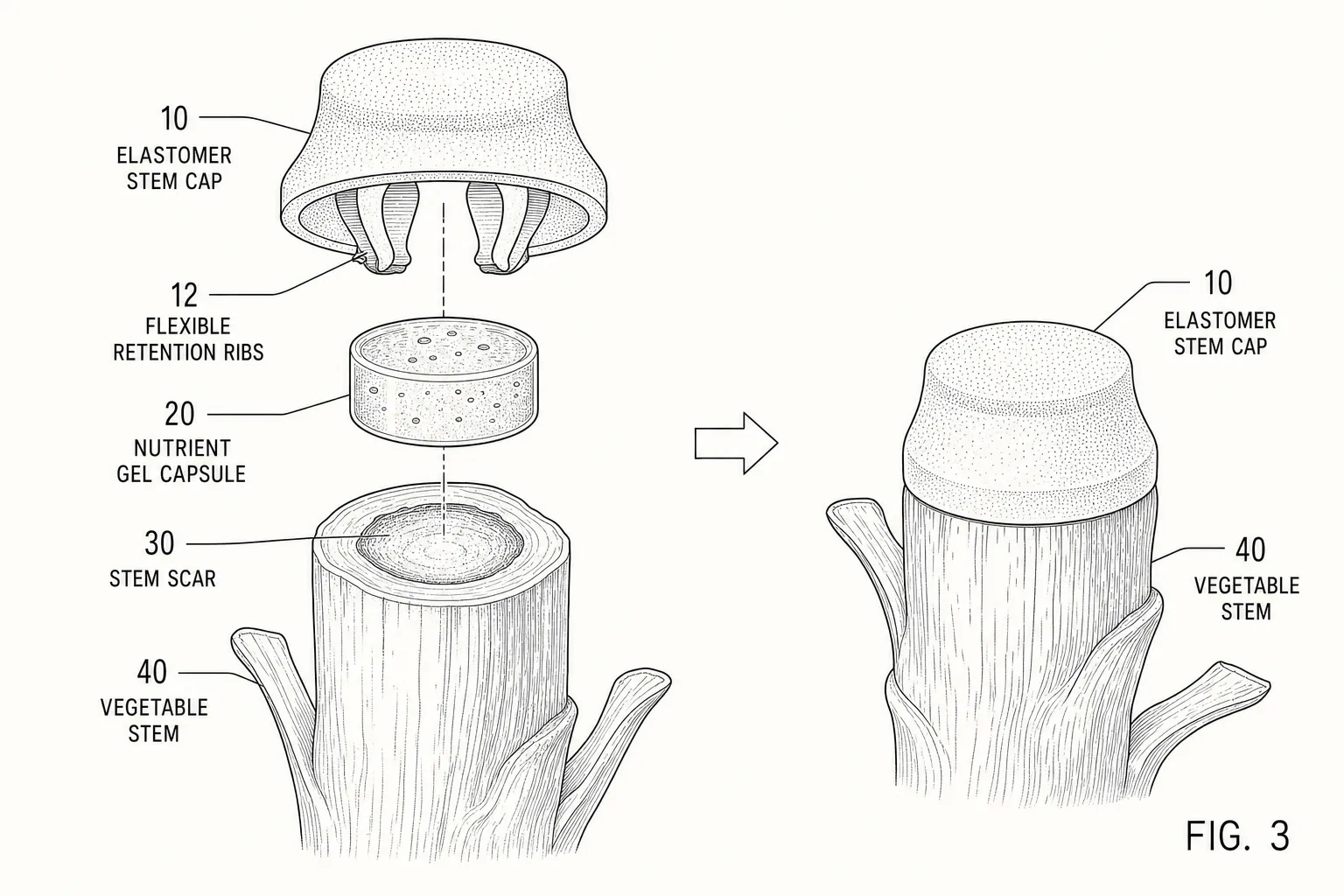
We have kept severed stems alive on our dining tables forever. In water dosed with sugar and a preservative, we did it for flowers, for beauty, and never once for food. The physiology is identical. A cut stem retains functional xylem; it will draw water and stay turgid for days or weeks. Broccoli, asparagus, celery, coriander, spinach, and the tomato truss all qualify. A truss of eight tomatoes is harvested with a hand span of vine, the cut end seated through a septum into a small sealed reservoir of nutrient gel, a soft skirt draping over each calyx to hold humidity at the stem scar — which is where a tomato loses most of its water and admits most of its microbes. One vase supports the whole bunch, so the hardware amortizes across eight fruits, not one. The supermarket has already run the demand experiment: tomatoes-on-the-vine command a premium for a vine that is dead, dry, and actively wicking moisture out of the fruit. The vine is theater. Customers pay for the theater. The vase makes the theater true.
At the lightest level sits the cap: a fitted seal for individual fruit that closes the stem scar, holds humidity, and absorbs ethylene to slow ripening. Minimal physiology, maximal reach.
The geometry of every interface is species-specific. A jointed tomato variety snaps at a knuckle and keeps its pedicel; a jointless one picks clean and offers nothing to hold. The vase for coriander is not the vase for broccoli. This per-species library of vascular interfaces — shapes, seals, gel formulations, cadences — is the accumulating asset. Each supported species is a small piece of applied botany that compounds.
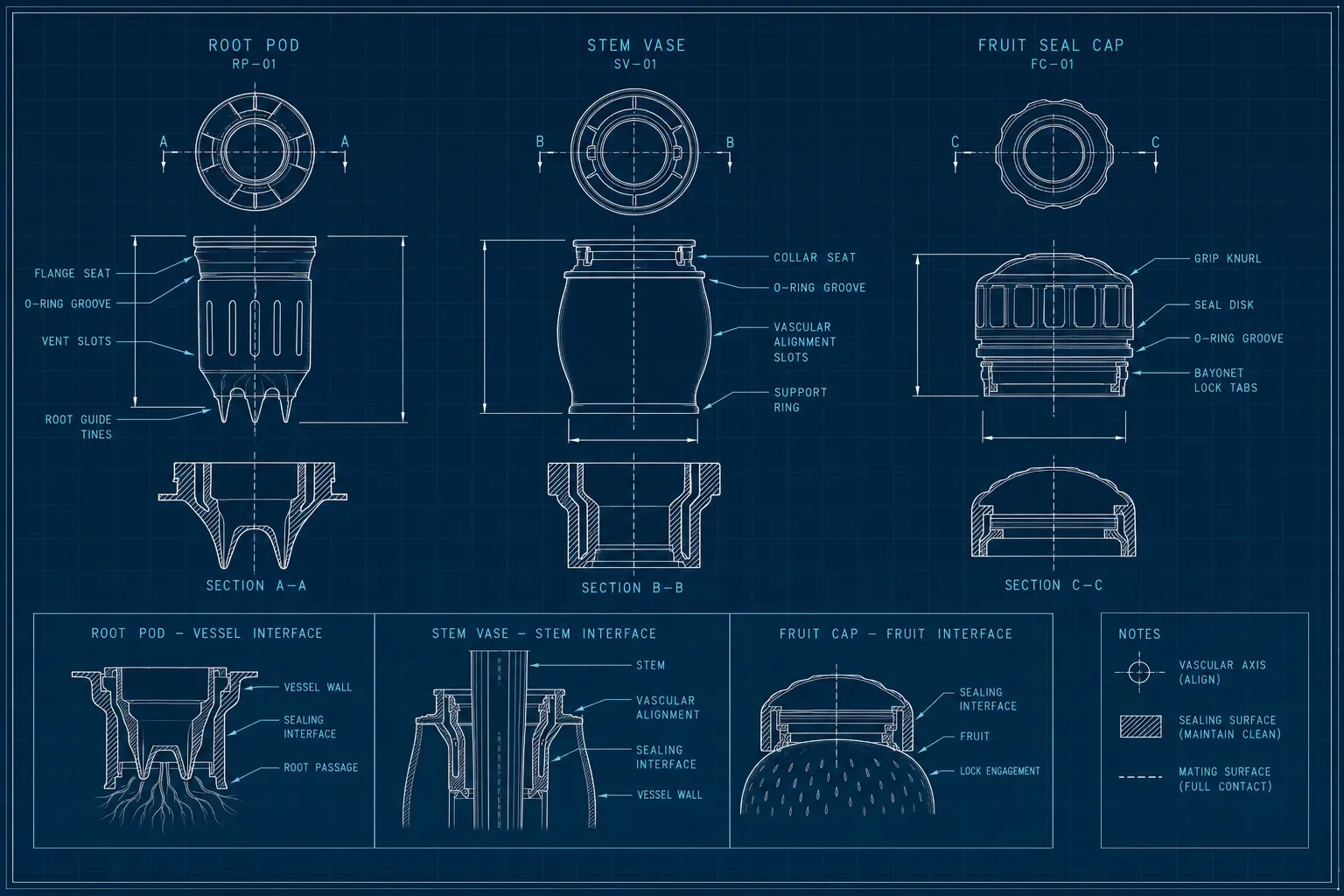
On materials, one rule: no plastic, no trash. Pods and vases circulate as returnable assets, washed and sanitized between cycles, in cities whose delivery density and container-return culture make two-way packaging genuinely viable. Where a disposable element is unavoidable, it is grown or composted, not landfilled.
The aisle at the end
This system does not pretend to feed the world or replace the pantry. The objections are known; they killed a generation of vertical farms: energy, capex, the brutal economics of lettuce. Grains, tubers, and onions will arrive dead and stay dead, as they should. The target is the one aisle where the current system is most wasteful and most dishonest — the perishables aisle, where a third of everything grown is thrown away and the rest is sold in managed decline under the word fresh.
A kitchen counter where the salad is still photosynthesizing. A tomato truss drinking from its vase. A weekly delivery in which nothing needs a refrigerator because nothing has begun to die. My mother kept a leaf alive for two months on the leftovers of her tea. Food can obviously stay alive all the way to the plate, nearly for free. The real question is why we built a supply chain that kills it first, and what the grocery store looks like when we stop.