
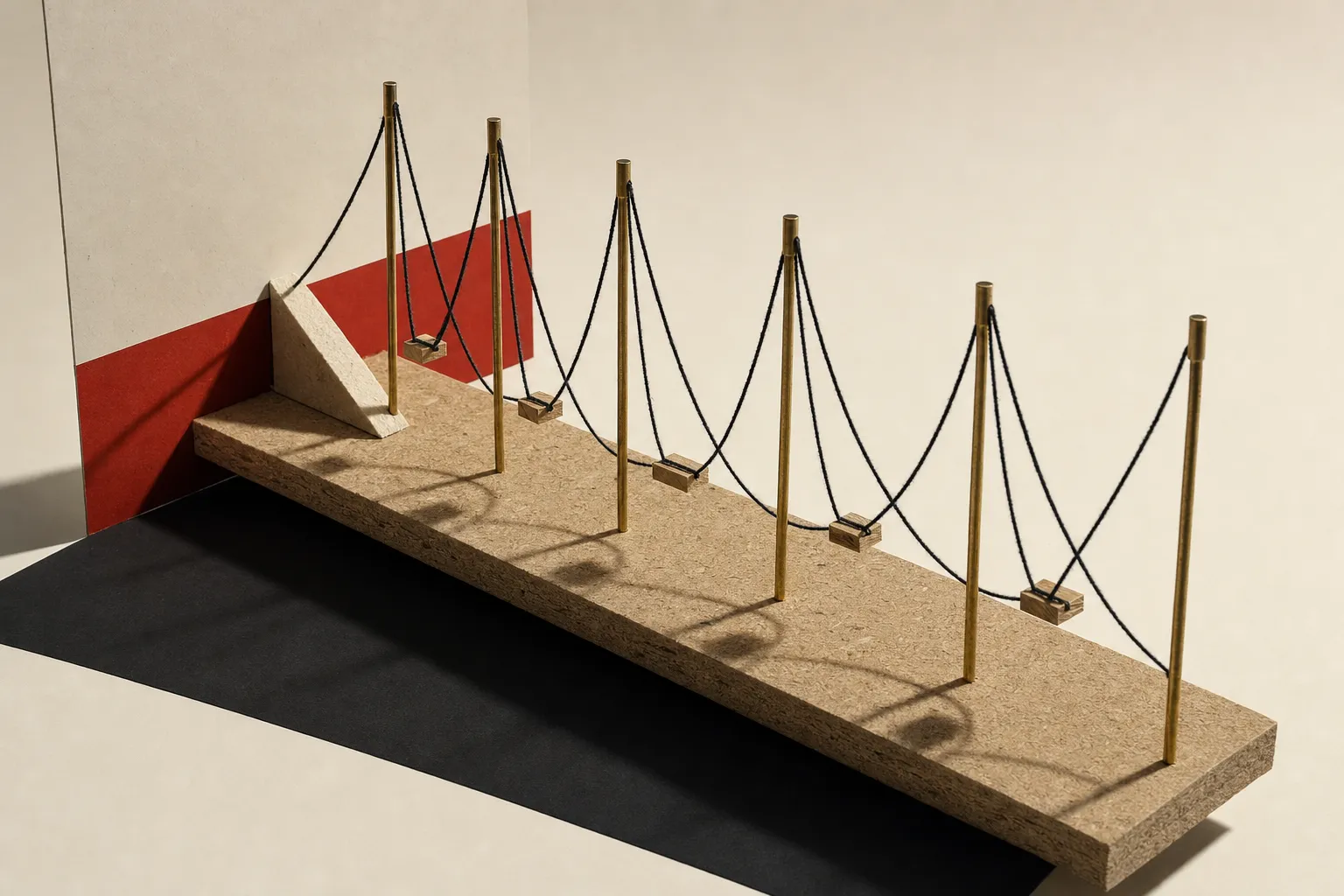
Proceedings of the Institution of Improbable Infrastructure, Vol. XIV, No. 3
I. The city
In Calandra there are no roads, only departures.
The city is built into a shallow bowl, and its towers stand along the rim like teeth, each one hollow, each one full of lifts that run all day and make a sound the citizens no longer hear. You arrive at the base of a tower, you are weighed, you are given a harness the colour of your destination, and you rise. At the launching floor there is a ring of doorways, one for each bearing, and beside each doorway a keeper who reads the wind and the wire and tells you whether your direction is open today.
Then you step off, and for thirty seconds Calandra is entirely yours.
The children of Calandra do not learn the names of streets. They learn cones - the set of places reachable from a given height, which is a different shape for every rooftop and shrinks as you descend. To live high in Calandra is not to have a view. It is to have options. The rich are those from whose windows many bearings are open; the poor live at the bottom of the bowl, where every cone has already closed over them, and all their journeys begin with a queue and a fare and somebody else's machinery.
Lovers in Calandra meet where their cones intersect, which is why the marriages of the city are geometric rather than romantic, and why the marriage brokers keep altitude tables rather than portraits.
A visitor asks how they get back.
The keeper is patient. There is no back. You land, you walk to the tower, you rise again, you choose a new bearing. The city is a machine for spending height, and the cables you admire are not Calandra at all. Calandra is the lifts. The cables are only the noise it makes while it spends what the lifts have saved.
In Calandra, no journey has ever been returned.
II. The proposal
The proposal considered here is a serious one and deserves a serious answer. It is this: that a dense city already lifts hundreds of thousands of people to great heights every day, for reasons entirely unrelated to transport, and throws that potential energy away as brake heat on the ride down. Recover it. Make the fortieth floor the street plane. Run cables between rooftops. Let people fall to where they are going.
The intuition is sound. The energy accounting is genuinely favourable, and we will show that below. What follows is an attempt to take the idea all the way to its limits, using the physics rather than the vibes, and to establish where it stops.
III. The governing equation
Three terms set the required tower height for a span of range R:
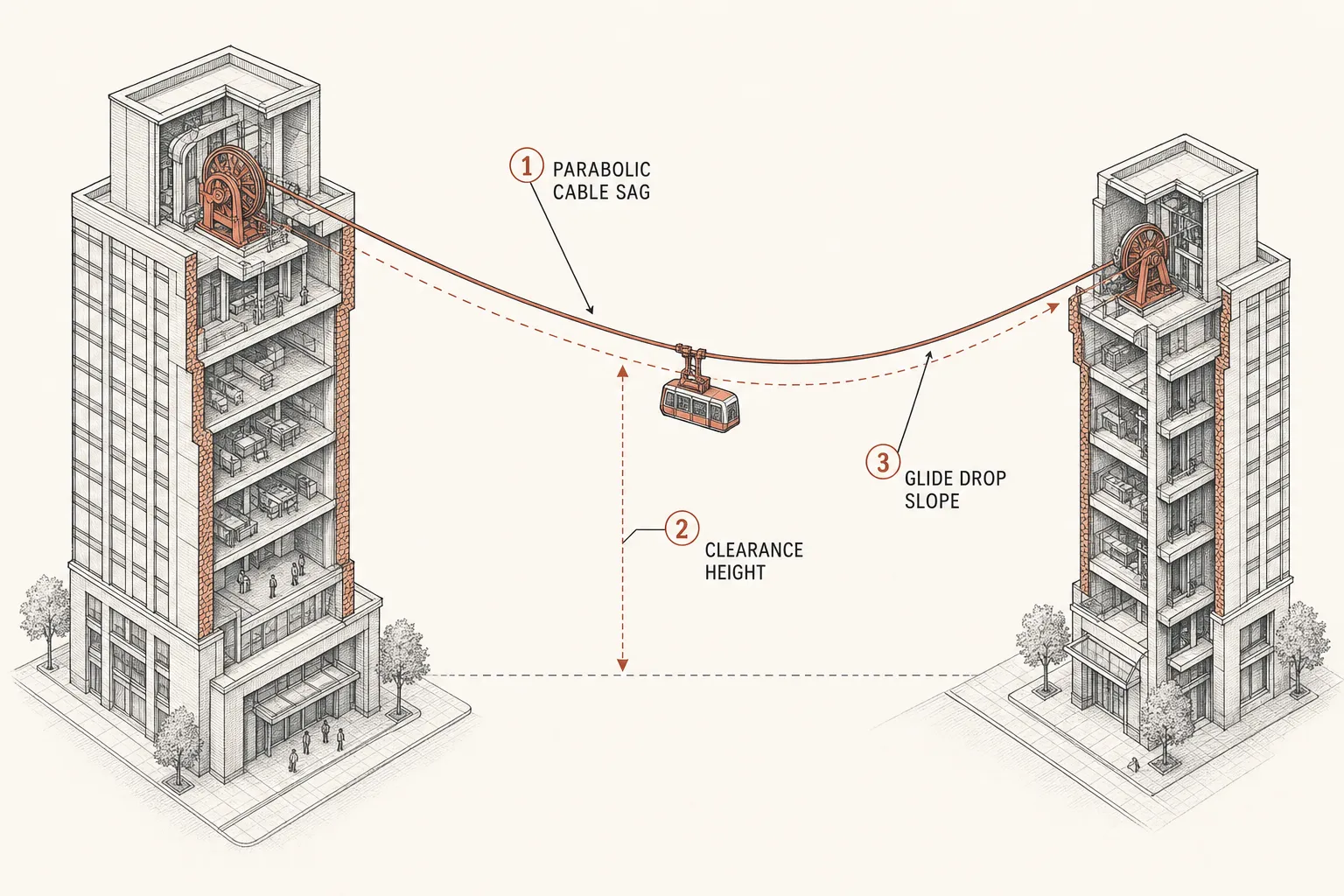
H = h_clear + R²/8c + R/G
The clearance term (h_clear) is rooftops plus safety margin. Call it 50 m.
The sag term (R²/8c) is where c = σ/ρg, the characteristic length of the cable material - working stress over weight density. This is the single most important number in the system and it is a property of the material alone. Steel at 500 MPa working stress gives c ≈ 6,500 m.
The glide term (R/G) is the height you must spend on drag, where G is glide ratio, exactly as in an aircraft. G is set by ballistic coefficient, m/C_dA, which makes the vehicle body the entire design problem:
| Vehicle | m/C_dA | Cruise | G (ideal) |
|---|---|---|---|
| Harnessed rider, upright | 150 | 70 km/h | 9 |
| Reclined, part-faired | 400 | 70 km/h | 17 |
| Sealed four-person pod | 800 | 90 km/h | 21 |
| Dense cargo pod | 1,600 | 110 km/h | 25 |
Ideal G does not survive contact with a real installation. Trolley losses, rope interaction, wind margin and a mandatory arrival energy reserve derate the system glide ratio to roughly 60% of ideal. The pod's 21 becomes about 12.5 in service. Every figure below uses the derated value.
The optimum span
Differentiating H with respect to R and setting to zero gives a pleasingly clean rule: the optimal span is the one where sag equals clearance.
R* = √(8·c·h_clear) ≈ 1,600 m for steel and 50 m clearance.
At that span: sag 49 m, glide drop 128 m, clearance 50 m. H ≈ 230 m. R/H ≈ 7.
The ceiling nobody expects
As span grows and sag is engineered away, H tends to h_clear + R/G, and therefore:
R/H → G
The range-to-height ratio can never exceed the glide ratio. Not with better cable, not with taller towers, not ever. This is the hard ceiling of the entire concept, and it means the question "what R/H can we achieve" is really the question "what is the glide ratio of the thing we are dropping."
Substituting a high-modulus polyethylene rope for steel raises c by a factor of sixteen even after brutal derating for creep, pushing R* out past 5 km. It buys R/H ≈ 10 and no more, because at that point sag has vanished and the glide term is the whole budget. Cable material is the highest-leverage variable available, and it is worth about 40%.
IV. Where the concept is genuinely strong
Energy. Cost per unit distance is 2.725/G Wh per kg. At G = 12.5 that is 19 Wh per passenger-km, or about 27 including lift inefficiency. Metro is 50 to 100. A car is 500. This would be the most efficient powered urban transport ever operated, for a specific and unglamorous reason: the cable supplies lift at zero induced drag, and induced drag is what makes aviation expensive.
The catenary is a free control system. The cable is steep at launch and shallow at arrival, which is precisely the speed profile you would design by hand. Better: size the total drop just under four times the sag, and the catenary's vertex falls short of the station, so the rider climbs the final stretch. Dip below the landing platform is δ = s(1 − Δh/4s)². That terminal upslope recovers roughly 40% of kinetic energy as height before any mechanical brake engages.
Bidirectionality dissolves. This is the elegant part of the proposal and it deserves credit. Vehicles never return along a cable. They land, ride the destination tower's lift, and dispatch outward on a different bearing. The network becomes a directed graph with towers as nodes, and the classical ropeway reciprocation problem is replaced by a bike-share rebalancing problem, which is tractable. At 5 s headway with four-seat pods, a single line carries ~2,900 passengers per hour - genuinely gondola-class.
V. Where the pod version dies
Tower moments. Horizontal tension reduces exactly to T = σA: working stress times metallic cross-section. A 1,250 mm² rope (roughly 50 mm nominal, allowing for fill factor) pulls 64 tonnes. Unbalanced at 230 m, that is 14,700 tonne-metres into the structural core, from one cable.
This is the finding that eliminates retrofit. No existing tower absorbs that. The radial cable array must be near-symmetric in plan, which means launch bearings are not a design choice but a structural equilibrium condition - the tower geometry begins dictating the network topology instead of the reverse. "Existing towers, redone" becomes "new cores, or ring-beam outriggers at the launch floor," and the capital argument is gone.
Wind. At 230 m, gusts run 1.5 to 2 times ground speed. A single-cable vehicle gallops. The remedy is twin track ropes at 1 to 2 m spacing with the vehicle held rigid between them - at which point you have built an aerial tramway carriage, doubled your cable mass, and doubled your sag term.
Ice. Accretion can double linear weight. There is no design answer, only a closure policy.
VI. The retreat: one rope, one rider
The proposal's fallback is to abandon the pod entirely. Single rope, single rider, harness and trolley, accepting this as an experience - a forest zipline at altitude, ruffled hair included. This changes a great deal, though not what one hopes.
Sag does not care about payload. Since s = R²/8c is a pure material property, dropping from a 600 kg pod to a 100 kg rider buys nothing. Over a 500 m span a 16 mm rope masses about 455 kg against the rider's 100 - the rope is overwhelmingly holding up itself, and the ratio worsens with span.
And the glide ratio collapses. A human in a harness is an appalling ballistic coefficient. G falls from 21 to 9 ideal, perhaps 5 to 6 in service. Since R/H ≤ G, the geometry gets worse: R/H ≈ 5.
But tension collapses faster, and this is the finding that matters. T = σA again. A 14 to 16 mm rope pulls 5.8 tonnes where the pod system pulled 64.
Run the short hop. R = 500 m: sag 4.8 m, glide drop 56 m, clearance 50 m.
H = 111 m. Tower moment = 640 tonne-metres.
Against 14,700. A twenty-three-fold reduction, and 640 t·m is genuinely retrofittable - an outrigger ring at a single floor, not a new core. A 111 m tower is a thirty-storey building, and those exist on every third block already.
The speed governs itself. On a 1:9 slope with a 100 kg rider, C_dA 0.65, and trolley friction included, drag balances at 15.8 m/s - 57 km/h, exactly the forest-zipline number. Low ballistic coefficient becomes a feature: the rider is drag-limited and cannot run away. A pod at G = 21 reaches 110 km/h and requires serious braking hardware; a bare rider self-limits, and the arrival climb plus a spring arrest handles the residual 12 kJ. Five hundred metres is a 33-second ride - long enough to be an event, short enough that January wind at 110 m is survivable.
The failure mode that actually stops it
Mass variance. G depends on m/C_dA, so a 55 kg rider sitting upright and a 120 kg rider tucked differ by a factor of two in glide ratio on the same fixed cable. Design for the light one and the heavy one arrives hot. Design for the heavy one and the light one stalls mid-span.
On a forest line, a stall is an embarrassment and a hand-over-hand rescue. At 110 m over a public street it is a rope-access operation with a road closure underneath. At any real ridership, a 1% stall rate is not an incident - it is a permanent standing rescue crew, and it will define the system's public identity within a month of opening.
The fix is cheap and belongs in the hardware rather than the person: a ballasted, part-faired trolley bringing every rider to a fixed 120 kg gross in a standardised shell. Variance collapses, and the shell provides somewhere to hang a small tail fin - which solves the other problem, that a human suspended from a single trolley has no yaw stability whatever and will rotate slowly for the entire descent in any crosswind, arriving backwards and unwell.
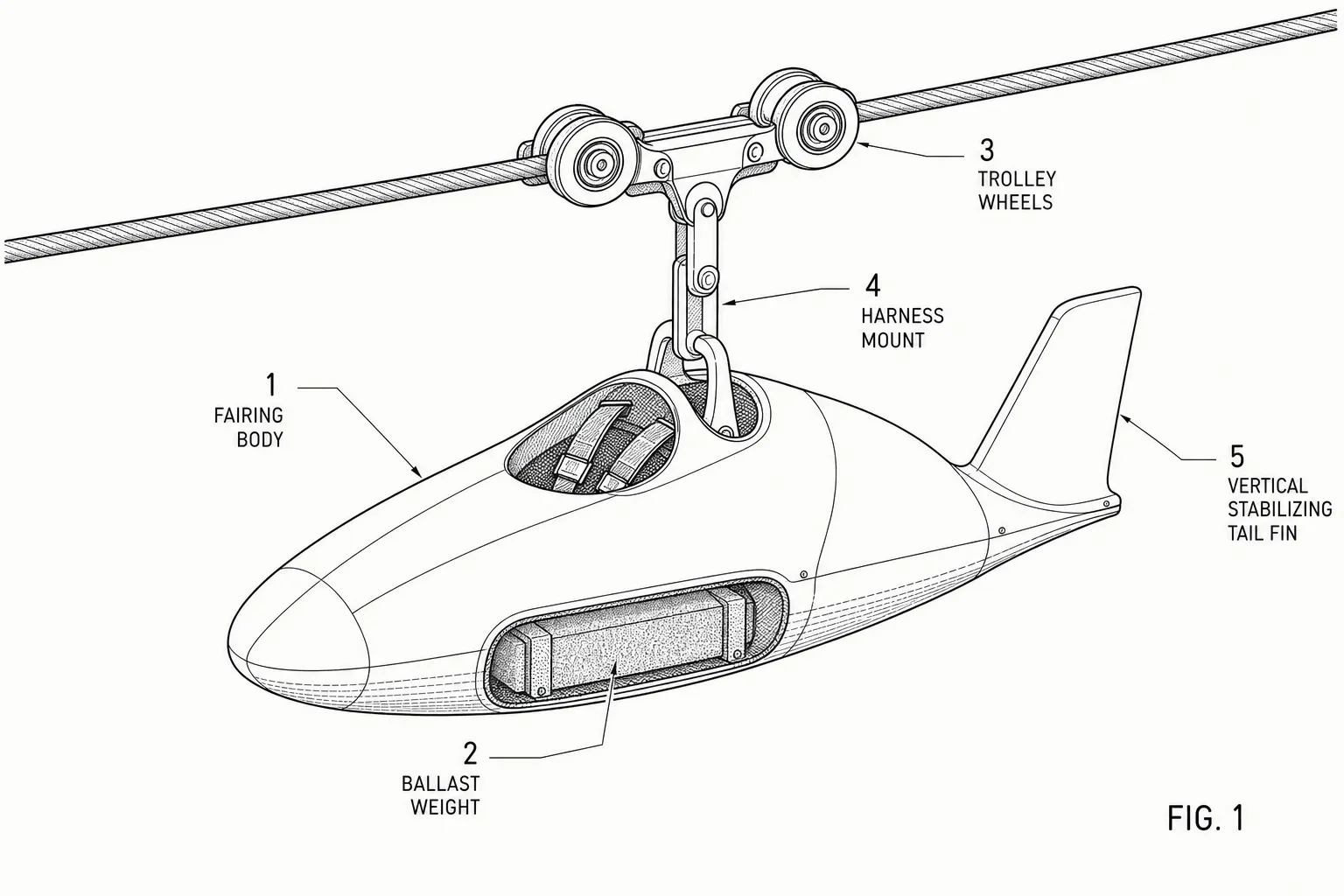
Ice remains. It cannot be designed out of a bare, undamped rope.
VII. The network arithmetic
At 500 m hops, crossing 10 km requires 20 transfers. Each is 33 seconds of flight and roughly four minutes of dismount, walk, queue, lift and re-harness. Total journey: over ninety minutes, of which eleven are spent moving.
Throughput is 100 to 200 people per hour per line. A detachable gondola does 4,000. A metro does 30,000.
This is not transit. It is a set of point-to-point links: 400 to 700 m chords between ordinary buildings, one or two hops per journey, spectacular, and correctly classified in law as an amusement ride rather than a transport mode. That reclassification is not a defeat - it means a private operator with two rooftop leases can build one, where a transit authority would need a decade.
VIII. Cargo, which is the honest version
Every constraint above softens when the payload is not a person. Dense, standardised mass. Finned and stable. Indifferent to cold, spin, discomfort and rescue. G of 25 rather than 9. No mass variance, because you control the mass.
More: gravity goods ropeways in mining have been net power-positive for over a century - loaded cars descending regenerate enough to haul the empties back up. A city where goods fall to the ground plane and generate the electricity that lifts the next batch is a real system with a real operating history, not a stunt.
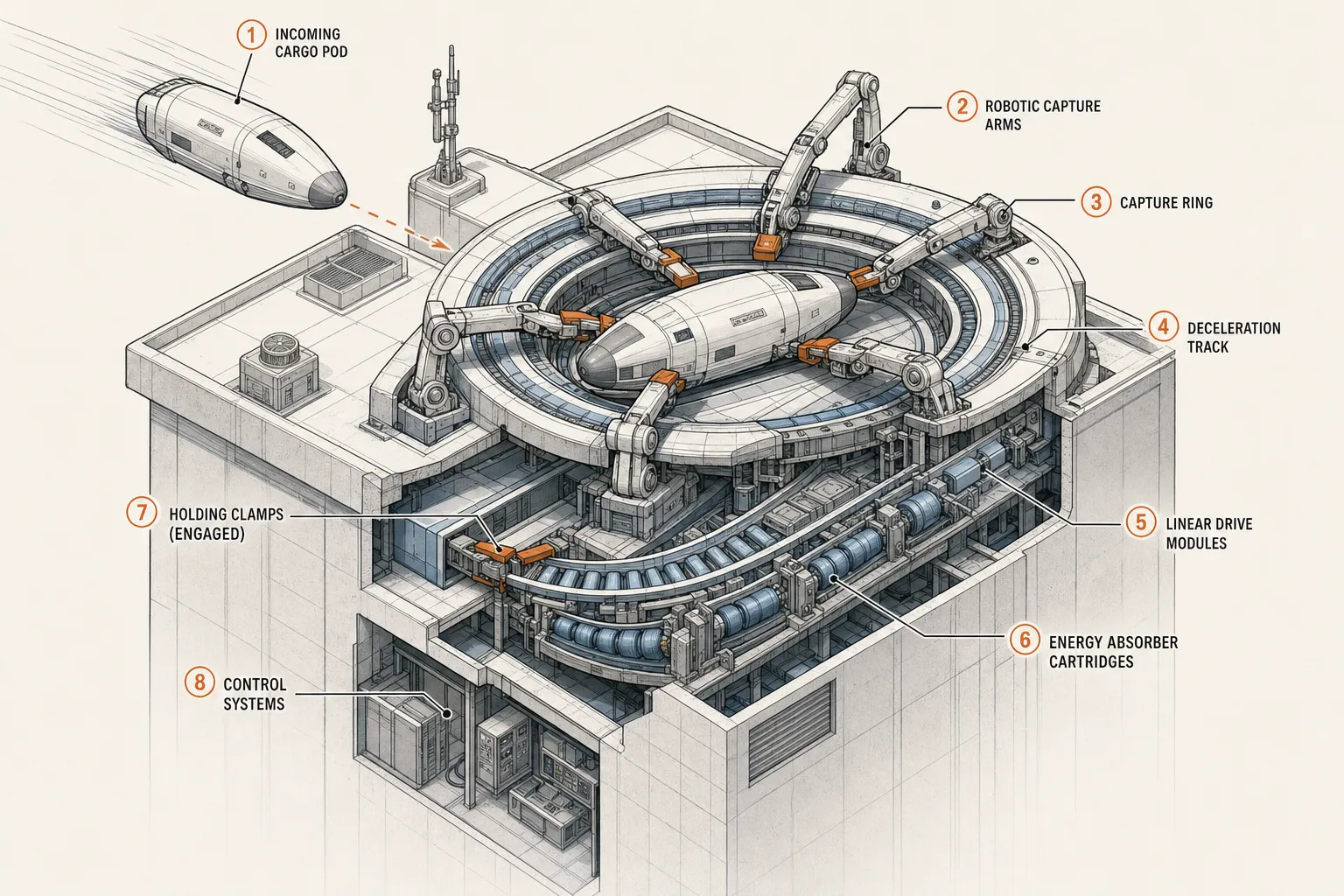
The engineering concentrates entirely in the capture-and-log rings at each end. A 50 kg pod at 90 km/h carries 15 kJ and must be caught to millimetre repeatability, unattended, every time. That is a solved robotics problem. The human equivalent is not.
IX. The convergence
Every fix points the same way. Make it continuous instead of one-at-a-time. Automate the transfers. Make it bidirectional. Add the second rope for stability. Enclose the passenger.
You have rebuilt the detachable-grip gondola from first principles. This is why La Paz and Medellín built gondolas.
The zipline's identity is four properties: cheap, one-way, singular, gravity-only. Each of the four is precisely what a transit network cannot tolerate, and removing any one of them removes the reason to have started here.
If the ultimate goal is unconstrained point-to-point urban aerial travel between rooftops, passenger VTOL drones are the likely endgame. They bypass fixed cable geometry, tower bending moments, and geometric descent cones entirely. What keeps them grounded is not aerodynamics but three practical walls: acoustic footprint (thousands of high-RPM thrusters operating near residential tower windows), battery energy density for sustained hover margins, and the regulatory complexity of managing low-altitude autonomous urban airspace. Until those resolve, fixed cables remain the only physical constraint system that holds a vehicle aloft for zero energy cost.
A note on the status of this document
This is an eccentric document. It was written to be handed to someone who has proposed a zipline city - probably late at night, probably with real enthusiasm - so that the answer they receive is a complete one rather than a shrug.
It is not a feasibility study. It is a brain-math exercise, and it should not be taken past the boundary of this page. The numbers are order-of-magnitude honest and internally consistent, but they are back-of-envelope: no dynamic analysis, no fatigue, no failure modes, no regulatory contact, no cost, no insurance, no discussion of what happens the first time a rope is struck by lightning with someone on it.
What the exercise is genuinely good for is that it produces three findings worth keeping, none of which were obvious at the start:
R/H can never exceed the glide ratio. Every "just build a taller tower" instinct dies against this, and it takes ten minutes of algebra to prove.
Sag is a material property, independent of payload. The rope is holding up itself. This is why lightening the vehicle - the first thing everyone reaches for - does nothing at all.
The energy figure is real. Roughly 20 Wh per passenger-km, against 500 for a car. Cable-supported transport genuinely is the most efficient powered movement available, and that fact deserves to outlive this document even though the zipline does not.
So: enjoy Calandra. Do not fund it.
The physics is beautiful and the answer is no.