
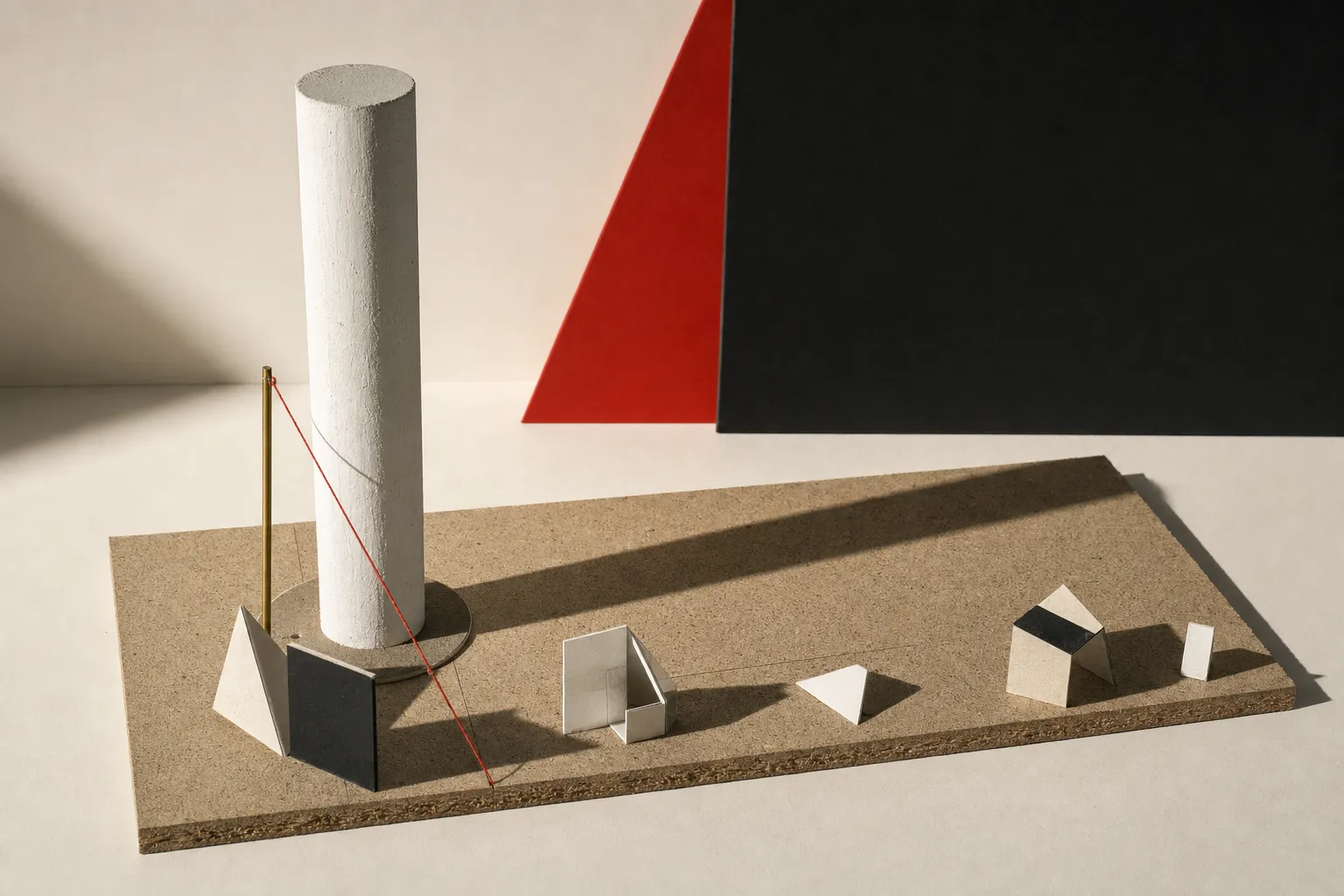
I. The Column
There is a concrete pier at Hebbal that was built to hold up a flyover that never came.1 It is a serious piece of engineering - a foundation designed for live traffic loads, easily ten crores of public money by any back-of-the-envelope reckoning2 - and it holds up nothing. It has stood there long enough that commuters joke it predates the dinosaurs.
Ask a commuter why it sits unfinished, and they will likely tell you about the famous five-hundred-metre stretch of alignment that sat on land the government had never acquired. But that particular land acquisition fiasco actually happened at a completely different flyover project across town.
The fact that these failure stories get conflated points to the larger problem: phantom infrastructure is not an isolated blunder, but a systemic, repeating pattern. Whether a project stalls because one agency forgot to acquire land at one junction, another failed to clear utility lines at a second, or a third redesigned an interchange mid-stream, the results blend together in the public imagination into a single composite urban myth.
Ask who decided what, in which order, and why, and you will find that nobody can tell you. Not because the information is secret, but because it is distributed - scattered across agencies that were each responsible for a piece and none responsible for the whole. The city's memory of its own failure has no custodian. There is no file you can pull that narrates the sequence. The only complete record is the concrete itself.
II. The Genre
Call it phantom infrastructure. It is a distinct genre of urban object, and it deserves to be named, because our cities are full of it and we have no vocabulary for it.
A phantom is not a ruin. Ruins had a life; they served, decayed, and now carry the dignity of having once worked. A phantom is not a construction site either, because a construction site has a future - it points forward. The phantom points nowhere. It is suspended intention: fully realized in material, never realized in purpose. Abandoned bus stops. Flyover stubs. Underpasses to nowhere. Pedestrian bridges over roads that were later rerouted. Places engineered for traffic that never came, and places engineered for silence that traffic overran anyway.
The biological analogy is the appendix - an organ the body built in an earlier chapter of its evolution, which no longer serves the function it was built for, and which the body carries anyway because removal is more trouble than coexistence. Every city has appendix organs. Indian metros have them in unusual abundance, and for a structural reason: the multiplicity of authorities. When six agencies share a junction, a failure belongs to no one, and what belongs to no one cannot be finished, cannot be demolished, and cannot even be narrated. It can only be endured.
III. What the City Says Now
Meanwhile, consider what the city currently says to its citizens through its surfaces. The dominant visual language of Indian public space is a logo plus two colours - white and blue stripes, or whatever the local authority's palette is - stamped on medians, railings, walls, and piers. This language communicates exactly one thing: authorship. This object was made by this body. It says nothing about ownership - nothing that lets the people who live among these objects feel that the objects are theirs, or that the objects are in any kind of dialogue with them.
The city, in other words, talks at itself constantly and with itself never. It labels. It does not converse. And in a society where public interaction largely requires prior familiarity - where strangers do not talk to strangers - the built environment is one of the very few channels through which a city's inhabitants could, in principle, address each other. We have left that channel broadcasting a test pattern.
IV. Kintsugi, Scaled
There is a Japanese repair tradition, kintsugi, in which a broken ceramic is rejoined with lacquer mixed with powdered gold. The crucial thing about kintsugi is what it refuses to do: it refuses to hide the break. The gold seam runs exactly along the fracture, announcing it. The repaired object is considered more valuable than the unbroken original - not despite the damage but because of the honesty of its repair. The break becomes part of the object's biography rather than a shameful secret.
Now scale that gesture up from a teacup to a ten-crore column.
The proposal is not to demolish the phantom, not to complete it, and above all not to paint it municipal blue and pretend it is ordinary. The proposal is to gild it - to place on top of that magnificently over-engineered, permanently vacant pier something that makes the thousands of people idling in traffic beneath it look up, think, and ideally smile. A light installation. A sculpture. An absurdity. The specific object matters less than the act, which is annotation: the city marking its own fracture in gold instead of camouflage.
This is worth stating precisely, because it is easy to mistake for things it is not. It is not beautification. Beautification conceals; annotation reveals. It is not a memorial, because memorials are solemn and this must not be. It is closer to the city developing the capacity for self-deprecation - which, in individuals, we recognize as a marker of maturity. A person who can joke about their own failures has metabolized them. A person who cannot is still ruled by them.
V. Why This Is Not What We Already Do
The immediate objection is that India already has public art programmes, and the objection deserves a serious answer, because the answer contains the whole argument.
The Kochi-Muziris Biennale allows artists to propose takeovers of parts of the city - the machinery exists. But it is centralized, curated by and for the art world, and its register is homage and prestige. The facade codes of Jaipur and Jodhpur govern colour and signage across whole districts - but these are instruments of unification, designed to make the city speak in one voice, which is the opposite of conversation. Cities regularly invite design students to paint flyover pillars and compound walls - and it shows: one-off decoration, no system, no thesis, thought that goes no deeper than the weekend it took to execute. The street art festivals of Bangalore and Delhi cluster around shops and commerce. The airport's celebrated installations were designed by a foreign architect for a space that, whatever else it is, is not truly public.
Every one of these is additive. Each puts something good where there was nothing, or renders an ugly surface neutral. None of them permits the city to talk about itself - least of all about its failures. They are all, in the deepest sense, services.
And here is the distinction on which everything turns: art is not a service. "Let's clean up this corner" is a valid argument, but it is a different argument - a tame one. A cleanup implicitly apologizes for the space. An artwork on the phantom column does not apologize; it testifies. The functional problem of the junction is, in the end, the easier problem - complex, yes, many variables, but at least you know what you are solving for; it yields, eventually, to engineering and court orders, as Hebbal's traffic itself recently did when the problem was shoved a few kilometres up the road and declared solved. Expression is harder precisely because there is no objective function. That is also why it is the part worth building a framework for. The solvable part will get solved without us.
VI. The Framework
What would it take? Less than it appears. The framework has five commitments.
One site at a time. Not a hundred activations at once - the city is not ready for that conversation, and more importantly, seriality is a feature. One site a month, or a quarter. The anticipation of where next becomes itself a form of civic discourse, the way a festival's approach is half the festival.
The city contributes only permission. No public funds. This single design choice pre-empts the objection that will otherwise kill everything: taxpayer money spent on a joke while roads have potholes. The city grants the space and the sanction, nothing more.
Citizens propose. An open call, loud enough for the whole city to hear: here is the site, what is your funniest, sharpest, most beautiful idea? A few years ago this would have filtered for professional artists, because rendering a credible proposal required professional skill. AI has collapsed that barrier. Anyone with a phone can now produce a compelling visualization of what the column could become. The proposal pool can genuinely be the city, not the city's credentialed class.
Sponsors fund. The Venice Biennale pavilion model: winning the slot gets you the space, not the money; you then find a backer. The sponsor gets association with the most talked-about object in the city that month. The model is proven, and it keeps the programme's economics entirely outside the public purse.
Temporary by charter. Nothing stays. This is not a compromise; it is doctrinal. Permanence converts a joke into a policy position, and policy positions get litigated. Temporariness is what keeps the register light enough to say true things. It also makes light the natural default medium - projection and illumination change nothing physical, require no structural certification of a column whose ownership nobody will admit to, and can transform a site utterly for the price of some fixtures and electricity. Sydney's Vivid and Barcelona's Llum have run this exact mechanics for years: open proposals, funded winners, a bounded season during which the city goes on pilgrimage to its own streets.3
Notice what the framework borrows and what it discards. Indian cities do not need to be taught festivals - our urban fabric is dense with affordances built precisely for temporary, recurring, participatory public events; we are a civilization fluent in the pop-up sacred. What you cannot do is invent a new festival and expect investment in it, because festivals accrete meaning over generations. But there is one thing every resident is already invested in without any onboarding: the city itself. The framework does not ask people to care about a new thing. It gives them a channel for a thing they already care about and currently have no way to express except as complaint.
VII. The Two Frictions
Honesty requires naming the two places this grinds.
Permission is harder than money. The very quality that makes a phantom eloquent - its jurisdictional orphanhood - makes it unadministrable. The Hebbal column stands precisely because no single body will claim it; that same vacuum means no single body can say yes to crowning it. The most meaningful sites are the least available ones. The workaround is optical: you do not need to touch the column to transform it. Projection from adjacent land - land somebody does own and can license - puts the image on the pier while the paperwork stays on the ground.
Sponsors blunt jokes. A brand will happily fund charm. It will not fund a critique of a body from which it needs permits. This is a real constraint, not a hypothetical one, and the honest responses are to keep early budgets small enough for individual patrons rather than corporations, and to accept that the opening installations will be gentle - whimsical rather than pointed. The edge can sharpen once the programme has proven it will not be shut down for smiling.
VIII. The Question, Which Is Also the Test
All of which resolves to a single question: can the city take a joke?
We say, half-seriously, that nobody in India can take a joke - that the national reflex to perceived mockery is offence, and offence's legal machinery. A city is an aggregate of that reflex plus an administrative apparatus with the power to act on it. So the question is genuinely open. A city that can permit an artwork on its own abandoned column - an artwork whose entire meaning is we built this wrong and we know it - is a city that has achieved something rare: institutional self-awareness expressed in public, at scale, with humour.
But here is the thing about the question: it is empirical, not philosophical. You do not answer it in an essay. You answer it by running one site. Even the failure modes are informative - if the installation is torn down, defaced, or litigated out of existence, that too is the city answering, and the answer becomes material for the next attempt. A conversation, remember, was the whole point. A refusal is also a reply.
IX. The Plinth Is Free
Return, finally, to the column. Sculptors throughout history have had to argue for their pedestals - the plinth is often the most expensive and most contested part of a public monument, because the plinth is what claims the ground.
Bangalore has already built the plinth. Ten crores of reinforced concrete, superbly founded, load-rated for highway traffic, positioned at one of the highest-dwell-time viewing points in the city - thousands of stationary spectators daily, held in place by the very congestion the column failed to solve. It stands there, paid for, empty, waiting.
Somewhere in the world there is a cheaper commission for a monument. But nowhere is there a more honest one.
Footnotes
-
Google Maps location pin, Hebbal Flyover Stub, Bangalore. ↩
-
While the direct material and labor cost of a single reinforced concrete pier and pile foundation typically ranges from ₹1.5 to ₹3 crore, the total sunk public expenditure—including utility relocations, geotechnical studies, traffic management, contractor overheads, and inflation across abandoned tenders—easily reaches ₹10 crore for the stalled segment. ↩
-
Artists, designers, creatives, architects, engineers and businesses are encouraged to submit a proposal for Light Installations new to Sydney for the Vivid Sydney Light Walk 2027. Destination NSW / Vivid Sydney, Expressions of Interest 2027 Light - Vivid Sydney (2026-06-17). Documenting that both Vivid Sydney and Llum BCN operate as temporary annual festivals featuring open calls for proposals and public light installations substantiates the author's framing that these municipal events share a common mechanics of open proposals, funded winning projects, and bounded seasonal urban engagement. ↩