

When enterprise software executives preach AI pessimism, it is easy to misread them as technology bears. When Palantir CEO Alex Karp attacks frontier lab valuations, token-metered economics, and benchmark hype, media commentary frames it as an insider warning of an AI bubble.
It is nothing of the sort. What looks like executive skepticism is actually a calculated positioning play—a narrative war over market architecture.
Palantir CEO Alex Karp discussing frontier model valuations, token economics, and enterprise software architecture.
The Strategic Incentive
There is a clear strategic incentive behind this posture. The enterprise AI landscape is locked in a battle between two competing market narratives:
-
Narrative A: The Frontier Capture Model. The smartest foundation model captures all downstream value. As labs achieve higher intelligence, the model layer absorbs application logic, permission controls, and workflow execution. In this world, existing enterprise platforms are disintermediated—reduced to low-margin UI wrappers around frontier API endpoints.
-
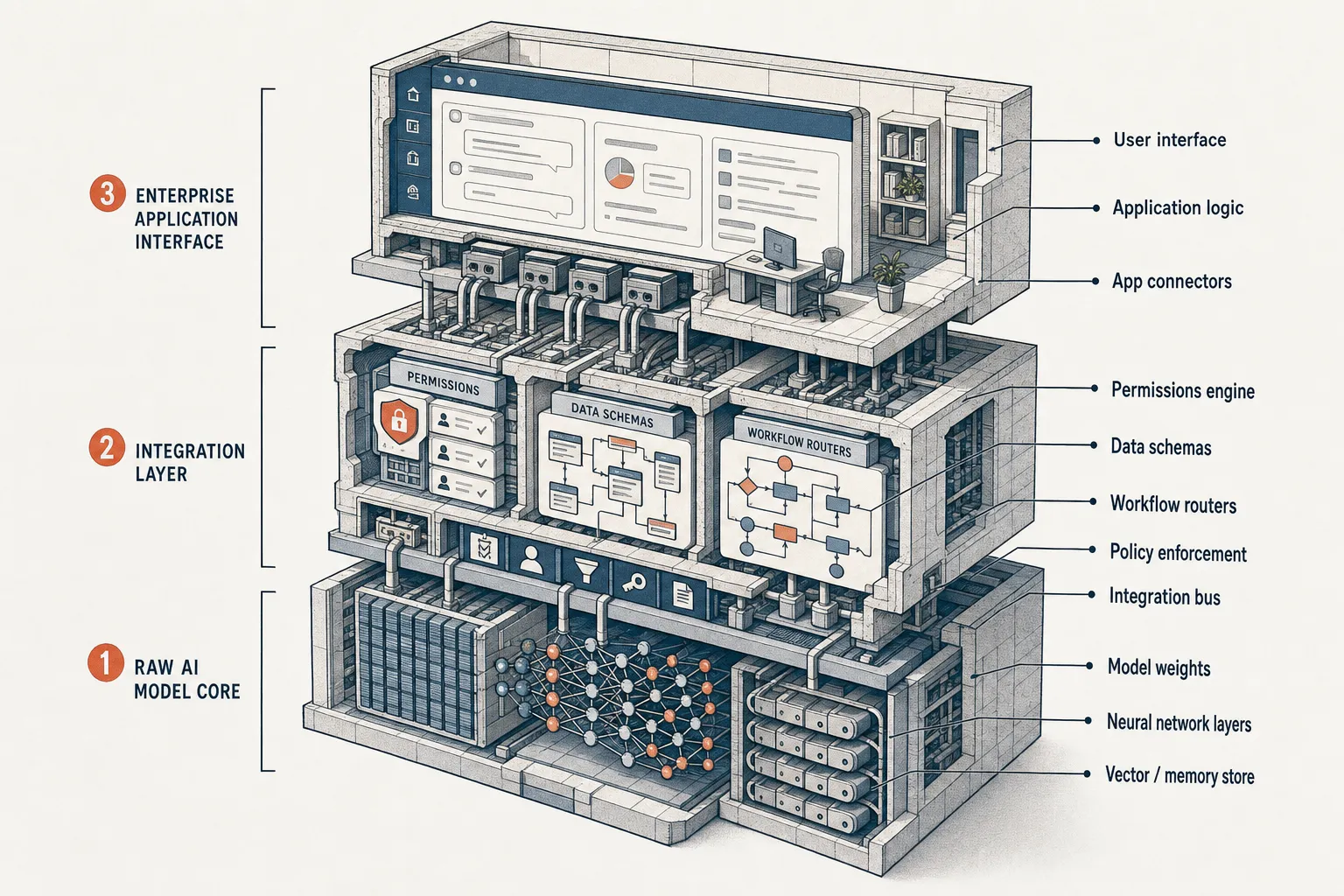
Narrative B: The System Integration Model. Models rapidly commoditize into interchangeable reasoning engines. The valuable, defensible layer is not the model itself, but the system connecting models to proprietary data schemas, enterprise permissions, and operational decisions. In this world, pure-play model labs face a price war on token inference, while integration platforms become extraordinarily important—and capture the structural margin.
When Palantir talks down LLM benchmarks and token economics, it is not expressing doubt about artificial intelligence. It is aggressively prosecuting Narrative B.
Three Operational Arguments
To make Narrative B win in the mind of enterprise buyers, incumbents press three specific structural claims:
Models are distinct from applications. A higher benchmark score on GPT or Claude does not automatically yield an operational outcome. Raw capability is useless without permission controls, ontology mapping, data schemas, and decision loops.
Token consumption is a vanity metric. Frontier labs report explosive adoption based on API inference volume. Increasing token spend reflects compute usage, not economic productivity. Enterprise spend on unguided inference often yields minimal business transformation.
Model vendor lock-in surrenders core IP. By relying continuously on external frontier models for core reasoning, enterprises risk handing over the operational logic that constitutes their competitive advantage. This concern accelerates the shift toward open-weight models and self-hosted infrastructure—which further commoditizing the frontier labs.
The Financial Proof
The clearest proof that this posture is market strategy rather than genuine pessimism lies in the financial results. While publicly casting doubt on standalone model products, Palantir's US commercial revenue surged 149% year-over-year, driven entirely by its AI integration platform.
Who Captures the Margin
The dispute in enterprise AI is not about whether the technology works, but which architectural layer earns the right to monetize it.
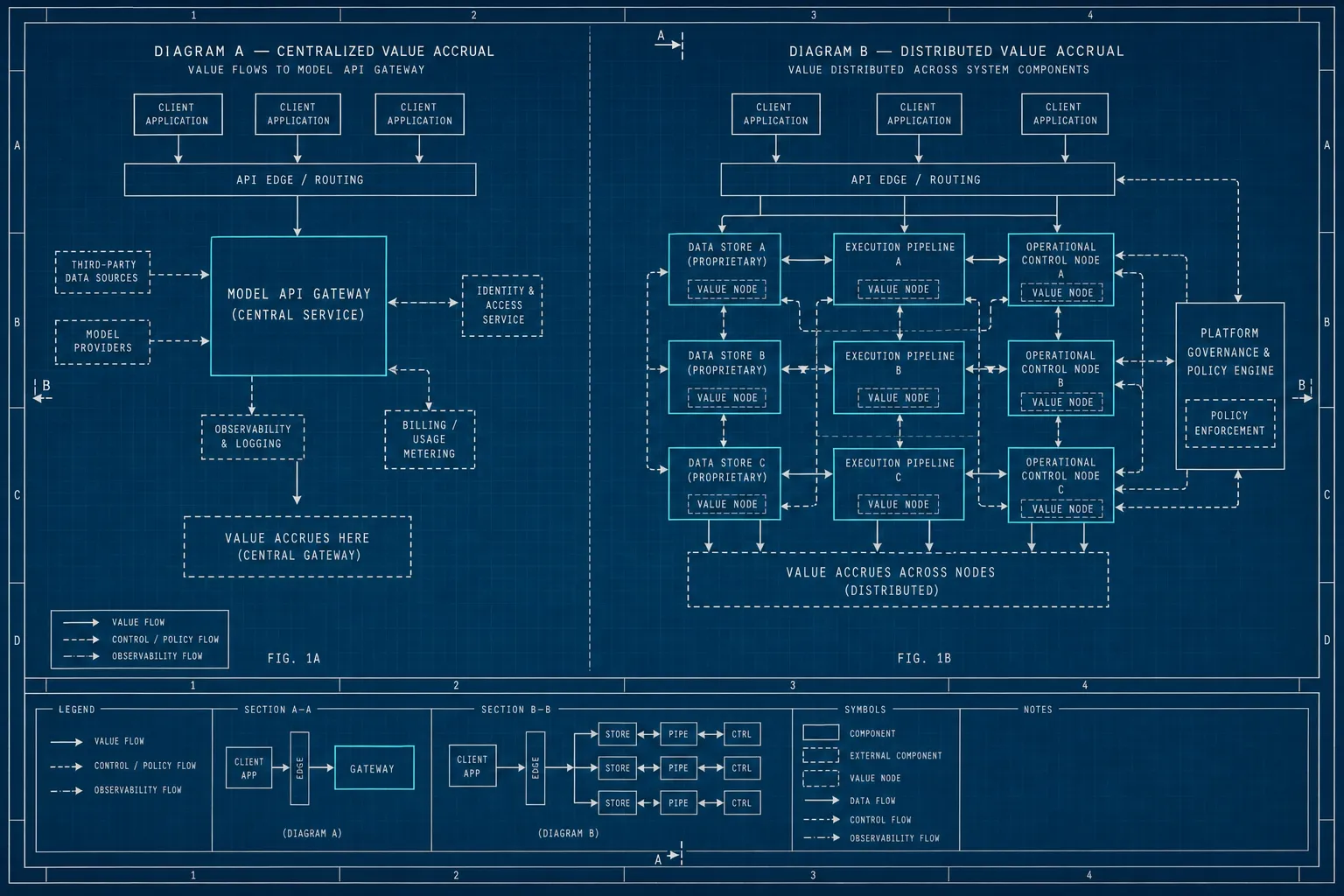
The war is not over whether AI is transformative, but whether value accrues to the model vendor or the system connecting intelligence to execution.
When an enterprise software giant argues that models are not applications, pay attention to the architectural boundary they are drawing. They are trying to convince the market that intelligence is a commodity—and that the bridge to operational reality is where the money lives.